What does each tool optimize for?
Sudowrite is built for literary novelists. Its prose generation is the most polished of the three; its 'Describe' and 'Brainstorm' tools are excellent for one-off scenes. It is not built for 200-chapter serials and its continuity tools are minimal.
NovelCrafter is built for outliners and worldbuilders. Its codex (manual story bible) is the deepest of the three. The tradeoff: you spend hours populating the codex by hand, and AI features rely on your own API key.
PlotWrite is built specifically for web serials — Royal Road, WebNovel and similar platforms, especially LitRPG and progression fantasy. It is the AI that reads your story, not the AI that writes it: the Story brain builds from your chapters, Canon check scans for contradictions, and the In-Between tracks the threads your story is moving along. You write; PlotWrite remembers every stat, rank and promise.
Story bible: manual codex, Story brain or nothing?
This is the single biggest difference, and it determines how much time you spend on bookkeeping vs writing.
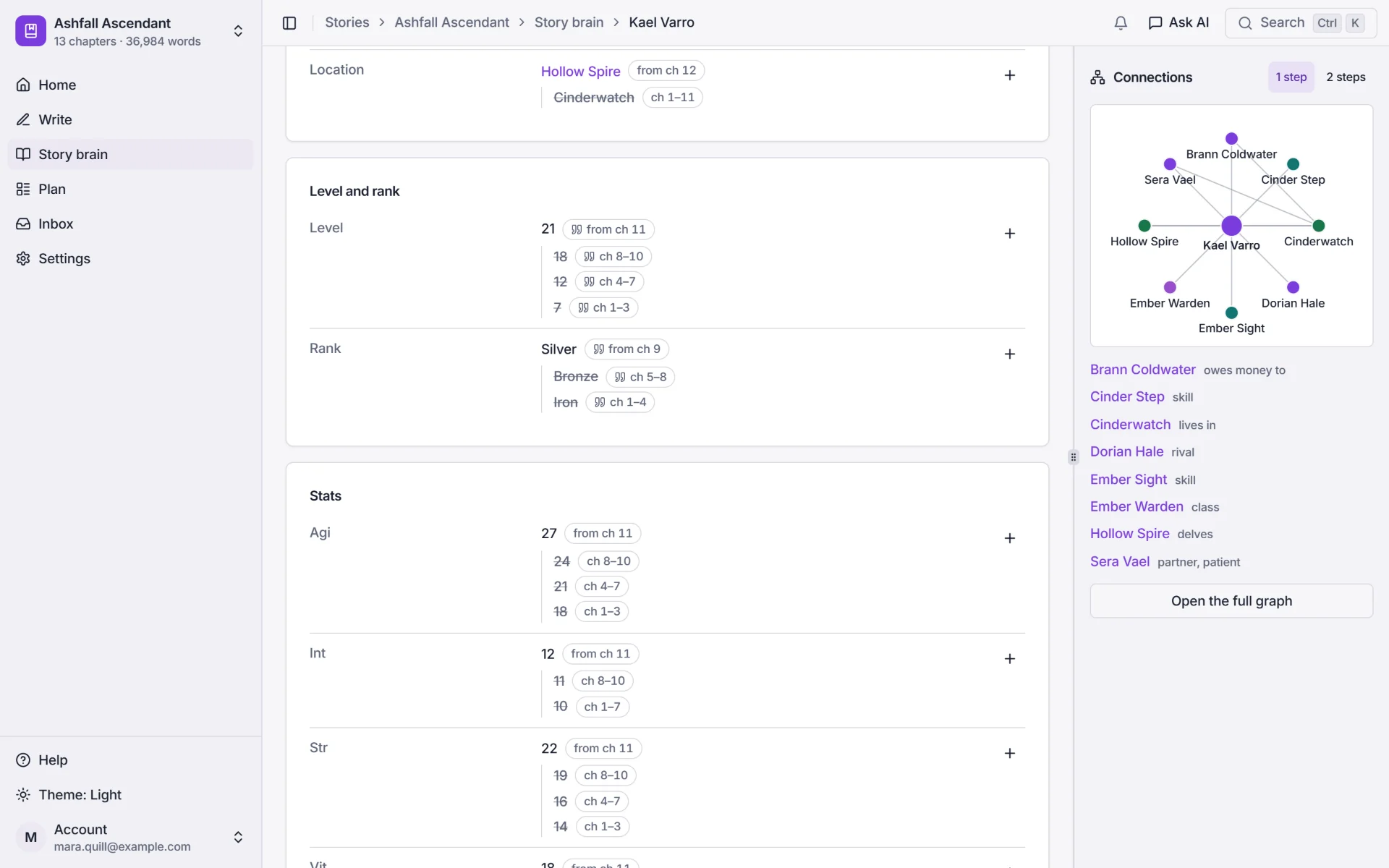
• Sudowrite: minimal. You can paste in character descriptions, but there's no real bible. • NovelCrafter: deep manual codex. Powerful but you build it. Expect 4–8 hours upfront and ongoing maintenance. • PlotWrite: the Story brain gives every character, place, item, skill and faction a page, with links, a graph and a timeline. It builds from the chapters you've already written, and facts it proposes wait for your approval in the Inbox. Facts are timed by chapter ("Silver rank from ch 9"), so a LitRPG stat sheet can show any character as of chapter N.
For serial authors writing 12,000+ words/week, manual bible maintenance is the productivity killer. Building from your chapters, with you approving each fact, is the most sustainable model.
Which tool catches continuity errors and contradictions?
Of the three, only PlotWrite scans for contradictions automatically. Long serials accumulate them, and they are a common reason readers drift away after chapter 100.
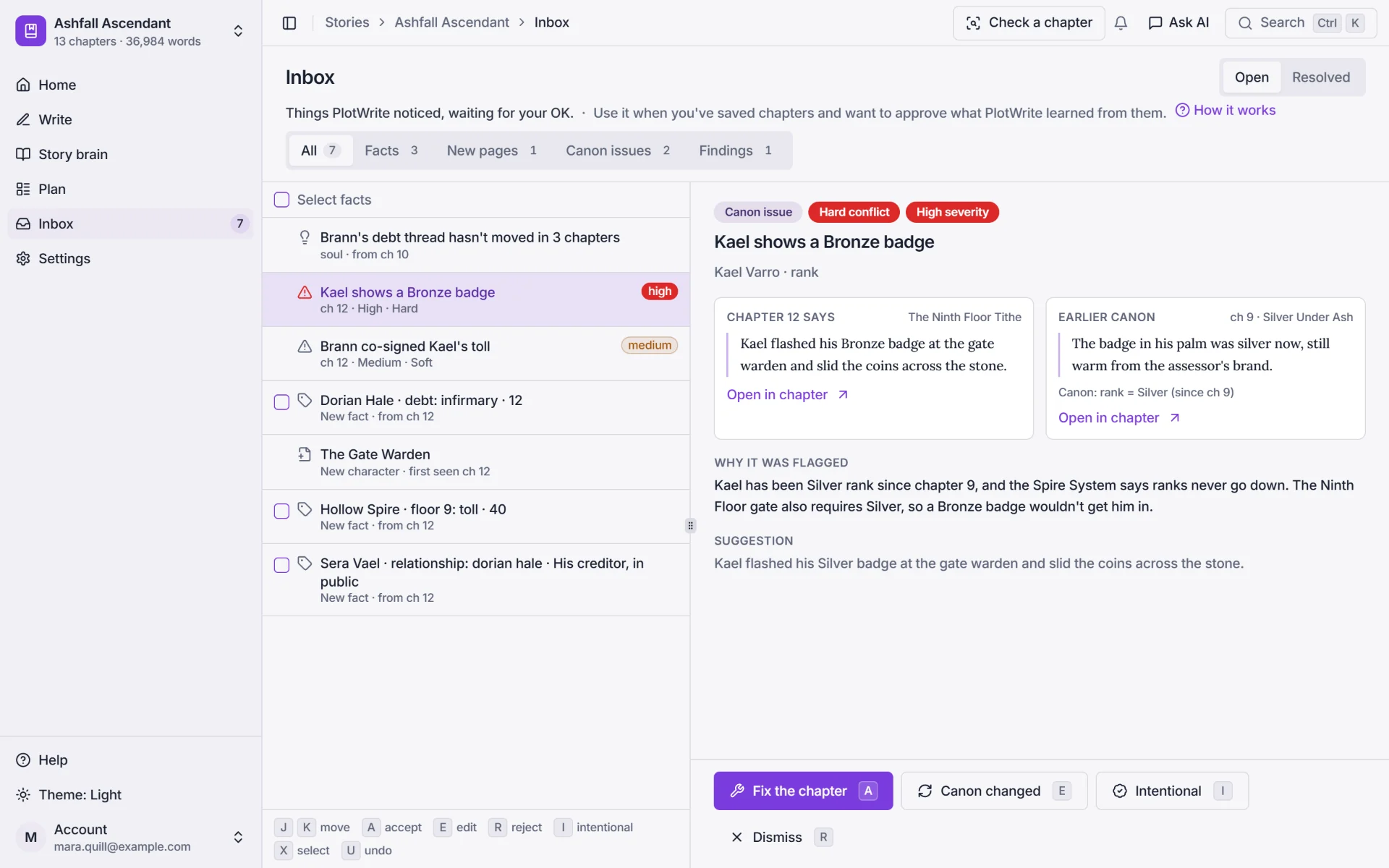
• Sudowrite: no continuity scanning. • NovelCrafter: codex-aware AI generation, but no automatic contradiction scan. • PlotWrite: Canon check finds contradictions (a rank going backwards, a dead character walking, a brother becoming a cousin), shows both quotes side by side, and offers a one-click fix previewed as a diff. The Continuity report lists what to fix first.
For a serial above chapter 50, a real contradiction scanner is no longer optional.
How much do PlotWrite, NovelCrafter and Sudowrite cost?
Pricing structures (as of 2025; check each pricing page for current rates):
• Sudowrite: $19–$59/month tiers, AI credits included but capped. Heavy users frequently hit limits. • NovelCrafter: ~$15/month, but you bring your own OpenAI/Anthropic API key — real spend often $30–$80/month for active writers. • PlotWrite: Storyteller $14/month, Architect $24/month, with a 7-day free trial and no card. PlotWrite never charges for AI: connect your ChatGPT or Claude subscription through the connector, connect OpenRouter in one click or paste an API key, or run a local model with LM Studio.
For a 12,000 words/week author, total monthly cost typically lands: Sudowrite $40–$80, NovelCrafter $45–$95, PlotWrite $14–$24 plus whatever your own AI provider charges (nothing extra if you use a subscription you already pay for).
Keeping a long serial straight is the hard part. PlotWrite remembers every rank, skill and secret in your story and checks each new chapter before you post. Works with the Claude or ChatGPT plan you already pay for. Free for 7 days.
plotwrite.ink learns your writing style, keeps track of your characters and world rules, and can draft the next chapter in your voice with your Claude or ChatGPT plan or your own AI key. Built for Royal Road, Wattpad, and serial authors who post weekly.
- No credit card
- Cancel anytime
- Full Architect access
- Works with your Claude or ChatGPT plan or your own AI key
Ready to try it on your own serial? Start 7-Day Free Trial
Which tool writes the best prose?
Sudowrite produces the most polished one-off passages, based on side-by-side outputs:
• Sudowrite: best for one-off literary passages. Polished, sometimes purple. • NovelCrafter: depends entirely on the model you bring. Same as raw GPT/Claude in voice. • PlotWrite: writing the prose is your job, and drafting tools are optional. If you use Draft with AI, it follows your Style DNA (POV, tense, your own rules, an avoid list), nothing enters the chapter without your Accept, and an optional polish pass removes AI-sounding phrases.
If your goal is one beautiful chapter for a literary anthology, Sudowrite. If your goal is a long serial in your own voice, PlotWrite. Note that Royal Road asks for an AI tag if you paste AI-written prose into a chapter, so check the rules before you do.
Which tool should you pick?
Pick Sudowrite if you write traditional novels, prioritize prose polish, and don't care about long-form continuity.
Pick NovelCrafter if you love manual control, you're a meticulous outliner, and you already have an OpenAI/Anthropic key you want to use.
Pick PlotWrite if you write web serials on Royal Road, WebNovel, or similar; if stats, ranks and plot promises have to stay straight across hundreds of chapters; if you'd rather have the story brain build from your chapters than maintain notes by hand.