What actually slows down a web serial author?
Pre-writing friction, not typing speed, is the real bottleneck. Most of a writing session isn't prose composition. It's re-reading old chapters, checking character details, deciding what scene comes next, fighting with continuity, and recovering from interruptions.
If you can compress that overhead, you write more without typing a single word faster. Every serious productivity gain comes from this insight.
Why is scene-level outlining faster than chapter-level outlining?
Because you sit down already knowing the next 200 words. Most authors outline at the chapter level: 'Chapter 12 — heist goes wrong.' This produces a daily start that requires inventing the entire scene structure on the fly.
Scene-level outlines look like: 'Beat 1 — Maya picks the lock, internal monologue about her sister. Beat 2 — alarm trips, Tom panics. Beat 3 — escape via roof.' You stop staring at the cursor. For a full-length example, see how to outline a 200-chapter serial in one day.
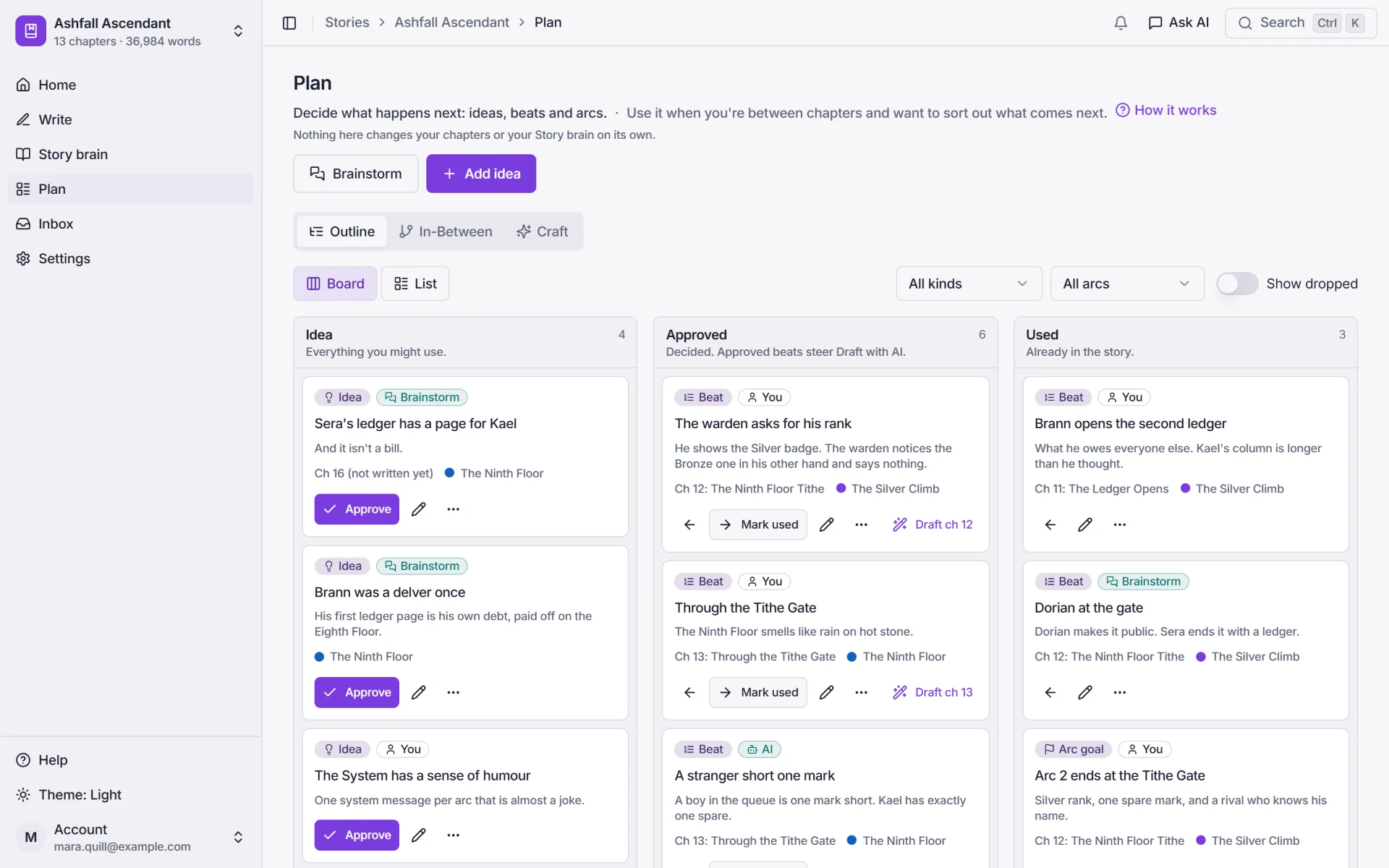
In PlotWrite, the Plan board holds your outline and arcs, with a brainstorm chat docked beside it that knows your story.
How do you stop losing 30 minutes to continuity lookups?
Keep a living story brain so you never have to search old chapters. Every serial author over chapter 50 knows the feeling: you're mid-sentence, you can't remember if your villain's blade was named 'Sorrow' or 'Whisper,' and you spend 20 minutes ctrl-F'ing through old chapters.
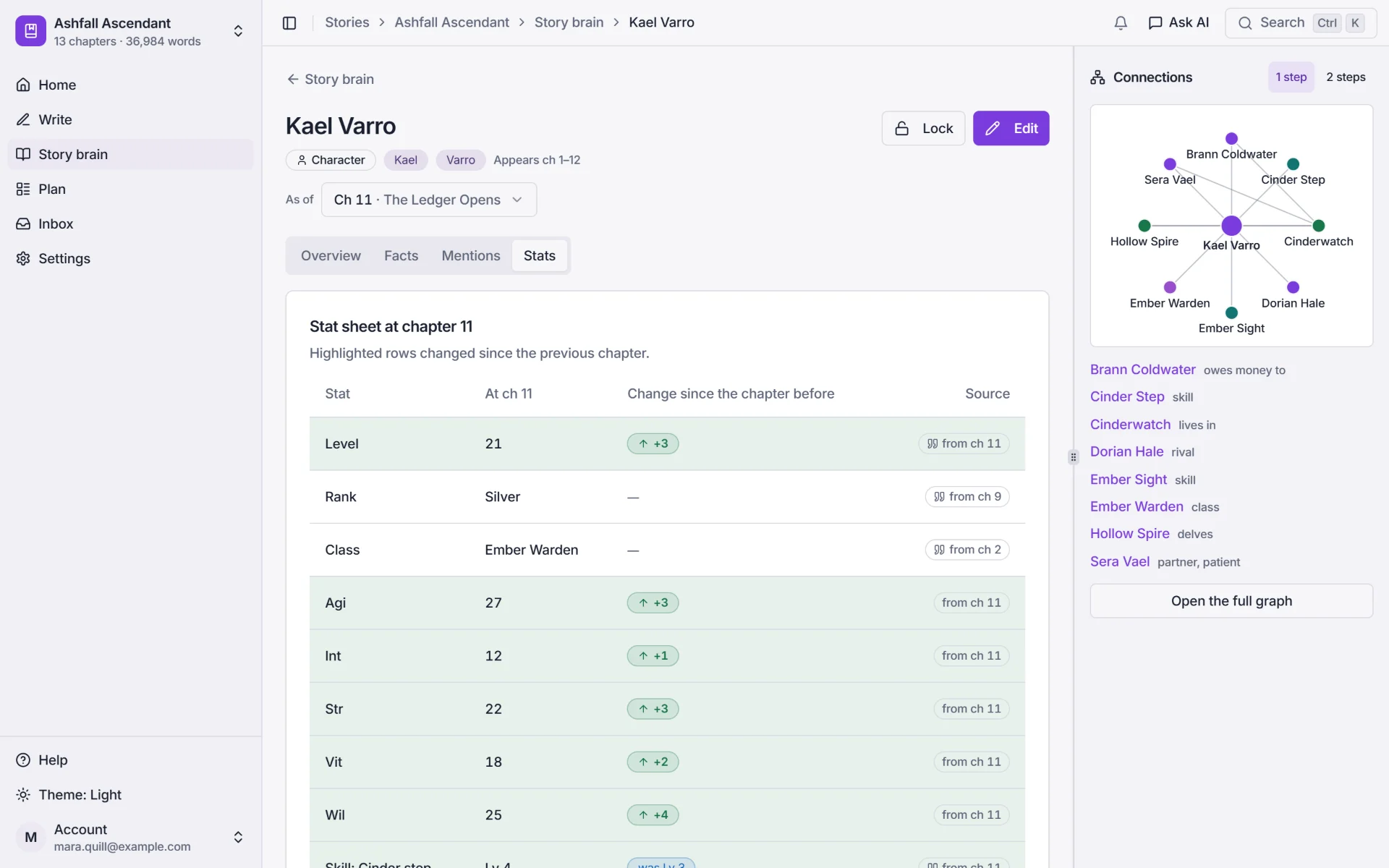
A living story brain, built from the chapters you've already written, removes most of this. The categories that matter most: character descriptions, item and skill names, ranks and stats, location layouts, magic system rules and the established timeline. Facts are timed by chapter, so you can see any character as of chapter N, and the canon check flags the slip before your readers do. For a starter list of what to track, see the continuity checklist for Royal Road authors.
What is the 'next-day brief' habit?
It is a three-line note you write at the end of each session for the next one. Spend 90 seconds on it: where the scene starts, the emotional state of the POV character, the next plot beat. This single habit is the difference between starting tomorrow at full speed and spending the first half hour re-orienting yourself.
PlotWrite's Story home also shows a single 'Your next step' card, which does some of this job for you.
Keeping a long serial straight is the hard part. PlotWrite remembers every rank, skill and secret in your story and checks each new chapter before you post. Works with the Claude or ChatGPT plan you already pay for. Free for 7 days.
plotwrite.ink learns your writing style, keeps track of your characters and world rules, and can draft the next chapter in your voice with your Claude or ChatGPT plan or your own AI key. Built for Royal Road, Wattpad, and serial authors who post weekly.
- No credit card
- Cancel anytime
- Full Architect access
- Works with your Claude or ChatGPT plan or your own AI key
Ready to try it on your own serial? Start your free trial
Can AI help you draft faster without losing your voice?
It can, but it is optional and it has a cost to weigh. Generic AI drafts read generic. Drafts grounded in your story brain, your Style DNA and the specific beat of the scene stay much closer to how you write. Draft with AI in PlotWrite works on your own AI connection: you plan the beats, approve them, draft in your voice, run a canon check, and nothing enters the chapter until you press Accept.
Royal Road asks for an AI tag when AI-written prose is pasted into a chapter, while memory, consistency checks and planning count as back-office help. If you want no AI prose at all, Tag-free mode hides every tool that writes for you. See the Royal Road AI policy explained for the details.
How often should a serial author take days off?
A common rule is the 14/2 cadence: 12–14 days of writing, then 1–2 days completely off. Many long-running serial authors have some version of it. No drafting, no editing, no answering reader comments. Brain off.
Writers who skip recovery days tend to hit a productivity cliff somewhere in the middle of a long serial and either drop it or post a long hiatus. Pushing through every week often produces fewer total chapters over a year than a disciplined recovery cadence. For the longer view, read how to write 200 chapters without burning out, and if you've already stalled, how to recover momentum after a week off.