How to Build a Story Bible for a Long Web Serial (And Why You Need One)
What to track, how to track it, and why every serial past chapter 30 collapses without one.
A story bible is a single source of truth for your serial: characters, relationships, locations, world rules, timeline and, for LitRPG, every stat change by chapter. Start it before chapter 10, update it after each chapter, and check new chapters against it before publishing to catch contradictions.
Key takeaways
- Track six things: characters, relationships, locations, world rules, timeline and progression.
- Contradictions usually start around chapter 25 to 35, so start the bible before chapter 10.
- Manual bibles go stale; a tool that reads your chapters keeps them current.
- Check each new chapter against the bible before you publish.
- Memory and consistency tools put no prose in your chapters, so no AI tag is needed on Royal Road.
A story bible is the document where you track everything in your story — characters, relationships, locations, world rules, power systems, timelines, items. For a 5-chapter short story, you can keep it all in your head. For a 200-chapter web serial, the absence of a story bible is what causes most serials to collapse. This guide covers what to track, how to track it, and why every web serial past chapter 30 needs one.
Want plotwrite.ink to draft your next chapter in your own voice?
What is a story bible?
A story bible is your single source of truth for everything that has happened, exists, or matters in your story. It is the document you check before writing a chapter to remind yourself what the protagonist's current stats are. It is the document you check after writing a chapter to update what just changed.
The term comes from television production, where a 'show bible' tracks every character, every world rule, and every plot thread across multiple seasons of writing. Web serials are essentially long-running TV shows, and they need the same tool.
Why does a web serial need a story bible by chapter 30?
Most new web serial writers can hold their entire story in their head for the first 25 chapters or so. They remember every character name, every magic rule, every location. Around chapter 30, the cracks start to appear. The character whose name was Aldric in chapter 12 becomes Aldrich in chapter 31. The 'cooldown' on the protagonist's signature ability that was 30 seconds in chapter 18 becomes 5 minutes in chapter 35. The merchant the protagonist met in chapter 20 has somehow forgotten that they already had a conversation in chapter 14.
Readers catch every single one of these mistakes. Royal Road's comment culture is unforgiving. A single committed reader will go back through your story, find the contradiction, and post a 200-word comment listing every retcon. This drags your average rating down. A lower average rating can cut your visibility in Royal Road's rankings, which in turn slows follower growth and Patreon income.
The story bible exists to prevent this. It is a defensive document. The work you put into maintaining it is paid back in fewer retcon comments.
What should a story bible track?
The minimum viable story bible tracks five categories.
Characters — name, age, physical description, current stats (if LitRPG), key abilities, current relationships, and a one-sentence summary of their role in the story.
Relationships — for each pair of important characters, what is the current state of their relationship? Allies? Romantic? Enemies? When did this state last change?
Locations — name, brief description, who lives or rules there, and what major events have happened there.
World rules — for each magic system, technology, or universal mechanic, what are the rules? What are the limits? What are the consequences for breaking them?
Timeline — a chapter-by-chapter (or event-by-event) record of major plot events, especially those that other characters can reference later.
Progression-heavy stories (LitRPG, Cultivation) need a sixth category: progression tracking — every level, skill, item, rank and stat change for the main characters, with the chapter number it changed.
Should you keep a story bible by hand or with a tool?
The manual approach is a Google Doc or a Scrivener document with sections for each category. You update it manually after each chapter. This works for the first 30 chapters. After that, the maintenance burden becomes real — you are spending 15–30 minutes per chapter updating the bible, on top of your writing time. Most writers stop doing it. The bible goes stale. The contradictions begin.
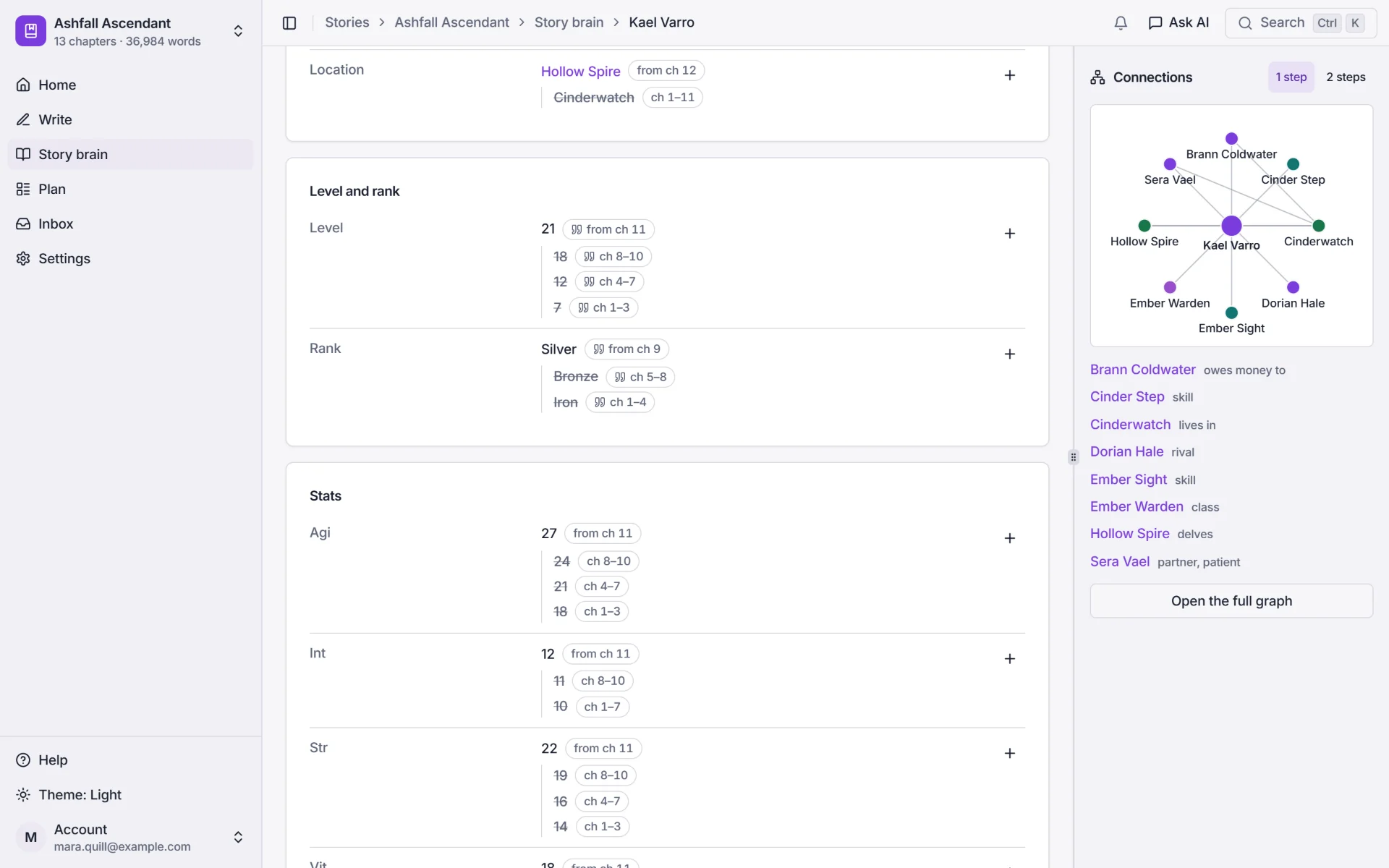
The automated approach uses an AI tool to read the chapters you have already written and build the bible from them. PlotWrite does this with its Story brain: it reads your chapters on your own AI, proposes new characters, places, items and stat changes, and waits for your approval in the Inbox before anything is added. You write the story; PlotWrite remembers it.
The time savings compound. A writer maintaining a manual bible can spend a large share of their writing time on upkeep over a long serial. A Story brain cuts that down to quick reviews of what was proposed.
For the habits that hold a serial together past chapter 300, see How to keep a 500-chapter web serial consistent. For tracking LitRPG numbers specifically, see How to track LitRPG stats.
plotwrite.ink drafts serial-ready chapters in your voice and builds your story bible from your chapters. Start your 7-day free trial →
How do you catch contradictions before readers do?
The most valuable part of a maintained story bible is the ability to check a new chapter against it and catch contradictions before publishing. This is called a Continuity Pass in traditional editing, and a Canon check in PlotWrite.
The check looks for: stat inconsistencies (the MC had STR 47 in chapter 30, why is it STR 50 in chapter 31 with no level-up?), character name spelling drift (Aldric vs Aldrich), timeline gaps (the journey from City A to City B took 3 days in chapter 20, why does it take 1 day in chapter 35?), and forgotten relationships (the merchant has met the MC twice already, why are they introduced again?).
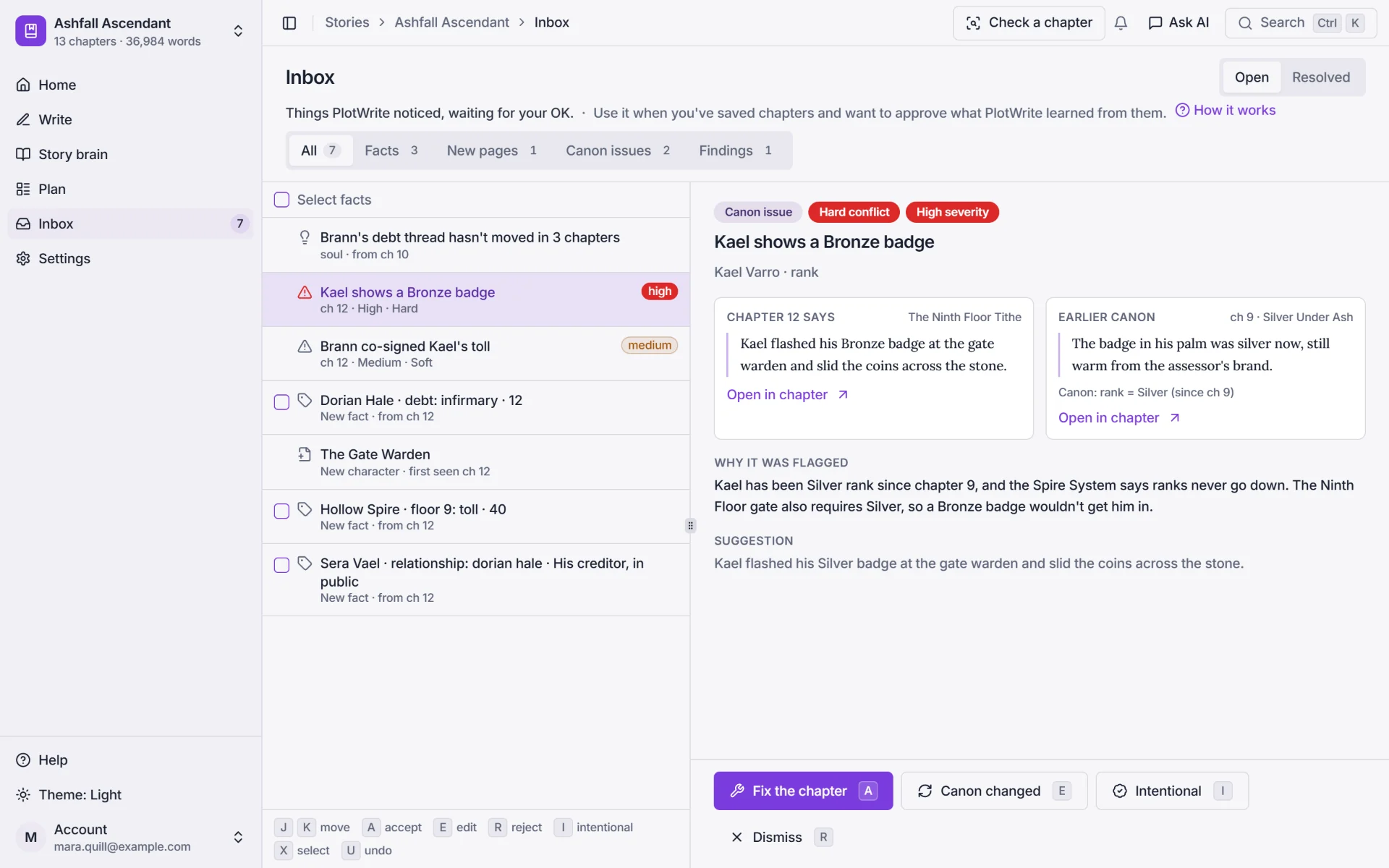
A quick check before publishing each chapter helps you catch many of the issues that would otherwise become 1-star comments. PlotWrite's canon check shows both conflicting quotes side by side and offers a one-click fix that you preview as a diff first. Start your free trial →
How does PlotWrite build a Story brain for you?
PlotWrite reads the chapters you have written and proposes pages for:
- Characters (with a one-line description and details like gender)
- Places (with type and significance)
- Relationships between characters, shown with [[links]], a graph and a timeline
- World rules (magic systems, technology, universal laws)
- Progression details for LitRPG/Progression Fantasy stories (skills, items, ranks, status changes), timed by chapter so a stat sheet can show any character as of chapter N
Nothing is added until you approve it in the Inbox, and you can edit any page by hand. After 50 chapters, you have a detailed searchable Story brain without typing it all yourself. Using it does not put prose in your chapters, so it counts as back-office help under Royal Road's AI policy (see /royal-road-ai-policy).
This is the entire reason PlotWrite exists. Manual bible maintenance is the silent killer of long web serials, and a Story brain lets you keep writing instead of organizing. Start your free 7-day trial →
Frequently asked questions
When should I start building a story bible?
Before chapter 1, ideally. At minimum, before chapter 10. The earlier you start, the easier it is to maintain. Starting a bible at chapter 60 means going back through 60 chapters to extract everything, which takes 10–20 hours by hand. Starting at chapter 1 takes 5 minutes per chapter.
Can I just remember everything instead of writing it down?
Not past chapter 30. Even very organized writers start making small contradictions around chapter 25–35. By chapter 100, no human can hold every detail of a 250,000-word story in working memory. The bible is for your future self, who will have forgotten things you currently think are obvious.
What's the difference between an outline and a story bible?
An outline plans what will happen in the future. A story bible records what has already happened (and the current state of everything). You can write a serial without an outline if you are a pantser, but you cannot write a long serial without some form of story bible.
What should a story bible include for a LitRPG?
Everything in the six categories, plus a progression log: every level, skill, item, rank and stat change with the chapter it happened in. That lets you check any number in a new chapter against what the character had at that point.
Sources
- Royal Road: AI text policy (blog #57)(royalroad.com)
Skip the blank page. Let plotwrite.ink draft your next chapter.
plotwrite.ink learns your writing style, keeps track of your characters and world rules, and can draft the next chapter in your voice with your Claude or ChatGPT plan or your own AI key. Built for Royal Road, Wattpad, and serial authors who post weekly.
- No credit card
- Cancel anytime
- Full Architect access
- Works with your Claude or ChatGPT plan or your own AI key
Quick answers from this guide
Direct one-page answers to the most-asked questions on this topic.
What is a story bible and why do web fiction writers need one?
A story bible is a single, searchable record of the characters, world rules, power systems, timelines, and locations in your serial. Web fiction writers need one because canon errors compound: chapter 80 contradicts chapter 12, readers notice immediately, and the resulting reviews hurt long-term ranking. Update it the same day you publish each chapter, never in batches.
How do you avoid canon mistakes in a long web serial?
Avoid canon mistakes by keeping one searchable story bible, updating it the day each chapter publishes, checking canon at every arc boundary, and searching instead of trusting memory for any detail older than about 10 chapters. Most canon errors come from writers relying on memory in a long serial.
How do you keep a web serial consistent across 100+ chapters?
Keep a searchable story bible with one page per character, place, item and rule, with facts tied to the chapter they appeared in, and check each chapter against it before you publish. A Google Doc stops working past about 30 pages. PlotWrite (plotwrite.ink) builds this Story brain from your chapters and flags contradictions before readers see them.
What is the fastest way to build a story bible for a long serial?
The fastest way is to build it from the chapters you have already written instead of typing it by hand. PlotWrite (plotwrite.ink) reads them on your own AI and proposes a page for every character, place, item and skill, with facts timed by chapter. Every proposed fact waits in your Inbox until you approve it.
How do you avoid plot holes in a 500,000-word web serial?
Compare every chapter against your story notes before you publish it. Look for three things: contradictions (a rank going backwards, a dead character walking), stats that drift, and promises left hanging. In PlotWrite (plotwrite.ink), the Check chapter sheet runs Continuity, Heart and Threads and shows the exact quotes that clash.
How do you keep character voice consistent across chapters?
Keep a short voice profile for each major character covering speech patterns, vocabulary, rhythm and emotional register, and read it before writing any scene that features them. Re-reading old chapters stops working past about chapter 20, so the profile has to live where you can open it in one click, such as a Story brain page in PlotWrite (plotwrite.ink).
Start writing your web serial today
plotwrite.ink builds your story bible, tracks your progression systems, and flags contradictions — so you can focus on writing the story that earns you readers and income.
Start your free trial — 7 days, no card needed