How to Write a Webnovel with plotwrite.ink: Step-by-Step Guide
A visual, step-by-step walkthrough of the current Plan, Write, Check, Review loop: Story brain, Canon check, the In-Between and the Continuity report.
To write a webnovel, pick a clear reader promise, plan only your first arc, write chapters on a schedule, record every fact, rank and promise as you go, check each chapter for contradictions before posting, and publish consistently. PlotWrite (plotwrite.ink) keeps the memory and checks so you keep writing.
Key takeaways
- Plan the first 10 to 25 chapters in detail, not 300; give each chapter one job.
- Start a Story brain before chapter 1, because continuity gets hard around chapters 20 to 30.
- Track progression at the chapter where it happens, then run Check chapter before every post.
- Stockpile 15 to 20 chapters, then post daily for the launch window and settle into a steady cadence.
- Planning and consistency checks need no Royal Road AI tag; pasting AI-written prose does.
- 1Quick Answer: The plotwrite.ink Webnovel Workflow
- 2Step 1: What kind of webnovel should you write?
- 3Step 2: Use the brainstorm chat to turn the idea into a story foundation
- 4Step 3: Build the first version of your Story brain
- 5Step 4: How do you plan the first arc of a webnovel?
- 6Step 5: Write chapter 1 in the editor
- 7Step 6: Let the Story brain catch up after each chapter
- 8Step 7: How do you track progression and status changes?
Write tool
Chapter 1 · The Moat Trial
Mira held the cracked focus stone until it bit into her palm. The spell circle stayed dark. The class went quiet.
Current plotwrite.ink workflow
Write, brainstorm, sync, and keep the Bible alive
Draft chapters in the main editor with scene lanes and // commands
Open idea sessions when a premise, scene, or beat needs direction
Track characters, rules, locations, progression, and relationships
Run Canon Sync and AI Summary plus Bible before publishing
Catch contradictions, cooldown issues, missing context, and continuity drift
Check the chapter hooks score in Canon Sync to strengthen endings for serial readers
Writing a webnovel is not one task. It is a repeatable production system: brainstorm a strong idea, write chapters on schedule, keep your Story brain alive, check canon, land your hooks, publish consistently, and convert readers into long-term fans. You write the chapters. PlotWrite remembers every stat, rank and promise, and catches the slip before your readers do. This guide walks through the current plotwrite.ink workflow from blank page to ongoing serial.
Want plotwrite.ink to draft your next chapter in your own voice?
Quick Answer: The plotwrite.ink Webnovel Workflow
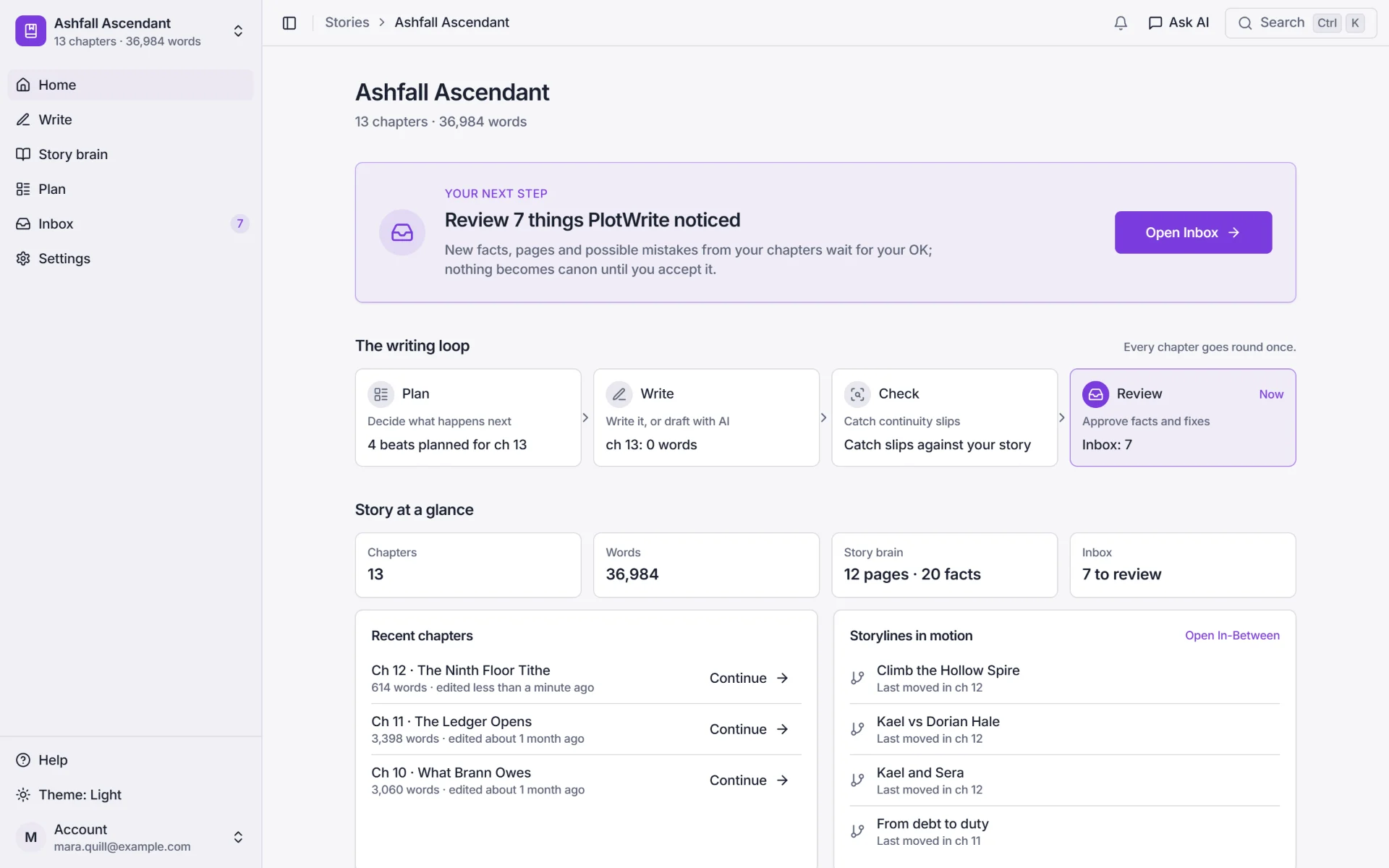
To write a webnovel with plotwrite.ink, start with a raw premise in the brainstorm chat, plan your first arc in Plan, write your chapters in the editor, let your Story brain collect the facts, run Check chapter before publishing, then repeat on a consistent release schedule. The loop on your Story home is Plan, Write, Check, Review, and a single "Your next step" card tells you where to go. The goal is not to plan forever. The goal is a system that lets you publish without losing track of your world.
Step 1: What kind of webnovel should you write?
Before you write chapter 1, decide what reader promise your webnovel is making. Webnovel readers return because they know what emotional and structural reward they are getting each week.
For Royal Road, the strongest promises are progression, power growth, escalating danger, clever systems, and satisfying chapter hooks. For Webnovel-style platforms, the strongest promises are dramatic momentum, frequent conflict, relationship tension, and rapid payoff. For Patreon-supported serials, the strongest promise is simple: there is always another chapter worth paying for.
Open plotwrite.ink and write a one-sentence promise in the brainstorm chat. The output should feel like a usable story brief, not generic advice. Examples:
- A failed mage gets a broken leveling system and has to exploit its bugs before the academy executes him.
- A reincarnated engineer builds a dungeon city one room, trap, and monster at a time.
- A powerless noble discovers her family curse is actually a hidden progression path.
Do not make the premise perfect. Make it specific enough that the brainstorm chat can ask useful questions.
Step 2: Use the brainstorm chat to turn the idea into a story foundation
The brainstorm chat is the first place to go when the idea is still messy. Paste your premise, a paragraph of worldbuilding, or even a scattered list of scenes. It can ask clarifying questions about genre, protagonist, conflict, stakes, tone, world rules, progression mechanics, and reader expectation. It sits docked beside your Plan and knows your story, so useful answers can be saved with "Save as idea".
Answer like a writer, not like a marketer. If you do not know something, say so. The point is to discover the story, not fake certainty. By the end of the conversation, you want five things:
- A protagonist with a clear wound, desire, and external goal.
- A world rule that creates pressure.
- A progression loop readers can understand.
- An antagonist or force that escalates.
- A first arc with a visible finish line.
The brainstorm chat uses your own AI connection: your ChatGPT or Claude subscription through the PlotWrite connector, OpenRouter or an API key, or a local model with LM Studio. PlotWrite never charges for AI. Carry the useful facts into your project, and the next output you want is a clean set of characters, rules, stakes, and progression promises.
Step 3: Build the first version of your Story brain
A webnovel becomes hard to manage around chapter 20 to 30. Characters multiply. Skills change. Locations gain history. Readers remember tiny details you forgot. That is why the Story brain has to start early.
In plotwrite.ink, your Story brain has a page per character, place, item, skill, faction and more, joined by [[links]], with a graph and a timeline. You can add pages manually, or build them from chapters you have already written by reading them on your own AI. Facts proposed from your chapters wait for your approval in the Inbox, so nothing changes without you.
For a new project, create or confirm these pages before chapter 1:
- Protagonist: name, goal, wound, power ceiling, starting weakness.
- Main supporting character: what they want and why they matter.
- Antagonistic force: person, institution, monster, system, or social pressure.
- Core location: academy, dungeon, kingdom, city, ship, tower, sect, or game world.
- Progression system: stats, ranks, levels, skills, classes, cultivation stages, or magic rules.
- Forbidden rule: the thing the story will test again and again.
Keep the first Story brain lean. A bloated one delays writing. A living one grows with the chapters.
plotwrite.ink drafts serial-ready chapters in your voice and builds your story bible from your chapters. Start your 7-day free trial →
Step 4: How do you plan the first arc of a webnovel?
New serial writers often try to outline 300 chapters before writing one. That feels productive, but it usually kills momentum. For a webnovel, plan the first arc in detail and leave later arcs flexible.
A strong first arc needs a promise, a test, and a payoff. The protagonist wants something visible. The world pushes back. The arc ends with a win, loss, reveal, promotion, exile, death, rank-up, unlocked skill, or irreversible change.
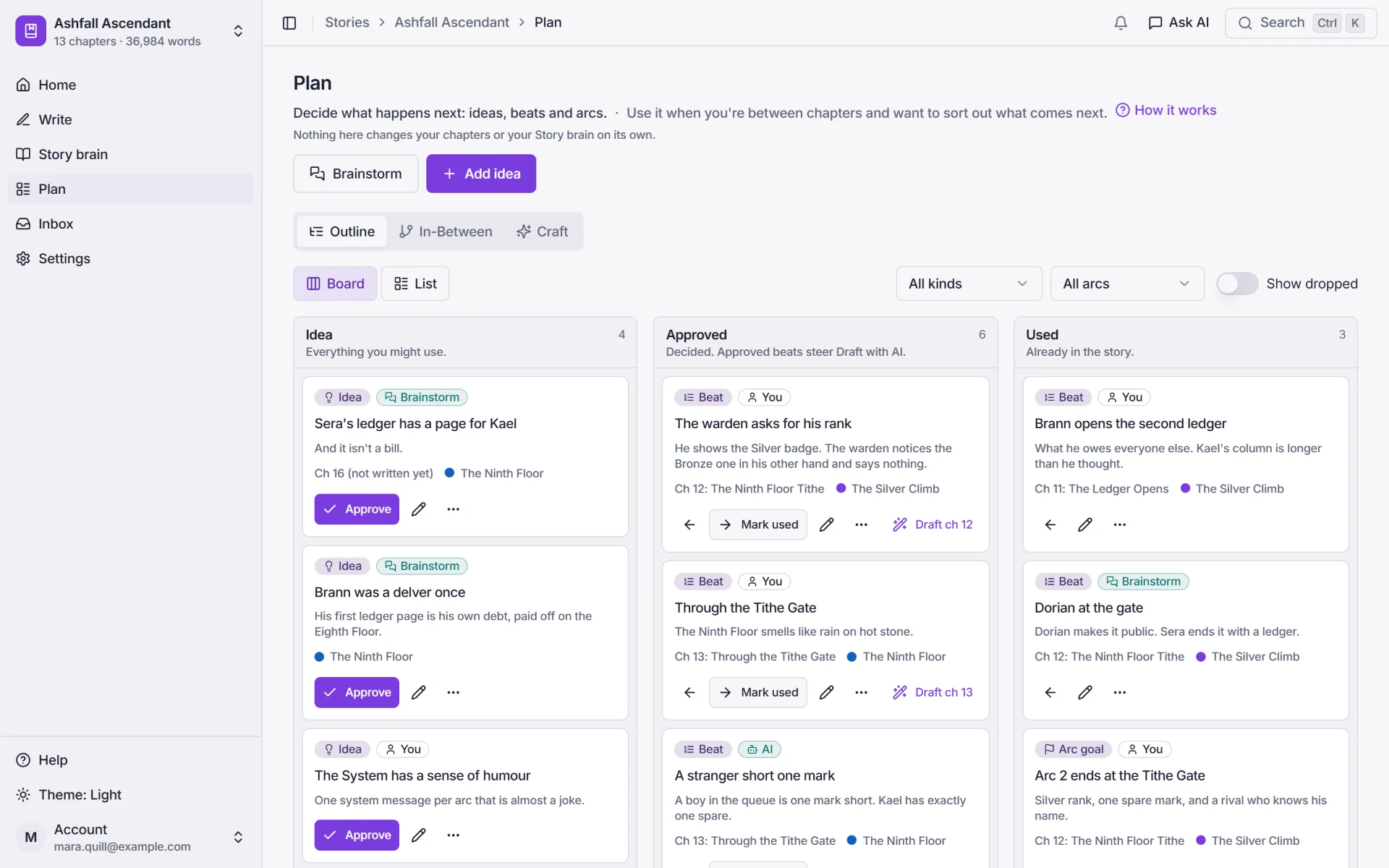
Use Plan, with its Outline board and list views and your arcs, to sketch 10 to 25 chapter jobs. Each chapter should have one job. Not five. One. Examples:
- Chapter 1: prove the protagonist is trapped and underpowered.
- Chapter 2: reveal the system behaves differently for them.
- Chapter 3: force the first public use of the power.
- Chapter 4: introduce the rival who understands the danger.
- Chapter 5: end with a choice that cannot be undone.
For Royal Road, make sure chapters 1 to 5 each end with a hook. Those early endings decide whether readers follow.
Step 5: Write chapter 1 in the editor
Open the editor and start with the chapter that proves the premise. Do not begin with encyclopedia worldbuilding. Begin with pressure. A character wants something, cannot get it, and the world reveals what kind of story this is.
A practical chapter 1 structure:
- Open on a problem the protagonist cannot ignore.
- Show the world rule through action.
- Reveal the protagonist's weakness.
- Give the reader one progression or mystery signal.
- End on a hook that makes chapter 2 necessary.
The prose is yours. Inside the editor, type // when you want a hand: Continue, Next beat, Write this beat, Rewrite, Expand, Describe, and Add to Story brain. The editor also has find and replace, focus mode, and a POV setting per chapter. If you would rather keep every prose-writing tool out of sight, Tag-free mode hides them all.
One honest note on Royal Road: planning, memory and consistency checks count as back-office help and need no AI tag, but pasting AI-written prose into a chapter means Royal Road asks for an AI tag. See Royal Road's AI policy and our guide to Royal Road AI tag rules.
Write rough. Then improve. A serial grows from consistent chapters, not from a perfect first paragraph.
Step 6: Let the Story brain catch up after each chapter
After finishing a chapter draft, update your Story brain. This is the maintenance step that keeps long serials from collapsing.
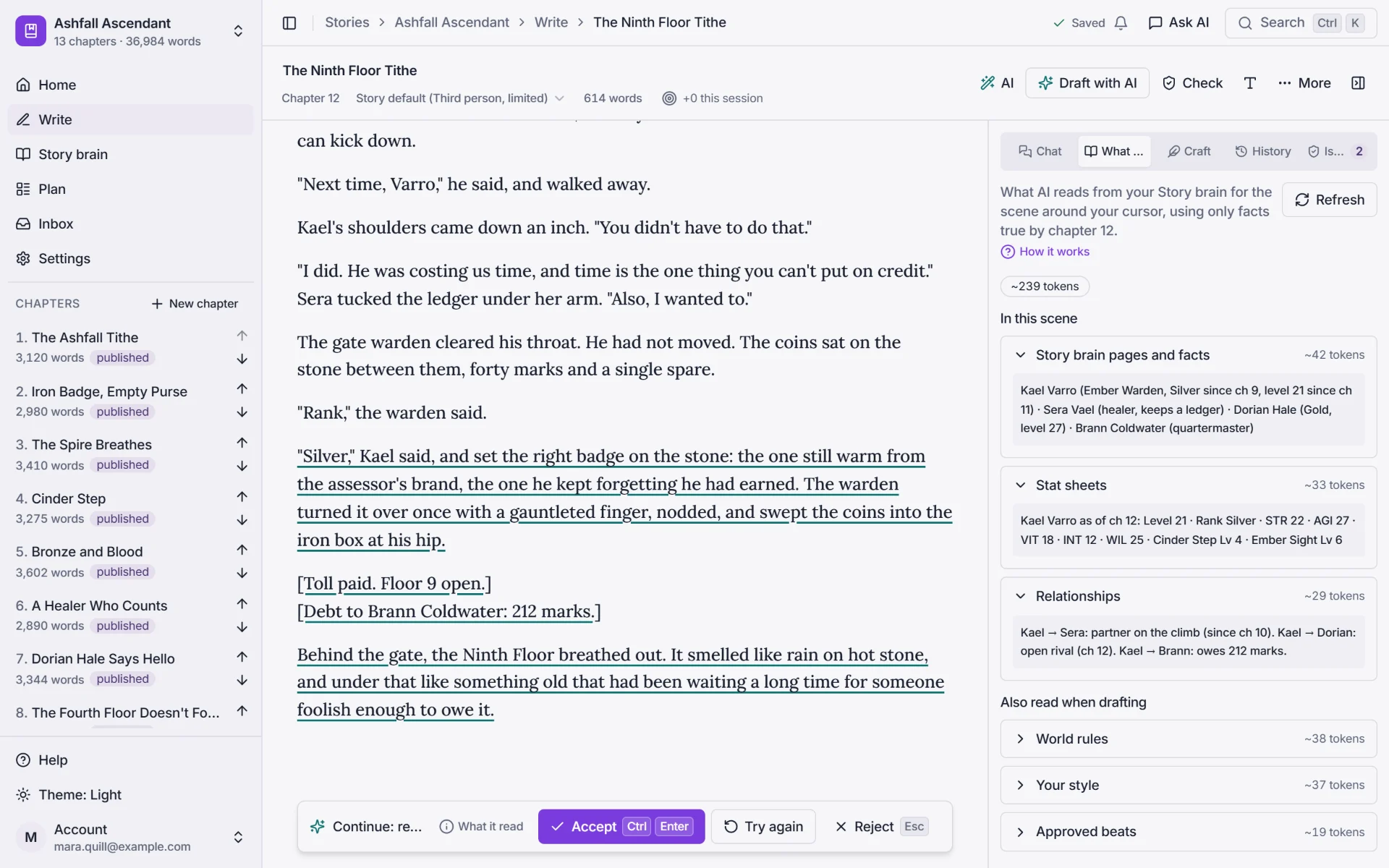
PlotWrite reads the chapter and proposes facts, such as a new skill, a changed rank or a new relationship. They wait in the Inbox. Accept the useful ones and skip anything too vague. You can also use "Add to Story brain" from the // menu on a passage you want recorded.
This matters because chapter 40 depends on chapter 4. If your protagonist gained Shadow Step in chapter 9, lost access in chapter 17, and upgraded it in chapter 26, the Story brain needs to know. Readers will know. Your Story brain should know too.
Step 7: How do you track progression and status changes?
If you write LitRPG, progression fantasy, cultivation, academy fantasy, dungeon core, or system fiction, progression tracking is not optional. It is the product.
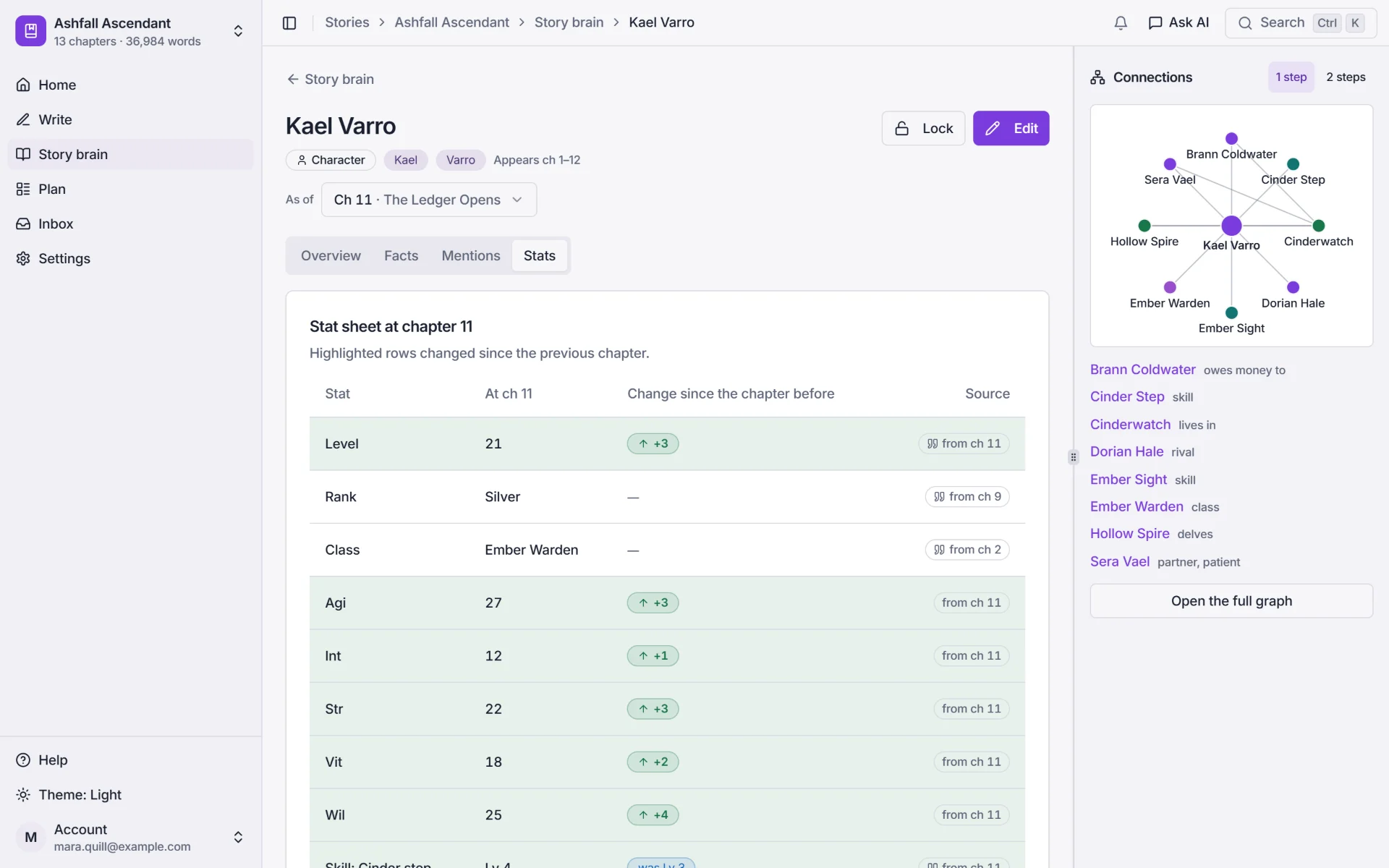
Every level, stat increase, class change, skill unlock, title, item, rank, injury, curse, and limitation should be tracked at the chapter where it happens. In plotwrite.ink, facts are timed by chapter ("Silver rank from ch 9"), and LitRPG stat sheets show any character as of chapter N, plus what changed since the previous chapter. It works for crunchy or smooth systems, cultivation realms, ranks, titles and skills.
A simple rule: if a reader would comment when it is wrong, track it. Power level? Track it. Familiar name? Track it. Contract condition? Track it. Sect rank? Track it. Inventory item used to solve a later problem? Track it.
For a deeper method, see how to track LitRPG stats. Progression errors are especially damaging because they break trust. The reader is following the math of satisfaction. If the math changes randomly, the payoff feels fake.
plotwrite.ink drafts serial-ready chapters in your voice and builds your story bible from your chapters. Start your 7-day free trial →
Step 8: Run Check chapter before publishing
Before you publish a chapter, open Check chapter. Its Continuity part runs the canon check against your Story brain and flags contradictions: a rank going backwards, a dead character walking, a brother becoming a cousin, the wrong location. It shows both quotes side by side and offers a one-click fix previewed as a diff.
Use it especially when:
- A character returns after many chapters.
- A skill, rank, stat, weapon, or rule appears again.
- You mention time, travel distance, injuries, cooldowns, or promises.
- The chapter resolves a mystery planted earlier.
- You are posting under deadline pressure.
The canon check is not there to make the story safe or bland. It is there to protect reader trust. You can still choose to break a rule, but you should do it intentionally, not by accident.
The same sheet has two more parts. Threads, powered by the In-Between, shows the story lines (main plot, romance, rivalry, mystery) and warns when one goes quiet. For a whole-story view, the Continuity report lists contradictions, stats that drift, promises still waiting and roles that flip on one printable page.
Step 9: Check your chapter hook
A webnovel chapter does not end when the scene stops. It ends when the reader needs the next chapter.
Before publishing, reread your ending, and use the Heart part of Check chapter (the Soul check) to ask whether the chapter hits emotionally. You are looking for one of four hook types:
- Unanswered question: the reader needs an explanation.
- Raised stake: the situation becomes more dangerous.
- Revealed secret: new information changes the meaning of the scene.
- Status change: the character's position changes in a way that demands resolution.
If the ending is only quiet reflection, it may be beautiful, but it may not convert. Add tension without betraying the tone. A good webnovel hook is not always a cliffhanger. Sometimes it is a promise that the next chapter will matter.
Step 10: How often should you publish a webnovel?
The best webnovel schedule is the one you can keep. For launch, daily posting for 14 to 30 days gives the strongest discovery signal. After launch, three chapters per week is sustainable for many writers. If you can only post twice per week, make those days sacred.
Recommended launch plan:
- Write 15 to 20 chapters before publishing.
- Publish daily for the first 2 to 4 weeks.
- Respond to every comment early.
- Add a short author note with your schedule.
- Move to a stable weekly cadence after the launch push.
Use plotwrite.ink to prepare chapters ahead of time. Chapter export (.txt or .md) is free on every plan, so copying a finished chapter to Royal Road is quick. The goal is to never publish from panic. Panic causes continuity mistakes, weak hooks, and burnout.
Step 11: Build the Patreon and reader funnel
Once readers are following, give them a clean next step. For web fiction, that usually means Patreon advance chapters.
A simple funnel:
- Public chapters on Royal Road, Scribble Hub, Webnovel alternatives, or your own site.
- End note says advance chapters are available.
- Patreon offers 3, 5, and 10 chapter tiers.
- plotwrite.ink helps you maintain the backlog without losing canon.
- KDP or ebook release comes later after a complete arc.
Do not overcomplicate rewards early. Advance chapters are the product. Side stories, Discord roles, Q&A posts, and art are bonuses. The reader pays because they want the next chapter now.
Step 12: Revise the system every arc
At the end of each arc, review three things: story health, reader response, and production health.
Story health: Did the arc pay off the promises it made? Did character decisions change anything? Did progression feel earned? The Continuity report and the In-Between are good places to check for promises still waiting.
Reader response: Which chapters got the most comments, follows, ratings, or Patreon clicks? Which endings made people ask for the next chapter?
Production health: Did your schedule nearly break you? Did the Story brain stay clean? Did you stockpile enough chapters?
Use those answers to plan the next arc. Webnovel success compounds when each arc teaches you how to write the next one better.
plotwrite.ink drafts serial-ready chapters in your voice and builds your story bible from your chapters. Start your 7-day free trial →
Complete beginning-to-end checklist
Use this checklist each time you start a new webnovel project:
- Write a one-sentence reader promise.
- Run the brainstorm chat and answer the foundation questions.
- Save the foundation into your Story brain.
- Create protagonist, world rule, progression system, and antagonist pages.
- Shape the first 10 to 25 chapter jobs in Plan.
- Draft chapter 1 in the editor.
- Use // commands when stuck or revising (and mind Royal Road's AI tag rules).
- Review the Inbox after each chapter and accept useful facts.
- Track progression changes at the chapter level.
- Run Check chapter before publishing.
- Check the chapter hook.
- Publish on a schedule.
- Reply to comments.
- Add Patreon once readers are asking for more.
- Review the arc and repeat.
This is the production loop: plan, write, check, review, publish, learn, repeat. plotwrite.ink is built to keep that loop moving (see all features), and you can try it with a 7-day free trial, no card needed.
Frequently asked questions
Can beginners use plotwrite.ink to write a webnovel?
Yes. Beginners can start with the brainstorm chat, answer guided questions, and build a first Story brain before writing chapter 1. The workflow supports both discovery writers and outliners.
How many chapters should I prepare before publishing a webnovel?
Prepare 15 to 20 chapters before publishing if possible. This gives you enough buffer to post daily during launch and avoid missing updates when life interrupts your writing schedule.
Does plotwrite.ink write the whole webnovel for me?
No. PlotWrite is the AI that reads your story, not the AI that writes it. It remembers your facts, checks canon and helps you plan. Optional drafting tools exist, but you control the story, voice and final prose. Pasting AI prose into Royal Road chapters means an AI tag.
How long does it take to write a webnovel?
It depends on your chapter length and pace. Plan the first arc of 10 to 25 chapters, then write toward a stockpile of 15 to 20 chapters before launch. A serial is ongoing, so the real target is a steady schedule you can keep.
When should I run the canon check?
Run Check chapter before publishing each chapter, especially when the chapter references powers, stats, past promises, timelines, relationships, injuries, or returning characters.
What is the best publishing schedule for a new webnovel?
For discovery, daily posting for the first 14 to 30 days works best. After launch, three chapters per week is a strong sustainable schedule for many serial writers.
Can I use plotwrite.ink for Royal Road, Webnovel, Scribble Hub, and Patreon?
Yes. The workflow works for any long-running serial platform. It is especially useful for Royal Road, Patreon-backed serials, LitRPG, progression fantasy, and stories with complex continuity.
Sources
- Royal Road blog: Royal Road AI text policy(royalroad.com)
- Amazon KDP Help: publishing your book(kdp.amazon.com)
Skip the blank page. Let plotwrite.ink draft your next chapter.
plotwrite.ink learns your writing style, keeps track of your characters and world rules, and can draft the next chapter in your voice with your Claude or ChatGPT plan or your own AI key. Built for Royal Road, Wattpad, and serial authors who post weekly.
- No credit card
- Cancel anytime
- Full Architect access
- Works with your Claude or ChatGPT plan or your own AI key
Quick answers from this guide
Direct one-page answers to the most-asked questions on this topic.
How do you write faster without losing quality?
Write faster by outlining each chapter to bullet-point depth before drafting, writing in 90-minute uninterrupted blocks, separating drafting from editing into different sessions, and capping revision at two passes. The biggest speed killer is editing while drafting. The second biggest is unclear outlines that force the writer to invent the story sentence by sentence.
How do you outline a web serial without killing your motivation?
Outline a web serial in three tiers: a one-page series summary (where the story is going), a five-arc skeleton (the major arcs), and a chapter-level outline for only the next 10–20 chapters. Detailed outlining beyond about 20 chapters usually demotivates writers and rarely matches what the story becomes.
What makes a good POV character for web fiction?
A good web fiction POV character has four traits: agency (makes decisions instead of only reacting), a distinct voice (recognizable in 50 words of prose), a specific vulnerability (something genuine to lose) and a visible competence trajectory (measurably stronger at chapter 50 than at chapter 5). A passive POV character is a common reason readers drop a long serial.
What is a soul engine, and what does PlotWrite offer instead?
A "soul engine" is an older name for tracking each character's emotional arc, relationships and motivations across a long serial. PlotWrite no longer uses that name. The same job is done by Soul check (does this chapter hit emotionally?), Reaction map and Resonance, all in Craft, next to your Story brain.
What is the best AI writing tool for Royal Road and web serials?
For a long Royal Road serial, the best AI tool is one built around memory, not just prose. Generic chatbots like ChatGPT and Claude lose continuity over long manuscripts. PlotWrite (plotwrite.ink) keeps a Story brain of every stat, rank and promise, timed by chapter, and its canon check catches slips before readers do. It reads your story rather than writing it, so no Royal Road AI tag is needed.
Can you write a 5,000-word chapter in a single sitting using AI?
Yes, but how fast depends on who writes the prose. With a beat outline and your Story brain ready, expect roughly two to four hours of your own writing. Draft with AI can cut that, but you still edit every draft, and pasting AI prose means an AI tag on Royal Road.
What software do top Royal Road writers actually use?
Royal Road writers typically run a writing tool (Scrivener, NovelCrafter, or a serial-first tool like PlotWrite), Royal Road's own scheduler, a Discord server for readers, and Patreon and KDP dashboards for income. The story-memory tool matters most: PlotWrite reads your chapters and keeps stats, ranks and promises consistent while you write the prose.
How do you batch-write a month of Royal Road chapters in a weekend?
Outline the whole batch on Saturday morning, write in your best two-hour blocks, then run every continuity check in one Sunday-evening pass. By hand, six chapters in a weekend is a good result and twelve is a stretch, so two weekends fill a month of daily posting. AI-written prose in a chapter means a Royal Road AI tag.
Can ChatGPT write a Royal Road chapter that ranks?
Rarely. Raw ChatGPT output tends toward generic prose, forgets your canon over a long serial, and Royal Road asks for an AI tag (AI-Assisted or AI-Generated) on AI-written text. A safer use of AI is memory and consistency checks while you write the prose yourself. PlotWrite (plotwrite.ink) is built for that.
How do you scale from 1 chapter per week to 7 chapters per week?
Cut the hidden time: batch-plan 7-12 chapters at once, stop rereading old chapters to check facts, and spend your writing hours on the prose itself. Add one chapter a week at a time and hold each step for a month, because speed without consistency costs readers. PlotWrite handles the planning and memory side; any AI-drafted prose needs Royal Road's AI tag.
Can you really make money writing webnovels with AI in 2026?
Yes, though nothing is guaranteed. Writers who sustain daily posting on Royal Road, WebNovel, and Wattpad can reach $500/month within about six months and $2,000/month within a year, mostly from Patreon advance chapters, Amazon KDP launches, and audiobook royalties. AI helps most by remembering your story and checking each chapter; AI-drafted prose needs Royal Road's AI tag.
Is plotwrite.ink better than Sudowrite for writing webnovels?
For a long LitRPG or progression serial on Royal Road, plotwrite.ink is usually the better fit, because it is the AI that reads your story, not the AI that writes it. Its story brain remembers every stat, rank and promise, and its canon check catches the slip before readers do. Sudowrite is better if you want AI to help draft prose paragraph by paragraph.
Is NovelCrafter good for writing webnovels?
Yes, for a novel written carefully scene by scene: NovelCrafter's Codex and scene-card editor are well regarded. For a long web serial on Royal Road, the gap is that Codex entries are mostly maintained by hand. PlotWrite (plotwrite.ink) builds its Story brain from chapters you have already written, times facts by chapter, and its canon check catches contradictions before readers do.
Is NovelMage better than Sudowrite?
It depends on the job. NovelMage is better if you write fantasy and want worldbuilding plus character art in one tool; Sudowrite is better for paragraph-level prose tools on a single novel. Neither is built to remember a long web serial's canon, which is the job plotwrite.ink is built for.
What is the best AI writing tool for Royal Road in 2026?
It depends on the job. For keeping a long Royal Road serial consistent, plotwrite.ink is built for it: it is the AI that reads your story, not the AI that writes it, remembering every stat, rank and promise and catching the slip before readers do. For generating prose, Sudowrite, NovelCrafter or a general chat model can do it, but Royal Road asks you to tag AI-written text.
How much does NovelCrafter cost vs plotwrite.ink?
NovelCrafter costs $4/month (Hobby), $12/month (Standard) or $24/month (Professional), plus whatever your own API key costs; check its pricing page for current tiers. plotwrite.ink costs $14/month (Storyteller) or $24/month (Architect), with a 7-day free trial and no card. PlotWrite never charges for AI: you connect your own ChatGPT or Claude subscription, OpenRouter, an API key or a local model.
Can AI write an entire webnovel chapter that readers will actually enjoy?
Yes, AI can draft an entire chapter, but whether readers enjoy it depends on what you do next. Edit it heavily in your own voice, check it against everything that came before (readers catch contradictions between chapters), and tag it honestly: Royal Road asks for an AI tag when AI-written prose goes into a chapter. Using AI only for memory and checks needs no tag.
Is Sudowrite worth it in 2026 for webnovel writers?
Sudowrite is worth it for novelists who want AI help drafting a single long manuscript. For serial webnovel writers on Royal Road, the bigger risk is continuity across hundreds of chapters, which is a memory problem, not a prose problem. PlotWrite is the AI that reads your story rather than writes it: it remembers every stat, rank and promise and catches slips before readers do.
What is the cheapest AI novel writing tool that actually works?
For occasional writing under 15,000 words per month, NovelCrafter Hobby at $4/month BYOK is the cheapest option with a real codex and editor. For serial writers, PlotWrite (Storyteller $14/month, Architect $24/month) never charges for AI: you can use your existing ChatGPT or Claude subscription through the connector, so the AI cost can be $0 extra. A 7-day free trial needs no card.
How fast can AI write a complete Royal Road chapter?
A modern AI model can draft a 2,500-3,000 word chapter in a few minutes. The slow part is making it publishable: editing it into your own voice and checking it against everything before it. Royal Road also asks for an AI tag when AI-written prose goes into a chapter. PlotWrite's drafting tools are optional; the Story brain and Canon check work without them.
Is it ethical to use AI to write webnovels?
Yes, using AI is ethical when you are honest about what it did. AI as memory, planning and consistency checks is widely accepted and, under Royal Road's policy, needs no AI tag. Publishing AI-written prose without disclosure is what misleads readers, and Royal Road and Amazon KDP both ask you to disclose it.
Can I use Claude or GPT with plotwrite.ink?
Yes. PlotWrite never provides or charges for AI, so you bring your own: connect your ChatGPT or Claude subscription through the PlotWrite connector (no API key), connect OpenRouter or paste an API key (OpenAI, Anthropic, Google, Mistral, DeepSeek), or run a local model with LM Studio. Keys are stored encrypted and AI usage bills to your own provider account.
Do readers care if my webnovel is AI-assisted?
Many readers do care, and they notice. On Royal Road, WebNovel and Wattpad, what readers punish fastest is inconsistency: a voice that drifts, canon that contradicts itself and stock AI phrasing. Royal Road asks authors to tag AI-generated text. If you write the prose yourself and use AI only to remember and check, no tag is needed.
Can plotwrite.ink replace NovelCrafter for serial writers?
For many serial writers on Royal Road, ScribbleHub, WebNovel or Wattpad, yes, especially LitRPG and progression authors. plotwrite.ink covers the Codex-style notes NovelCrafter is known for and adds what 200-chapter serials need: a story brain built from chapters you've already written, facts timed by chapter, LitRPG stat sheets "as of chapter N", and a canon check that catches contradictions. For a literary novelist working slowly on one manuscript, NovelCrafter's scene-card editor is still excellent.
Start writing your web serial today
plotwrite.ink builds your story bible, tracks your progression systems, and flags contradictions — so you can focus on writing the story that earns you readers and income.
Start your free trial — 7 days, no card needed