How to Write LitRPG: The Complete Guide for New Authors
Stat system design, level pacing, skill acquisition scenes, and the LitRPG-specific pitfalls to avoid.
To write LitRPG, give your story a small, consistent game system: 4–6 attributes, visible levels and skills, and simple formulas. Pace levels fast early and slow later, make each new skill a story event, write the story before the stat blocks, and track every number so it never contradicts itself.
Key takeaways
- LitRPG (Literary Role-Playing Game) sells because progression is visible and measurable on the page.
- Start with 4–6 attributes and simple visible formulas; add complexity only when the story demands it.
- Pace levels fast early, slower later, and treat each new skill as a story event.
- Write the story first and let stats serve it; inconsistent stat math is the mistake readers catch fastest.
- Royal Road builds the audience; Amazon KDP is the long-term income path.
LitRPG — Literary Role-Playing Game — is the genre that mashes the mechanics of a tabletop RPG into novel form. Stats. Levels. Skills. Items. Quests. It is also one of the most commercially successful web fiction genres on Royal Road and Amazon. This guide covers exactly how to design a stat system, pace progression, write skill acquisition scenes, and avoid the mistakes that sink most new LitRPG authors.
Want plotwrite.ink to draft your next chapter in your own voice?
What is LitRPG, and why does it sell?
LitRPG layers explicit game mechanics on top of a fantasy or sci-fi story. The protagonist sees stat screens. They gain levels with visible XP bars. They unlock skills with named tiers. They loot items with quantified bonuses. The reader sees all of this on the page, in a system text format that mimics a video game UI.
This sells for one specific reason: progression is visible and quantified. In a traditional fantasy novel, the reader has to infer that the protagonist is getting stronger from context clues. In LitRPG, the reader can literally count the strength increase. STR went from 10 to 15. The protagonist's punch now does 23 damage instead of 12. The reader is rewarded for paying attention with a constant feedback loop of measurable progress. It is the same satisfaction as leveling up in a video game, delivered in book form.
Progression Fantasy is a sister genre that uses the same psychological hook (visible, measurable progression) but without the explicit game UI. LitRPG and Progression Fantasy together make up a large share of the top-trending stories on Royal Road.
How do you design a LitRPG stat system?
Most new LitRPG authors over-engineer their stat system. They invent 14 attributes, 8 derived stats, and a complex formula for how each one affects combat. The reader's eyes glaze over. The author writes themselves into a corner where every chapter requires a spreadsheet to maintain consistency.
The rule: start with the smallest stat system that supports your story, and add complexity only when the story demands it. The most common working stat system is 4–6 attributes (Strength, Dexterity, Intelligence, Constitution, Wisdom, Charisma — pick 4–6, drop the rest). Each attribute increases by 1–2 per level. Most readers will never need more.
Derived stats (HP, MP, attack power, defense) should be derivable from attributes through a simple visible formula. 'HP = Constitution × 10' is enough. The reader does not need to see the formula every chapter, but you the author must know it cold so you do not contradict yourself.
Levels should mean something concrete. Do not have your protagonist gain 8 levels in one chapter for no reason. Each level should be a small narrative beat. Each tier (Level 1–10 = Novice, 11–20 = Apprentice, 21–30 = Adept, etc.) should correspond to a story arc or major milestone.
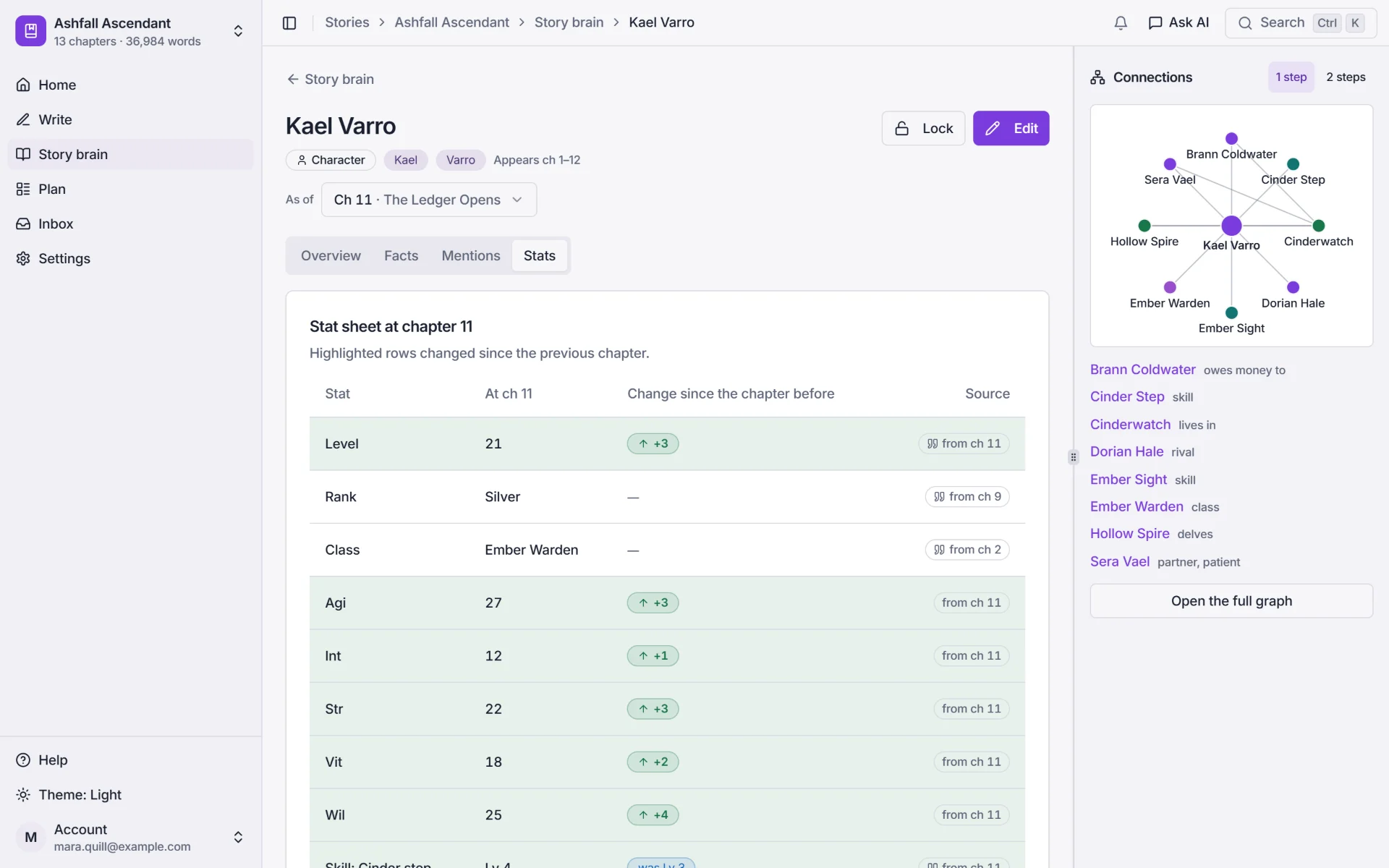
Once the system exists, the hard part is keeping its numbers straight across hundreds of chapters. How to track LitRPG stats across a long serial covers the tracking side, and PlotWrite for LitRPG shows stat sheets kept by chapter: any character "as of chapter N", with what changed since the previous chapter.
How fast should a LitRPG protagonist level up?
Pacing is the single biggest skill in LitRPG writing. Too slow and readers get bored. Too fast and the protagonist becomes overpowered before the story can support it.
The rule of thumb: the protagonist should gain roughly 1 level per 1–2 chapters in early game (Levels 1–20), 1 level per 3–5 chapters in mid game (Levels 20–60), and 1 level per 8–15 chapters in late game (Levels 60+). This creates the same pacing curve as a real RPG — fast progress at first, slower and more meaningful gains as the protagonist climbs.
New skill acquisition should be paced even more carefully. The protagonist learning a new ability is a major story event. Reserve it for chapter climaxes. A protagonist who learns a new skill every chapter quickly becomes a kitchen sink of unused abilities. A protagonist who learns one major skill every 5–8 chapters has time for that skill to be fully explored, mastered, and shown off in combat.
How do you write a skill acquisition scene?
The skill acquisition scene is the LitRPG equivalent of a romance novel's first kiss. It is a high-emotion moment readers actively wait for. Most new authors blow through it in two paragraphs. Slow down.
The formula: build pressure → moment of insight or discovery → system text reveal → immediate consequence. Build pressure means the protagonist is in a situation where they need this skill (a fight they cannot win, a problem they cannot solve, a question they cannot answer). The moment of insight is the cognitive or emotional shift — they realize how to do the new thing. The system text reveal is the cathartic payoff: 'YOU HAVE LEARNED [SKILL NAME] — TIER 1.' The immediate consequence is using the skill in the current scene to resolve the pressure. Stuck on what to call the skill? Try the free LitRPG skill name generator, and the System notification generator for the reveal text.
Do not have the protagonist learn a skill, then walk to a bedroom and sleep. Have them learn the skill and use it on the next sentence. The reader's brain needs the immediate payoff.
plotwrite.ink drafts serial-ready chapters in your voice and builds your story bible from your chapters. Start your 7-day free trial →
How to balance stats with story
The trap most new LitRPG authors fall into: they write the stat blocks first and try to wrap a story around them. The result reads like a game design document with dialogue.
Write the story first. Decide what the protagonist needs to do in each scene to advance the plot. Then assign the stats and skills that support those actions. The numbers exist to serve the story, not the other way around.
A useful test: if you removed every stat block and system message from your chapter, would there still be a story? If the answer is no, the chapter is not finished. The stats are decoration on the cake. The cake itself is character, conflict, and consequence.
Common LitRPG mistakes that kill stories
Mistake 1 — overpowered protagonist too early. The protagonist who is the strongest person in the world by chapter 20 has nowhere to go. Keep your protagonist meaningfully challenged for at least the first 50 chapters.
Mistake 2 — info dumps disguised as system text. A 400-word system message explaining the entire magic system is an info dump with a fake mustache. Reveal mechanics through play, not exposition.
Mistake 3 — inconsistent stat math. The protagonist with STR 47 in chapter 30 cannot suddenly have STR 32 in chapter 35 without a reason. Readers will catch this. Track your stats meticulously or use a tool that tracks them for you.
Mistake 4 — skill bloat. A protagonist with 47 active skills by chapter 50 has too many for the reader to keep track of. Most successful LitRPGs cap the protagonist at 6–12 actively used skills, with the rest being passive or rarely used.
Mistake 5 — no consequences for failure. If the protagonist always wins, there is no tension. Let them lose. Let them be injured. Let them have stat penalties from a curse or a wound. Failure is what makes the eventual victories meaningful.
You write. PlotWrite remembers every stat, rank and promise, and its canon check catches a rank going backwards or a dead character walking before your readers find it in the comments. It reads your story; it does not write it for you. Start your free trial →

Should you publish LitRPG on Royal Road or Amazon?
LitRPG dominates both Royal Road and Amazon, but the publishing path looks different.
Royal Road is the launch pad. Post your serial there to build an audience, get reader feedback, and identify which arcs of your story will become books.
Amazon (KDP) is the income engine. Once you have a Royal Road audience, pull your first 80,000–100,000 words off Royal Road, edit them into a polished book, and publish on KDP. Many authors enroll in Kindle Unlimited (KU) for the first 90 days. Royal Road readers can buy on launch day and leave reviews, which helps KU's algorithm show your book to other LitRPG readers.
The common cadence: keep writing on Royal Road continuously, and publish a new KDP book every 4–6 months. Income varies enormously from author to author, so treat any monthly figure you see as an outlier rather than a promise. Write every word of it yourself: Royal Road asks for an AI tag if you paste AI-written prose into a chapter (see Royal Road's AI policy), while memory and consistency tools need no tag.
Frequently asked questions
Do I need to know how to play tabletop RPGs to write LitRPG?
It helps but is not required. What matters is understanding the loop of visible progression — leveling up, gaining skills, getting stronger in measurable ways. If you have played any RPG video game (Skyrim, World of Warcraft, Diablo), you already understand the genre's appeal.
How many stats should my LitRPG system have?
4–6 attributes is the sweet spot. STR, DEX, INT, CON is enough for many stories. Add WIS and CHA only if your magic system or social mechanics require them. More than 6 attributes confuses readers and creates more chances for inconsistencies.
Should the protagonist see a system screen, or just feel the changes?
If your story is LitRPG, yes — visible system screens are the genre convention. If you want the same psychological hook without the game UI, write Progression Fantasy instead, where progress is shown through narrative beats and demonstrated power.
What is the difference between LitRPG and progression fantasy?
LitRPG shows explicit game mechanics on the page: stat screens, levels and system messages. Progression fantasy uses the same visible-growth hook but shows power through narrative beats and ranks, without a game UI.
Does Royal Road allow AI help when writing LitRPG?
Royal Road asks for an AI tag if you paste AI-written prose into a chapter. Memory, consistency checks and planning tools are back-office help and need no tag. See Royal Road's AI policy.
Sources
- Royal Road: AI text policy (blog #57)(royalroad.com)
- Amazon KDP Help: Kindle Unlimited and KDP Select(kdp.amazon.com)
Skip the blank page. Let plotwrite.ink draft your next chapter.
plotwrite.ink learns your writing style, keeps track of your characters and world rules, and can draft the next chapter in your voice with your Claude or ChatGPT plan or your own AI key. Built for Royal Road, Wattpad, and serial authors who post weekly.
- No credit card
- Cancel anytime
- Full Architect access
- Works with your Claude or ChatGPT plan or your own AI key
Quick answers from this guide
Direct one-page answers to the most-asked questions on this topic.
What is LitRPG and how is it different from Progression Fantasy?
LitRPG (literary role-playing game fiction) shows explicit game mechanics on the page: visible stats, levels, skill panels and system messages. Progression fantasy is any story built on measurable character growth, with or without a visible game system. All LitRPG is progression fantasy, but most progression fantasy is not LitRPG.
How do you write LitRPG stat blocks readers actually enjoy?
Good LitRPG stat blocks are short (under 15 lines), formatted in a consistent code-style box, appear no more than once every 3–5 chapters, and always reveal a story-relevant change. Show only what changed plus 3 to 5 reference stats, and hide everything that did not move.
What is the best way to plan a LitRPG progression curve?
Plot the protagonist's main stat or tier against chapter number and aim for a curve that slows over time, not a straight line. A workable rule of thumb is that each tier takes about 40% more chapters than the one before. Record every stat change against the chapter it happened in, so you can see where the curve really sits.
How do you outline a 7-arc progression fantasy from scratch?
Plot seven arcs of 25-40 chapters each. Give every arc four ingredients: one power tier transition, one new or escalated faction, one personal stake that resolves inside the arc, and one mythic stake that moves toward the series climax. Lay the skeleton on a board, then stress-test each arc before you write it.
Does NovelMage work for LitRPG and progression fantasy?
Partly. NovelMage works for LitRPG worldbuilding and visuals (maps, character portraits, class art), but it is not built to track stats, skills and promises across hundreds of chapters. For that, PlotWrite's Story brain (facts timed by chapter, stat sheets as of any chapter) and Canon check are a stronger fit. You write; PlotWrite remembers.
Start writing your web serial today
plotwrite.ink builds your story bible, tracks your progression systems, and flags contradictions — so you can focus on writing the story that earns you readers and income.
Start your free trial — 7 days, no card needed