What are the four cliffhanger types every serial author should master?
A working cliffhanger is one of these four shapes:
• Question cliff: 'And then she opened the door — and recognized the face inside.' (Reader needs to know who.) • Threat cliff: 'The blade was already moving when Tom turned.' (Reader needs to know if Tom survives.) • Reveal cliff: 'It wasn't her father in the photograph. It was her future self.' (Reader needs to know what this means.) • Reversal cliff: A confident character is suddenly vulnerable, or a defeated character is suddenly winning. (Reader needs to know how the new state plays out.)
Mix the four across an arc. A serial that uses only threat cliffs becomes exhausting. A serial that uses only question cliffs feels evasive. The variety creates rhythm.
How soon must a cliffhanger pay off? The trust ledger
Resolve a cliffhanger within 1–2 chapters. Every cliff opens a debt with the reader: they gave you their attention and you owe them resolution. Pay within 1–2 chapters and the trust ledger stays positive. Stretch the resolution across 5+ chapters and readers start to feel manipulated, and many drop the serial.
A useful rhythm is 'three open, one closing'. Three story questions are alive at any moment; one closes per chapter; a new one opens. The tension stack never empties.
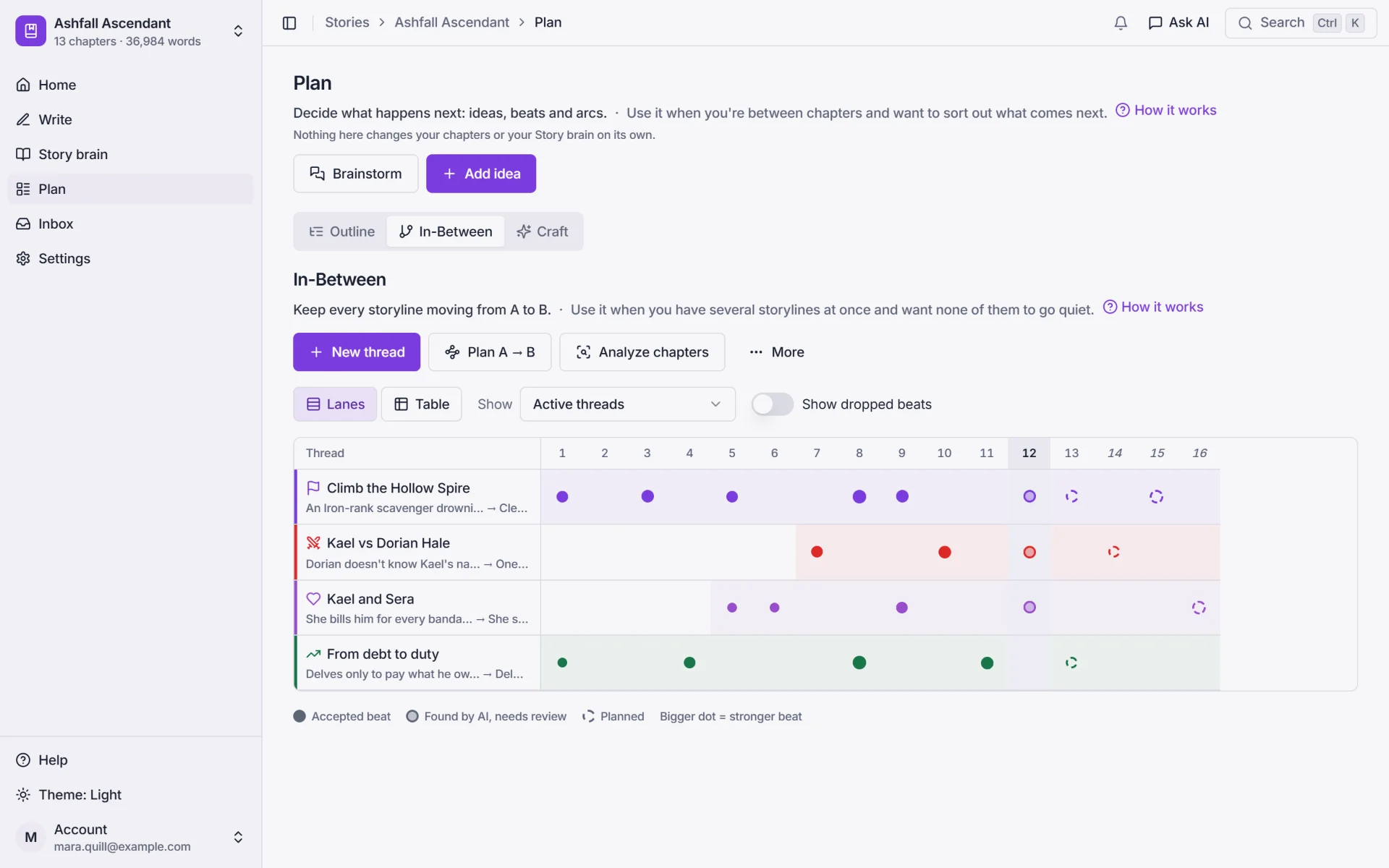
This is a bookkeeping problem as much as a craft one. In PlotWrite, the In-Between tracks each thread (main plot, romance, rivalry, mystery) chapter by chapter and warns you when one goes quiet, so a promised payoff doesn't quietly slip away. You still decide where every cliff lands.
How long should a web serial chapter be?
For daily serials, 1,800–2,500 words is a practical target. Shorter chapters take less time to read, which makes a daily binge easier and creates more chapter-end hooks per week. Longer chapters (4,000+ words) can work, but each one then needs a strong hook of its own.
The tradeoff is frequency versus heft. Authors who post shorter chapters more often give readers more natural stopping points, and each stopping point is a chance to land a cliff. If your natural chapter length is 4,000+, consider splitting at scene breaks and ending the first half on a hook.
Treat these figures as rules of thumb from common serial practice, not guarantees: your own readers' comments and drop-off are the better guide.
A cliffhanger only pays off if the next chapter agrees with everything before it. PlotWrite remembers what you set up, flags threads that have gone quiet, and checks each chapter before you post.
plotwrite.ink learns your writing style, keeps track of your characters and world rules, and can draft the next chapter in your voice with your Claude or ChatGPT plan or your own AI key. Built for Royal Road, Wattpad, and serial authors who post weekly.
- No credit card
- Cancel anytime
- Full Architect access
- Works with your Claude or ChatGPT plan or your own AI key
Ready to try it on your own serial? See how PlotWrite keeps a LitRPG serial consistent
How should you pace the inside of a chapter?
A working chapter has a three-act micro-shape: setup (reader re-orients in about 200 words), escalation (the chapter's mini-conflict), and the cliff (the last 50–150 words pivot into a new question, threat, reveal, or reversal).
Chapters that meander in the middle, or that resolve cleanly at the end, tend to give readers less reason to continue. Always end on the open door, never the closed one.
How do you find the cliff in a chapter that doesn't have one?
Restructure rather than add content. Move a later scene's opening line to the current chapter's ending. The 'reveal' or 'threat' that was going to open chapter 13 instead closes chapter 12.
This works because the binge reader experiences the cliff at the moment of attention transition, not at the moment you intended to deliver it. For longer arcs where tension sags between big set pieces, see keeping readers engaged during arc transitions.