The Royal Road Chapter Hook Formula: Why Readers Click Next Chapter
The 4 hook types that earn next-chapter clicks on Royal Road, with rewrite templates.
A Royal Road chapter hook is an ending that makes the reader click Next Chapter. Four types work: the unanswered question, the raised stake, the revealed secret and the status change. End on something concrete, never on resolution, and vary the type across consecutive chapters.
Key takeaways
- Four hook types earn the click: unanswered question, raised stake, revealed secret, status change.
- End on a concrete, visible moment, not on resolution or internal monologue.
- Vary the hook type across consecutive chapters to avoid reader fatigue.
- Rewrite the last 200 words of every chapter against a four-point checklist before publishing.
On Royal Road, the difference between a hit and a quiet flop is rarely the writing quality. It is the chapter ending. Royal Road readers binge — they read 5, 10, 20 chapters in a sitting — and the only question that matters at the end of every chapter is: 'Do I click next, or close the tab?' This guide breaks down the 4 hook types that earn the click, with examples, common mistakes, and rewrite templates you can apply tonight.
Want plotwrite.ink to draft your next chapter in your own voice?
Why do chapter hooks matter more on Royal Road than in novels?
Traditional novels can afford a slow chapter ending. The reader has already paid for the book and is sitting in a comfortable chair. Web serials cannot. Every chapter ending is a fork in the road: the reader either clicks the 'Next Chapter' button (Royal Road conveniently puts it at the bottom of every chapter) or they close the tab and go back to scrolling Twitter. Forever.
The Royal Road follower count is downstream of click-through (see how the Rising Stars algorithm works). Your trending position is downstream of follower count. Your Patreon income is downstream of trending position. Every dollar you will ever earn from Royal Road traces back to chapter endings. This is not an exaggeration. This is the actual math.
What are the 4 hook types that work on Royal Road?
Every successful Royal Road chapter ending is built on at least one of four hook types. The best chapter endings combine two or three. They are: the unanswered question, the raised stake, the revealed secret, and the status change.
Hook Type 1 — The unanswered question
End the chapter at the moment a major question is asked, before the answer arrives. The question can be literal (a character asking another character something the reader desperately wants to know) or implied (the reader is now asking the question themselves).
Example (weak): 'He walked into the throne room. The king sat waiting. They began to talk.'
Example (strong): 'He walked into the throne room. The king did not look up from the map. "Tell me," the king said quietly. "How did you really survive the cave?" — END CHAPTER —'
The reader cannot stop. They must know how he survived. They must know what the king already knows. They must know what happens when the answer comes out. Click.
Hook Type 2 — The raised stake
End the chapter at the moment the situation gets demonstrably worse. Not a vague 'things were bad.' A concrete escalation the reader can feel in their stomach.
Example (weak): 'The army was approaching. He felt nervous about the upcoming battle.'
Example (strong): 'He counted the torches on the ridge again, slower this time. Two hundred. Maybe more. His own forces, dug in along the river, numbered forty-three. — END CHAPTER —'
The stake is now visible and quantified. The reader has done the math themselves. They want to know how he survives forty-three against two hundred.
Hook Type 3 — The revealed secret
End the chapter at the moment a secret is revealed that recontextualizes everything before it. This is the hardest hook to write well, because it requires planting the secret chapters earlier so the reveal lands.
Example: A LitRPG protagonist has spent 30 chapters thinking he has a 'broken' starter class. The chapter ends with him casting his first real ability — and the system text reveals the class is actually a hidden Tier-9 mythic class that hasn't been seen in 1,000 years. — END CHAPTER —
The reader will not stop. They want to see the world's reaction. They want to know what this means for every previous chapter. They want the next chapter, immediately.
Hook Type 4 — The status change
End the chapter at the moment a character's status visibly changes. New title, new rank, new injury, new ally, new enemy. The change must be tangible and have downstream consequences.
Example: 'The notification appeared in his vision and refused to go away. CONGRATULATIONS — YOU HAVE BEEN MARKED AS HERETIC BY THE CHURCH OF THE FIRST FLAME. ALL CLERICS WITHIN 1000 KM ARE NOW HOSTILE. — END CHAPTER —'
The protagonist's entire world just shifted. Every NPC interaction in the next chapter is now loaded with new tension. The reader cannot wait to see what happens at the next inn, the next town, the next meeting with a former friend.
plotwrite.ink drafts serial-ready chapters in your voice and builds your story bible from your chapters. Start your 7-day free trial →
What mistakes kill a chapter ending?
Mistake 1: ending on resolution. 'They all went home and slept well.' The reader has no reason to keep reading. Save the resolution for the start of the next chapter, not the end of this one.
Mistake 2: ending on internal monologue. 'He thought about everything that had happened, and felt that things would probably get harder from here.' Vague, abstract, and gives the reader nothing concrete to anticipate.
Mistake 3: telegraphing the cliffhanger. 'Little did he know, behind him, the assassin was approaching with a knife raised…' The reader is being talked at, not pulled forward. Show the assassin's shadow on the wall instead. Let the reader notice it themselves.
Mistake 4: reusing the same hook type for 10 chapters in a row. Variety matters. If every chapter ends on a status change (new level, new skill, new title) the reader becomes numb to it. Mix question, stake, secret, and status across consecutive chapters. For genre-specific pacing, see the LitRPG writing guide.
How do you check and rewrite a chapter ending?
Before you publish any chapter, run the last 200 words against this checklist:
- Does the ending pose an unanswered question, raise a stake, reveal a secret, or change a status?
- Is the reader physically wanting the next chapter right now?
- Is the ending concrete and visible (not abstract or internal)?
- Have I varied the hook type from my last 3 chapter endings?
If any answer is no, rewrite the last 200 words. It is the highest-leverage edit you can make to your serial.
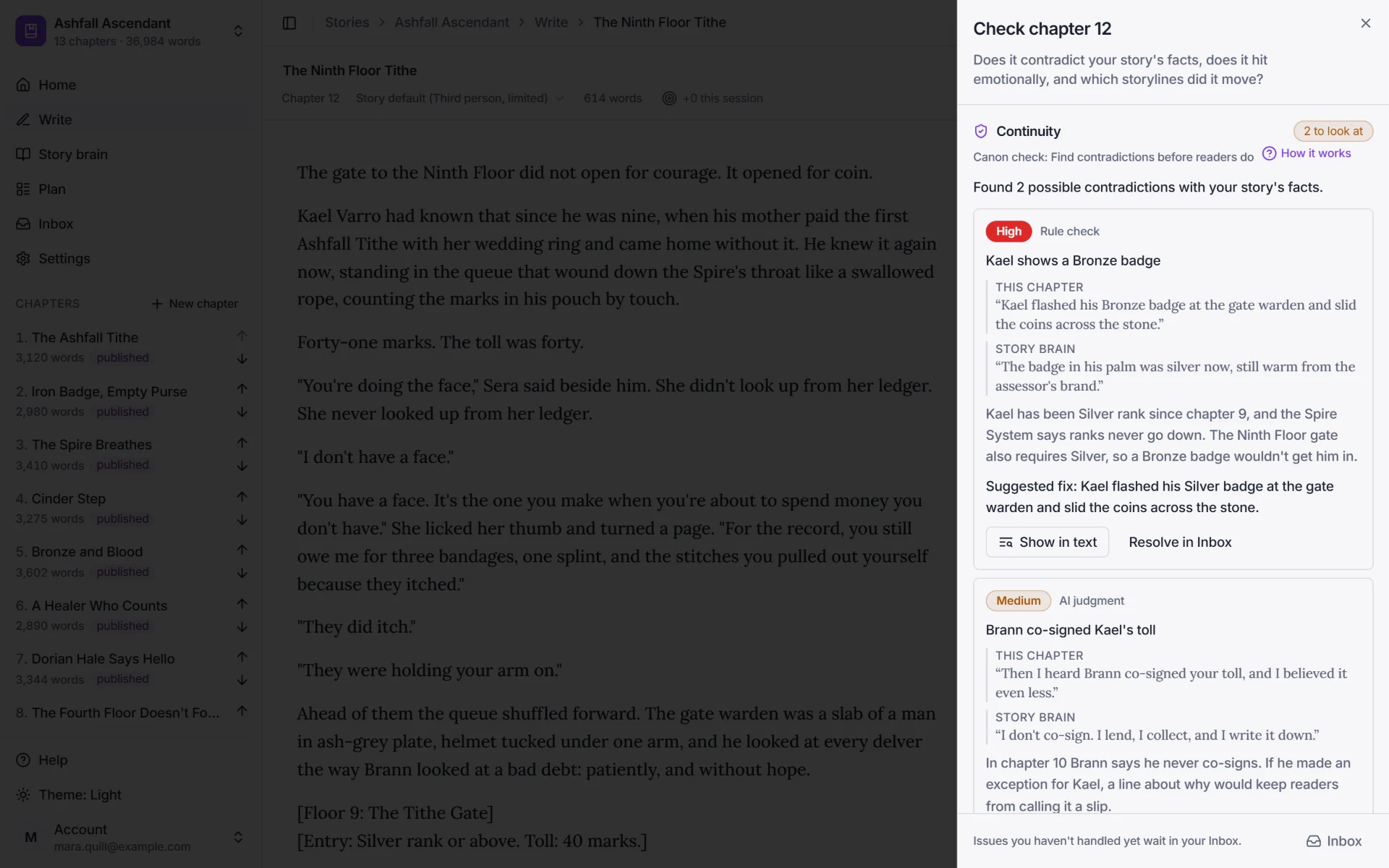
PlotWrite will not write your hook for you, but it helps you keep the promises that make hooks pay off. Threads in the Check chapter sheet show which promises are still waiting, Soul check asks whether the chapter hits emotionally, and Canon check catches continuity slips before readers do. Reader view, also in Check chapter, reads your chapter like a Royal Road reader and scores the opening hook and cliffhanger. Start your free trial →
Frequently asked questions
How long should a Royal Road chapter be?
The Royal Road sweet spot is 2,000–3,500 words per chapter. Shorter chapters (under 1,500 words) feel thin. Longer chapters (over 4,000) cause readers to drop off mid-chapter. Aim for 2,500 as a target, with the strongest possible hook in the last 200 words.
Should every chapter end on a cliffhanger?
Every chapter should end with momentum (one of the 4 hook types), but not every chapter needs a literal cliffhanger. A revealed secret or a status change is a hook without being a 'help, I'm hanging off a cliff' moment. Variety prevents reader fatigue.
What's the difference between a hook and a cliffhanger?
A cliffhanger is one specific type of hook — usually 'the raised stake' taken to its extreme. Hooks include cliffhangers but also questions, secrets, and status changes. All cliffhangers are hooks. Not all hooks are cliffhangers.
What is a chapter hook on Royal Road?
A chapter hook is the final moment of a chapter, written so the reader wants to click Next Chapter instead of closing the tab. It usually poses a question, raises a stake, reveals a secret or changes a character's status.
Can you check whether a chapter ending works before publishing?
Yes. Run the last 200 words against the four-point rewrite checklist above. PlotWrite's Reader view (in Check chapter) also scores the opening hook and cliffhanger and suggests fixes; it analyzes your writing and does not write the hook for you.
Skip the blank page. Let plotwrite.ink draft your next chapter.
plotwrite.ink learns your writing style, keeps track of your characters and world rules, and can draft the next chapter in your voice with your Claude or ChatGPT plan or your own AI key. Built for Royal Road, Wattpad, and serial authors who post weekly.
- No credit card
- Cancel anytime
- Full Architect access
- Works with your Claude or ChatGPT plan or your own AI key
Quick answers from this guide
Direct one-page answers to the most-asked questions on this topic.
What is the best cliffhanger formula for web fiction?
The best web fiction cliffhanger uses three lines: a sudden reversal, one concrete sensory detail, and an unanswered question the reader finishes in their own head. End on a short line with white space after it, not a long paragraph or vague dread.
How do you write a web fiction blurb that converts?
A web fiction blurb that converts has four parts: a one-sentence hook stating the central conflict, one or two lines of stakes, a line that shows the story's voice, and an open question the reader cannot answer from the blurb. Keep it under 100 words and make every line concrete.
How do you generate chapter outlines that hit Royal Road tropes?
Give the AI your story notes, your last three chapters, and the trope you want to hit (system reveal, power-up, betrayal). Ask for three outline options ranked by reader payoff, then edit the best one. PlotWrite does this in the brainstorm chat docked beside your Plan, which already knows your Story brain.
How do you write a strong chapter 1 for Royal Road?
A strong Royal Road chapter 1 opens on one concrete, sensory moment, reaches the inciting incident within roughly the first 1,500 words, shows the protagonist making a real choice, and ends on a forward question that pulls the reader into chapter 2. Most readers decide from the first page whether to follow, so it is the highest-leverage chapter you will write.
Start writing your web serial today
plotwrite.ink builds your story bible, tracks your progression systems, and flags contradictions — so you can focus on writing the story that earns you readers and income.
Start your free trial — 7 days, no card needed