What makes a LitRPG system work?
Visible — readers can see the numbers, classes, and skills. Predictable — when a Level 12 Mage casts Fireball, the same Mage at Level 12 always does roughly the same damage unless something explained changes it. Decision-forcing — the protagonist regularly chooses between stats, classes, or skills, and those choices have lasting consequences. Systems that fail one of these three feel like decoration. Systems that hit all three feel like a game readers want to play through the character.
How often should you show a LitRPG stat block?
Show full stat blocks every 3–5 chapters in arc 1 while readers learn the system. After roughly chapter 20, drop to milestone-only (level ups, class unlocks, major loot). Always show the delta — what changed since last time. Bare numbers without context bore readers; deltas with reactions hook them.
How do you stop power inflation in LitRPG?
Linear scaling kills LitRPG. If a Level 50 hero is just 'Level 10 with bigger numbers,' the threat dies. Solve this with one of three structural patterns: (1) tiers — power scaling resets at thresholds (mortal → ascended → divine); (2) opportunity cost — every choice closes other paths so the hero is always trading; (3) external scale — the enemies and stakes grow faster than the hero, forcing creative solutions over brute force.
Keeping a long serial straight is the hard part. PlotWrite remembers every rank, skill and secret in your story and checks each new chapter before you post. Works with the Claude or ChatGPT plan you already pay for. Free for 7 days.
plotwrite.ink learns your writing style, keeps track of your characters and world rules, and can draft the next chapter in your voice with your Claude or ChatGPT plan or your own AI key. Built for Royal Road, Wattpad, and serial authors who post weekly.
- No credit card
- Cancel anytime
- Full Architect access
- Works with your Claude or ChatGPT plan or your own AI key
Ready to try it on your own serial? Track your LitRPG stats — free trial
How do you keep a LitRPG skill tree consistent?
Track every skill, ability, and stat from chapter 1, with the chapter each one changed. Authors who skip this end up with chapter 87 contradicting chapter 12 — a Level 40 character suddenly missing an ability they unlocked at Level 8. Readers catch every contradiction and post receipts in the comments.
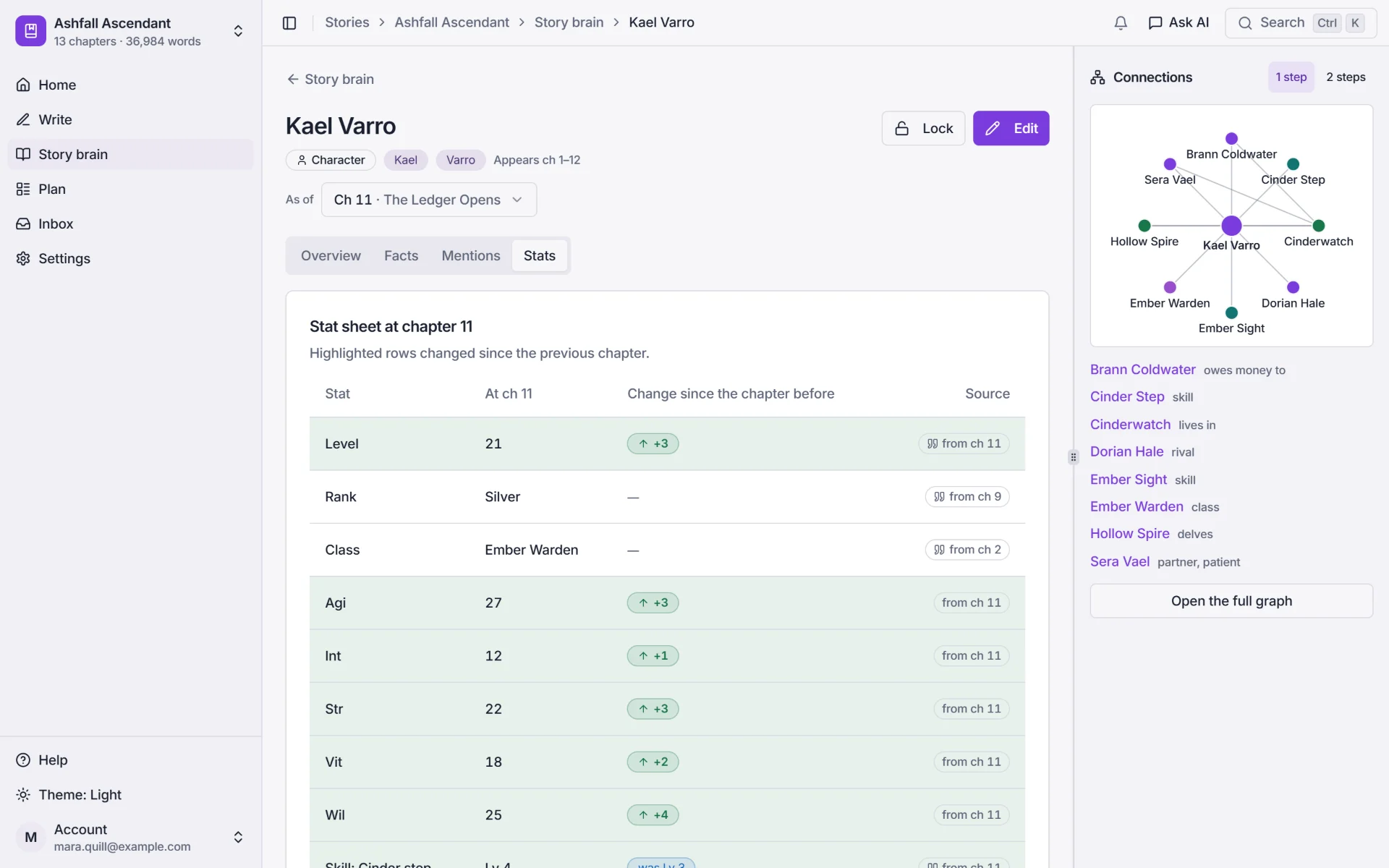
A spreadsheet works. So does PlotWrite's Story brain, which keeps facts timed by chapter ("Silver rank from ch 9") and shows any character as of chapter N, with what changed since the previous chapter. You still write every word; PlotWrite just remembers the numbers and flags a rank that goes backwards, so the slip gets caught before your readers do.
What should a LitRPG status window actually do?
Status windows should do at least one of three jobs every time they appear: deliver new information (the hero discovers a hidden stat), force a choice (which class branch to take), or land emotional beats (the level up that arrives at the worst possible moment). Status windows that just restate what readers already know train them to skim.