What happened when I posted 29 AI-drafted chapters in a week?
I launched a progression-fantasy serial on Royal Road. I wrote chapter 1 by hand. Everything after that was drafted by an early version of PlotWrite's Auto-write: I planned chapters, queued them, read the results, fixed what I noticed and posted.
The output was real. In the first seven days, 29 chapters and 81,381 words went up. I kept going, and by the end the serial had about 62 chapters and roughly 170,000 words.
The problems arrived more slowly than the chapters did. Readers started pointing out things that didn't line up. Then the reviews said it plainly: the story was inconsistent, and it read as AI-generated. The overall rating fell to about 2 stars. The readers were right on both counts.
Why does posting faster break a serial?
Here's the trap I walked into. Volume feels like progress. Every morning there were new chapters, the word count climbed, and the release schedule looked like the ones that do well on Royal Road. It's easy to believe that if you post enough, the story will take care of itself.
It doesn't. A serial is a promise to remember. Readers keep track of who is related to whom, what rank everyone holds, where each character is, how much time has passed and who owes what to whom. At my pace, I couldn't. I was reviewing one chapter at a time, and each chapter looked fine on its own. The contradictions only showed up across chapters, which is exactly where I wasn't looking and exactly where readers live.
The early Auto-write made this worse, not better. It had notes about the story, but no reliable memory of what was true as of a given chapter. So every new chapter was a fresh chance to quietly rewrite something that was already settled. Producing words faster just meant producing contradictions faster.
Which continuity errors did readers catch?
These hurt the most, because each one is the kind of thing a reader notices and a quick edit misses.
The brother. The main character's brother didn't stay the same person. His identity and his rank changed from one chapter to another. In progression fantasy, rank is the scoreboard readers follow, so when it flips without explanation, they stop trusting every other number in the story too.
The setting and the timeline. Places and the order of events didn't add up. A character would be somewhere they couldn't be yet, or time would pass differently depending on which chapter you read.
Allies who switched sides. Characters who had been on the main character's side turned against him, or the other way round, with no reason on the page. A betrayal can be the best scene in a book. A betrayal nobody planned reads as a mistake, because it is one.
None of these are exotic errors. They're the ordinary result of drafting faster than anyone is keeping track.
Do you need to tag an AI-drafted story on Royal Road?
The second thing I got wrong isn't about craft. I didn't tag the serial as AI-generated.
Royal Road's AI-text policy (its blog post #57) asks authors to tag stories that contain AI-generated text, and it treats back-office help such as brainstorming, planning or checking differently. My chapters were drafted by AI, so they needed the tag. At the time I told myself that reading and fixing the drafts made them mine. I don't think that anymore. Readers have a right to know what they're reading, and some of the anger in those reviews came from finding out on their own.
I've written up which PlotWrite tools need Royal Road's AI tag and Royal Road's AI tag rules, explained, both with links to Royal Road's own pages. The short version: if AI wrote the prose you post, tag it.
Keeping a long serial straight is the hard part. PlotWrite remembers every rank, skill and secret in your story and checks each new chapter before you post. Works with the Claude or ChatGPT plan you already pay for. Free for 7 days.
plotwrite.ink learns your writing style, keeps track of your characters and world rules, and can draft the next chapter in your voice with your Claude or ChatGPT plan or your own AI key. Built for Royal Road, Wattpad, and serial authors who post weekly.
- No credit card
- Cancel anytime
- Full Architect access
- Works with your Claude or ChatGPT plan or your own AI key
Ready to try it on your own serial? Start 7-Day Free Trial
What would I do differently now?
If I started that serial again, I'd pick one of two honest paths.
Write it yourself, and use AI to remember and check. This is what I'd suggest to most authors. You write the chapters. The AI reads them and keeps track of everything that slipped past me: who holds what rank as of which chapter, where everyone is, which promises are still open, which relationships changed and when. Before you post, it checks the new chapter against what came before and shows you what contradicts. Royal Road treats that kind of help as back-office work, so it doesn't need a tag.
Or draft with AI, and tag it honestly. Some authors will still want AI to draft, and that's their call as long as readers are told. If you go that way, tag the story the way Royal Road asks, read across chapters rather than one at a time, and check every draft against your canon before it goes up.
What I wouldn't do again is what I did: draft at full speed, check by eye, and leave the tag off.
How did this change PlotWrite?
PlotWrite grew out of this serial, but not in the way the old version of this post suggested. The lesson wasn't that I needed to draft faster. It was that nothing in my workflow read the story back to me.
So PlotWrite was rebuilt around reading and checking.
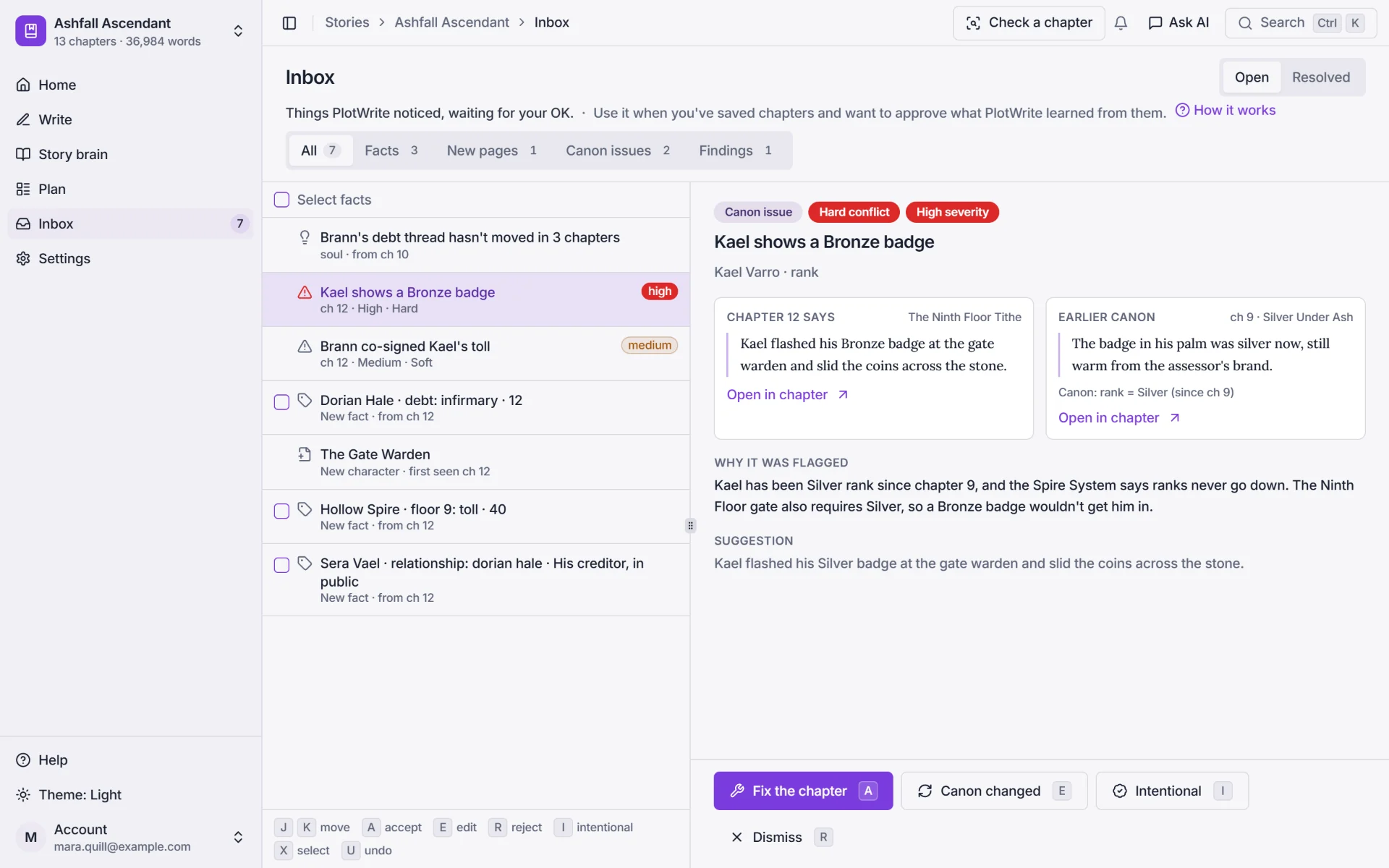
A story brain with chapter-timed facts. It reads your chapters and records each fact along with when it became true. A character's rank in chapter 9 and his rank in chapter 30 can be different facts, and PlotWrite knows which one applies to the chapter you're on.
A canon check. Before you post, it compares the new chapter with the story brain and quotes both sides of any contradiction, so you can see what the chapter says and what the story already established.
The In-Between. It follows your open promises and storylines from A to B across chapters and tells you when one has gone quiet, so a thread doesn't get dropped or quietly reversed.
Tag-free mode. One account setting hides every tool that writes prose for you, so nothing you paste into a chapter needs Royal Road's AI tag. Planning, memory, checks and ideas stay.
Drafting is still there for authors who want it, but it's optional and labelled for what it is: AI-written text that needs Royal Road's AI tag if you post it. What I needed in that first week wasn't a faster writer. It was something that remembered the story.