PlotWrite

    plotwrite.ink vs NovelCrafter: A Deep Dive for Serial Writers (2026)

    8 min read Updated By the PlotWrite team

    NovelCrafter is a polished codex and scene-card editor, best for one novel at a time. PlotWrite (plotwrite.ink) is built for long Royal Road serials: it builds a Story brain from your chapters, times facts by chapter and runs a canon check for contradictions. Both use your own AI.

    NovelCrafter is the most cited alternative to Sudowrite in serious writer circles, and rightly so. It is well built. The question this article answers is narrower: if you write a long Royal Road serial with ranks, stats and promises to keep straight, is NovelCrafter the right tool, or is plotwrite.ink? The honest answer depends on how you write, and one gap decides it for most serial writers: who remembers chapter 12 when you are on chapter 212.

    TL;DR

    • NovelCrafter is a strong codex + scene-card editor built for one-novel-at-a-time writers.
    • plotwrite.ink is the AI that reads your story, not the AI that writes it. It is built for LitRPG, progression and cultivation serials on Royal Road and similar sites.
    • Key gap: NovelCrafter does not time facts by chapter or run a canon check across your chapters. plotwrite.ink's Story brain does, with LitRPG stat sheets "as of chapter N".
    • Drafting is optional in plotwrite.ink. Style DNA with Hard lock (Architect) makes every AI output follow your voice; NovelCrafter relies on per-scene style prompts.
    • Both are bring-your-own-AI: connect your own key (OpenAI, Anthropic, OpenRouter and others) and pay that provider directly. plotwrite.ink also connects to your ChatGPT or Claude subscription; NovelCrafter says subscriptions cannot be used with it.
    • Try plotwrite.ink free for 7 days, no card.

    Write your serial with PlotWrite: it remembers every rank, skill and secret and checks each new chapter before you post.

    Start 7-Day Free Trial

    What does NovelCrafter do well?

    NovelCrafter's codex (story bible) is excellent. Drag-and-drop scene cards, custom prose modes, prompt templates, and a clean Markdown editor make it one of the most polished writing UIs on the market. It supports bring-your-own-key for Anthropic, OpenAI, OpenRouter, and local models. For a writer working on a single novel over six months, it is hard to beat.

    Where does NovelCrafter get in the way for serial writers?

    Three frictions add up. First, the codex is a reference you maintain. If a new character appears in chapter 42, you add them by hand or accept the drift. Second, facts are not timed by chapter, so "Silver rank from chapter 9" or a stat sheet as of chapter 11 is something you track yourself. Third, nothing reads your finished chapters looking for contradictions, so a brother who turns into a cousin around chapter 80 is something your readers find first.

    What does PlotWrite do differently from NovelCrafter?

    Three core differences. Story brain: a page per character, place, item, skill and faction, built from the chapters you have already written by reading them on your own AI. Facts it proposes wait for your approval in the Inbox, and each fact is timed by chapter, so LitRPG stat sheets show any character as of chapter N. Canon check: it finds contradictions such as a rank going backwards or a dead character walking, shows both quotes side by side, and offers a one-click fix previewed as a diff. The In-Between: it tracks every thread from A to B and warns when one goes quiet.

    Drafting exists too (Draft with AI, and Auto-write on Architect), but it is optional, and nothing enters your chapter without your Accept. Note that Royal Road asks for an AI tag if you paste AI-written prose into a chapter, while memory and consistency checks need no tag. See Royal Road's AI policy explained.
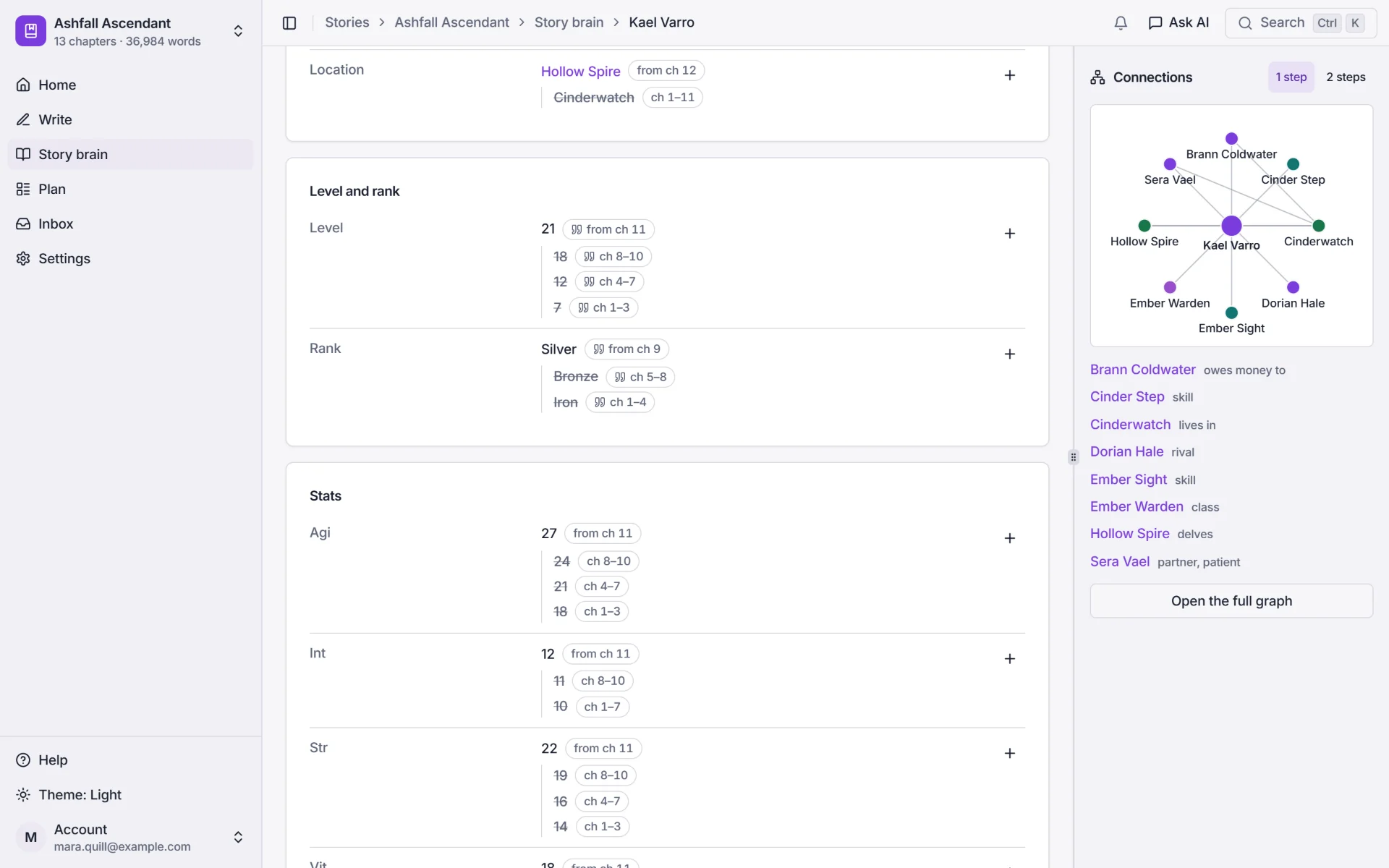
    A Story brain page in PlotWrite with a facts timeline showing Iron, Bronze and Silver rank by chapter
    From PlotWrite (sample story).
    7-day free trial

    Keeping a long serial straight is the hard part. PlotWrite remembers every rank, skill and secret in your story and checks each new chapter before you post. Works with the Claude or ChatGPT plan you already pay for. Free for 7 days.

    plotwrite.ink learns your writing style, keeps track of your characters and world rules, and can draft the next chapter in your voice with your Claude or ChatGPT plan or your own AI key. Built for Royal Road, Wattpad, and serial authors who post weekly.

    Start 7-Day Free Trial
    • No credit card
    • Cancel anytime
    • Full Architect access
    • Works with your Claude or ChatGPT plan or your own AI key

    Ready to try it on your own serial? Start 7-Day Free Trial

    How do NovelCrafter and PlotWrite pricing compare?

    NovelCrafter: $4/mo Hobby (BYOK only, limited features), $12/mo Standard, $24/mo Professional. All tiers require your own API key for AI calls.

    plotwrite.ink: $24/mo Architect (or $14/mo Storyteller, without Auto-write, learned Style DNA with Hard lock, and Craft). $240/year Architect or $140/year Storyteller. AI is never included or sold: you connect your own subscription, key or local model and pay that provider directly. 7-day free trial with everything included and no credit card.

    For a writer using their own API key, plotwrite.ink Architect + Anthropic runs $39–$79/mo all-in. NovelCrafter Pro + Anthropic runs $44–$84/mo. The cost edge is real but small. The real edge is a story brain that remembers your canon.
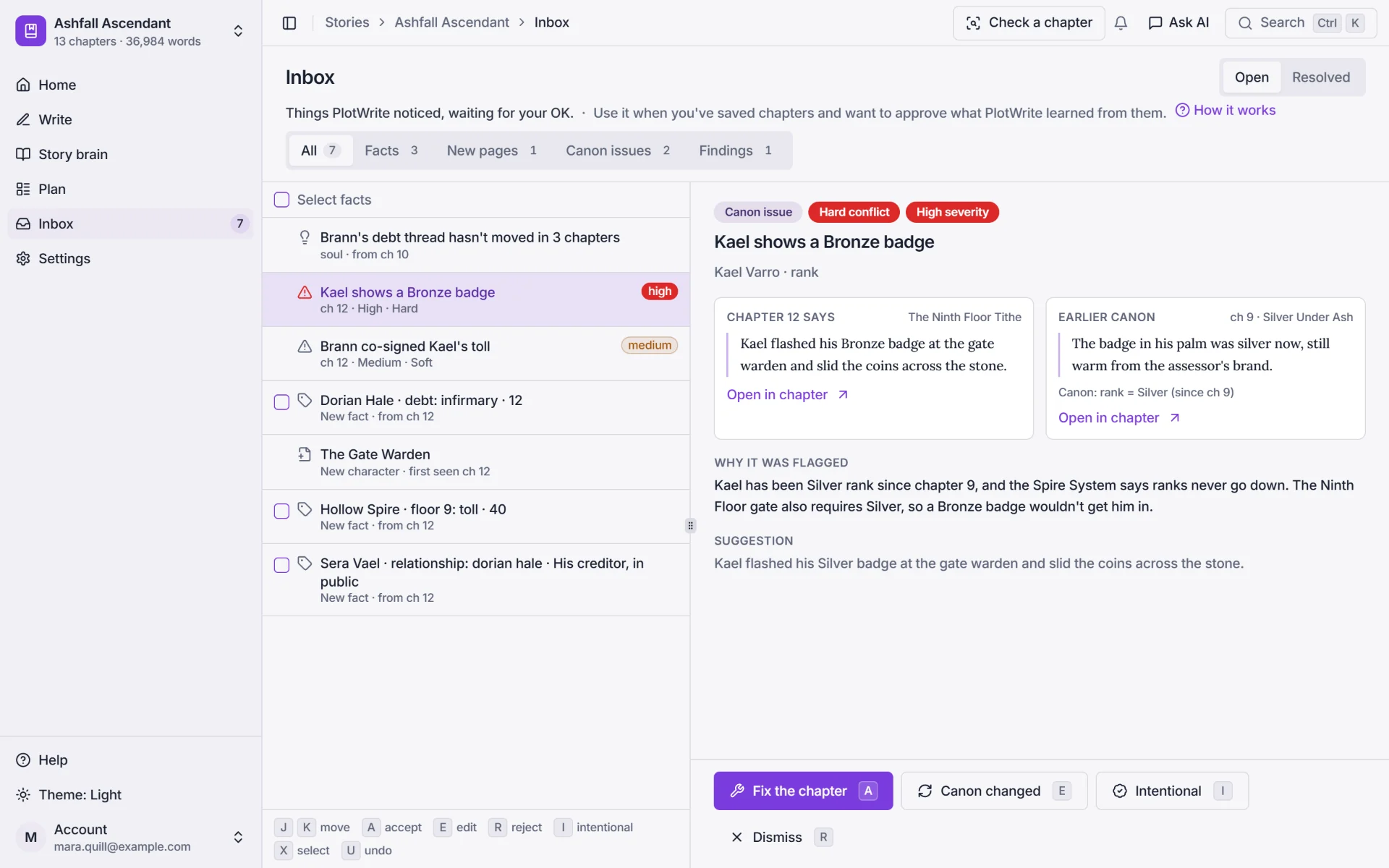
    The PlotWrite Inbox showing a canon issue with two conflicting quotes
    From PlotWrite (sample story).

    Should you pick NovelCrafter or PlotWrite?

    Pick NovelCrafter if you are writing a single novel for agent submission or KDP self-pub, you love the scene-card workflow, and long-running continuity is not your problem. Pick plotwrite.ink if you write a LitRPG, progression or cultivation serial on Royal Road, WebNovel, ScribbleHub, or Wattpad, and you want something that remembers every stat, rank and promise and catches the slip before your readers do.

    What's climbing Rising Stars, every Tuesday

    One short email a week: the serials climbing Royal Road's Rising Stars, why they're climbing, and one thing to borrow for your own launch. Free. Unsubscribe in one click.

    Frequently asked questions

    Can I migrate my NovelCrafter codex to plotwrite.ink?+

    Not as a direct codex import. Paste your existing chapters in and build your Story brain, which reads your chapters on your own AI and proposes the cast, places, and world rules for you to approve in the Inbox.

    Does plotwrite.ink support OpenRouter like NovelCrafter?+

    Yes. You can connect OpenRouter in one click, paste an API key (OpenAI, Anthropic, Google, Mistral, DeepSeek and more), use a local model with LM Studio, or use your ChatGPT or Claude subscription through the PlotWrite connector.

    Is NovelCrafter cheaper if I only write occasionally?+

    Yes. NovelCrafter Hobby at $4/mo is the cheapest BYOK option on the market. plotwrite.ink's lowest plan is Storyteller at $14/mo, because it is designed for active serial writers.

    Does NovelCrafter check my chapters for continuity errors?+

    NovelCrafter's codex is a reference you maintain by hand. PlotWrite's canon check reads your finished chapters, finds contradictions like a rank going backwards, and shows both quotes side by side.

    Do I need an AI tag on Royal Road if I use PlotWrite?+

    Not for memory, consistency checks or planning. Royal Road asks for an AI tag only if you paste AI-written prose into a chapter. See the Royal Road AI policy for details.

    Sources

    1. NovelCrafter pricing(novelcrafter.com)
    2. Royal Road AI text policy (blog #57)(royalroad.com)

    Continue reading

    Built for serial authors who want to earn

    PlotWrite remembers every rank, skill and secret in your story and checks each new chapter before you post. Works with the Claude or ChatGPT plan you already pay for, or your own AI key.

    No credit card required · Cancel anytime · Full Architect access · Works with your Claude or ChatGPT plan or your own AI key

    More from the blog