What is Sudowrite built for?
Sudowrite optimizes for the literary novelist. The default workflow is paragraph-by-paragraph: write a few sentences, hit 'Write More', edit the suggestion, repeat. The tools (Describe, Brainstorm, Rewrite) all assume you are working slowly and carefully on a single long-form manuscript.
That is appropriate for a 90,000-word standalone novel you will polish for six months before submitting to agents. It is not appropriate for a Royal Road serial that needs fresh chapters on a steady schedule with consistent canon, indefinitely.
What do serial writers actually need from an AI tool?
Three things Sudowrite does not provide. First, a voice that does not drift across hundreds of chapters. Voice drift over a long serial is exactly what readers notice, and comments flag the inconsistency.
Second, a persistent story memory that keeps itself current. Sudowrite has a Story Bible feature, but you maintain it by hand. Serial writers with 80+ characters, ranks, skills, complex systems, and 200+ chapters of canon struggle to keep up with that overhead.
Third, a check across chapters. Sudowrite's workflow is built around writing a scene or passage at a time. Serial errors happen between chapters: a rank that flips, an ally who changes sides for no reason. Whatever drafts the words, something has to compare each new chapter with everything before it.
Why is plotwrite.ink purpose-built for serials?
plotwrite.ink is the AI that reads your story, not the AI that writes it. You write. It remembers every stat, rank and promise, and catches the slip before your readers do.
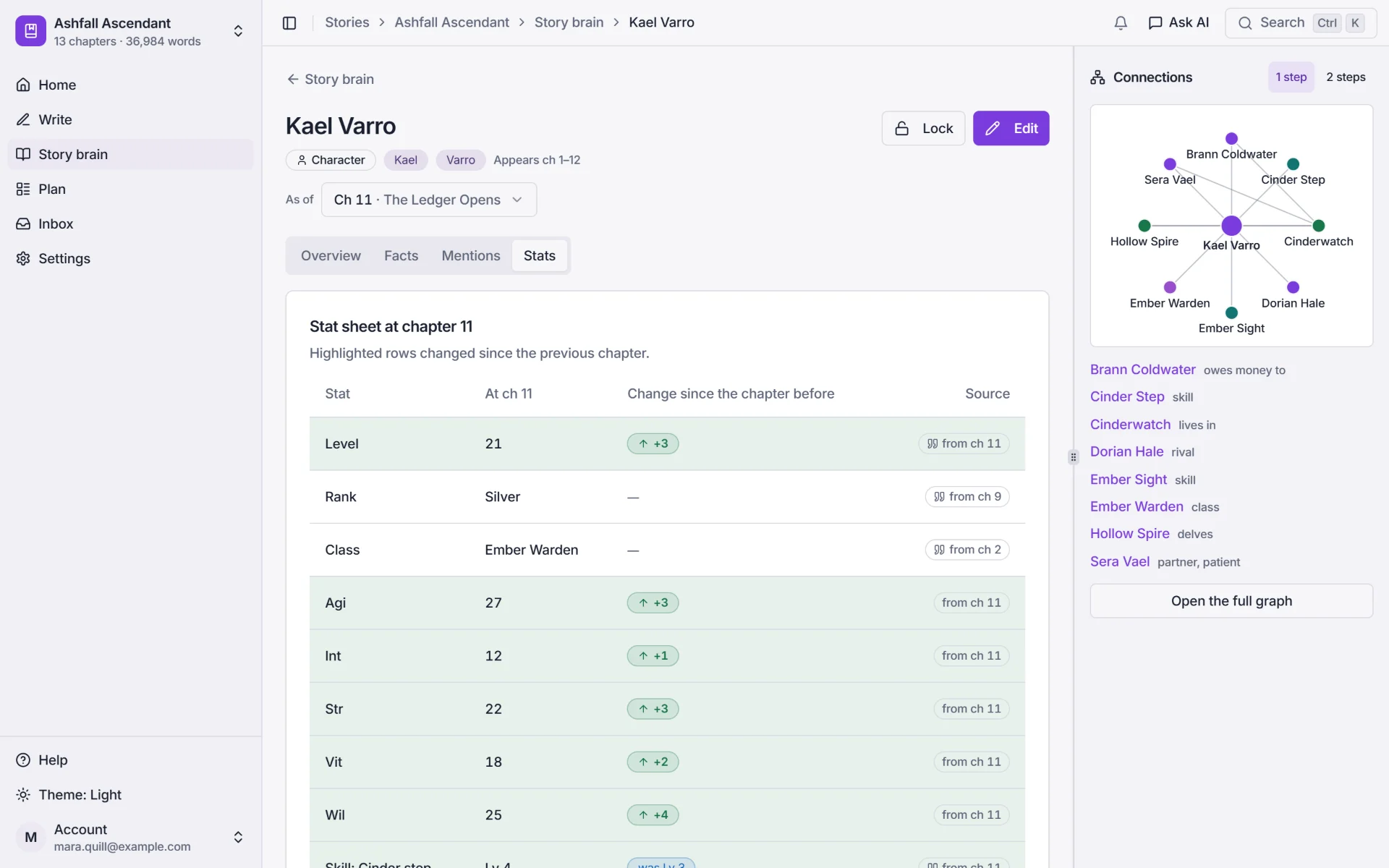
The Story brain is built from the chapters you've already written, by reading them on your own AI. It keeps a page per character, place, item, skill and faction. Facts are timed by chapter ("Silver rank from ch 9"), so a LitRPG stat sheet can show any character as of chapter N. Facts proposed from your chapters wait for your approval in the Inbox.
The canon check finds contradictions, such as a rank going backwards, a dead character walking, or a brother becoming a cousin. It shows both quotes side by side and offers a one-click fix previewed as a diff. The In-Between tracks every thread your story moves along and warns when one goes quiet.
Style DNA holds your POV, tense, own rules and an avoid list. On the Architect plan it also learns your voice from your chapters, and Hard lock makes every AI output follow it. Drafting with AI and Auto-write exist, but they are optional. See all of it on the features page.
AI is bring-your-own: use your ChatGPT or Claude subscription through the PlotWrite connector, connect OpenRouter or paste an API key, or run a local model with LM Studio. PlotWrite never charges for AI, so you pay your provider directly with no markup.
Keeping a long serial straight is the hard part. PlotWrite remembers every rank, skill and secret in your story and checks each new chapter before you post. Works with the Claude or ChatGPT plan you already pay for. Free for 7 days.
plotwrite.ink learns your writing style, keeps track of your characters and world rules, and can draft the next chapter in your voice with your Claude or ChatGPT plan or your own AI key. Built for Royal Road, Wattpad, and serial authors who post weekly.
- No credit card
- Cancel anytime
- Full Architect access
- Works with your Claude or ChatGPT plan or your own AI key
Ready to try it on your own serial? Start 7-Day Free Trial
What did my own launch teach me about choosing a tool?
I launched my own progression-fantasy serial on Royal Road with an early version of Auto-Write: 29 chapters and 81,381 words in the first seven days. Then readers caught what the speed hid. The main character's brother changed identity and rank, the timeline didn't add up, and allies switched sides for no reason. The rating fell to about 2 stars, and I hadn't tagged the story as AI-generated, which Royal Road asks for.
The lesson for choosing a tool: drafting speed is the easy part. A serial needs something that remembers the story and checks each chapter against it. That's what plotwrite.ink is built around now. Memory, consistency checks and planning count as back-office help under Royal Road's AI policy, so no AI tag is needed for them. Pasting AI-written prose into a chapter does mean Royal Road asks for an AI tag. See Royal Road's AI policy explained.
The full write-up is at the 81,000-word case study.
How do Sudowrite and PlotWrite pricing compare?
Sudowrite: $19/month Hobby (225k AI words), $29/month Professional (1M words). Word caps apply.
plotwrite.ink: $14/month Storyteller or $24/month Architect (adds Auto-write, learned Style DNA with Hard lock, and Craft). Annual prices are $140 and $240. There are no per-word caps, and AI runs on your own subscription, key or local model, billed by your provider (your provider's own limits still apply). Every plan starts with a 7-day free trial with no card.
For serial writers shipping a lot of words per week, bringing your own AI is usually cheaper at volume. For novelists shipping 5k words per week, the price gap is irrelevant, and Sudowrite's UX may suit you better.