Skip to content

    For cultivation and xianxia authors

    Every realm, stage and sect elder, right as of any chapter.

    Qi Condensation, Foundation Establishment, Core Formation: PlotWrite keeps each character's realm and stage, techniques, sect standing and Dao insights as facts timed by chapter, checks new chapters against them, and plans the road to the next breakthrough.

    The AI that reads your story, not the AI that writes it.

    • No card needed
    • Cancel anytime
    • PlotWrite never charges for AI
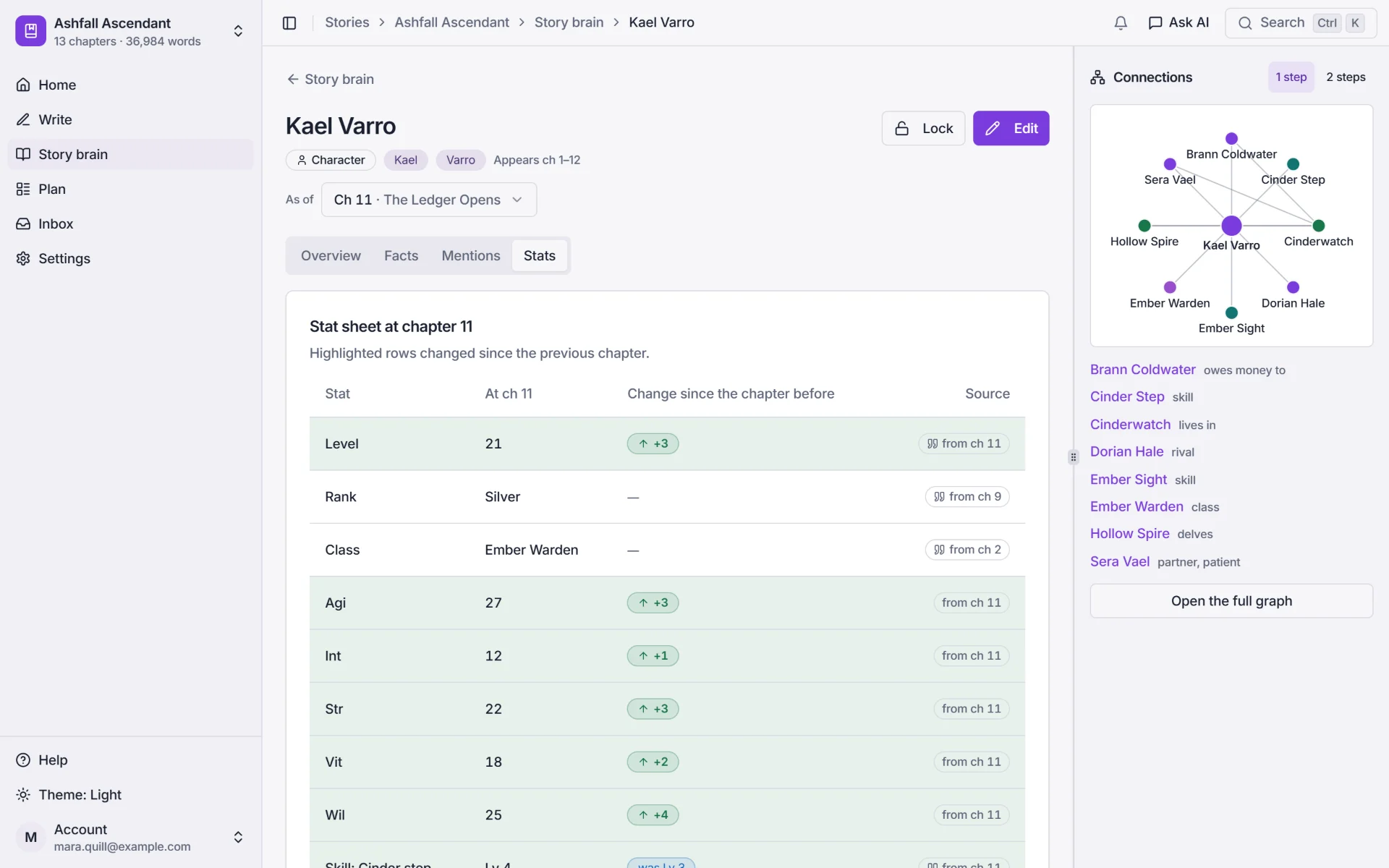
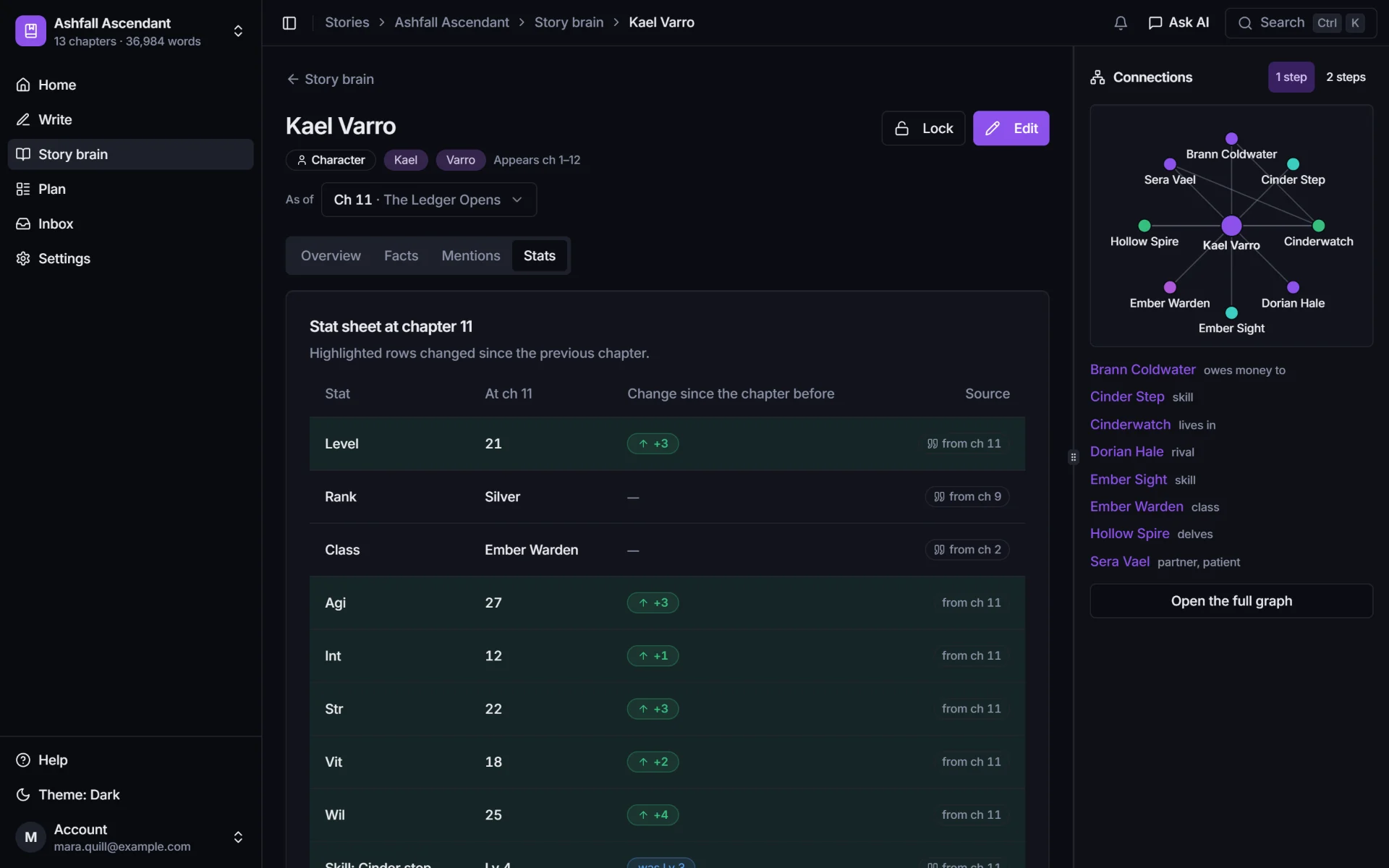
    Kael Varro's stat sheet at chapter 11: level 21 (up 3), rank Silver, class Ember Warden, AGI 27 (up 3), INT 12 (up 1), STR 22 (up 3), VIT 18 (up 2), WIL 25 (up 4), each with the chapter it came from.

    Screens from PlotWrite running on a made-up sample serial, Ashfall Ascendant, whose ranks go Iron, Bronze, Silver. Realms and stages are kept the same way, under your own names.

    The problem

    A cultivation world has a lot to remember.

    Nine realms with three stages each, two sects, a dozen elders and a technique for every occasion. Somewhere around chapter 100, something slips.
    • A realm or stage slips

      He reached the peak of a realm in one chapter and is back at its middle stage thirty chapters later, with no injury to explain it.

      Ch 112He had reached the peak of Foundation Establishment.

      Ch 140As a mid-stage Foundation Establishment cultivator, Lin knew better.

    • Sect politics tangle

      Who is whose senior brother, which elder backs which faction, and who answers to the Inner Court. Readers keep their own charts.

      Ch 30Elder Mo is the Outer Court's only Nascent Soul.

      Ch 95Elder Mo, a Core Formation elder of the Inner Court, nodded.

    • A technique forgets its price

      A technique with a cost is the best kind. Then a fight needs it three times, and the cost quietly disappears.

      Ch 44Each strike of the Nine Suns Palm burns a year of his lifespan.

      Ch 79He threw the Nine Suns Palm again, and again, and again.

    Made-up examples of the slips this genre makes.

    How PlotWrite helps

    How PlotWrite keeps the Dao straight.

    A memory of every realm, sect and technique by chapter, a check that reads each chapter against it, and a plan for the road between breakthroughs.

    Realms and stages as of any chapter

    A page for every cultivator, sect and technique.

    Every realm and stage, technique, sect rank and Dao insight is a fact with the chapter it became true. Pick a chapter and see the world as it stood then.

    • A character's full climb: each realm and stage, and the chapter it was reached.
    • Sects, elders and disciples linked to each other, with a graph of who connects to whom.
    • Techniques with their costs and limits, quoted from the chapter that set them.
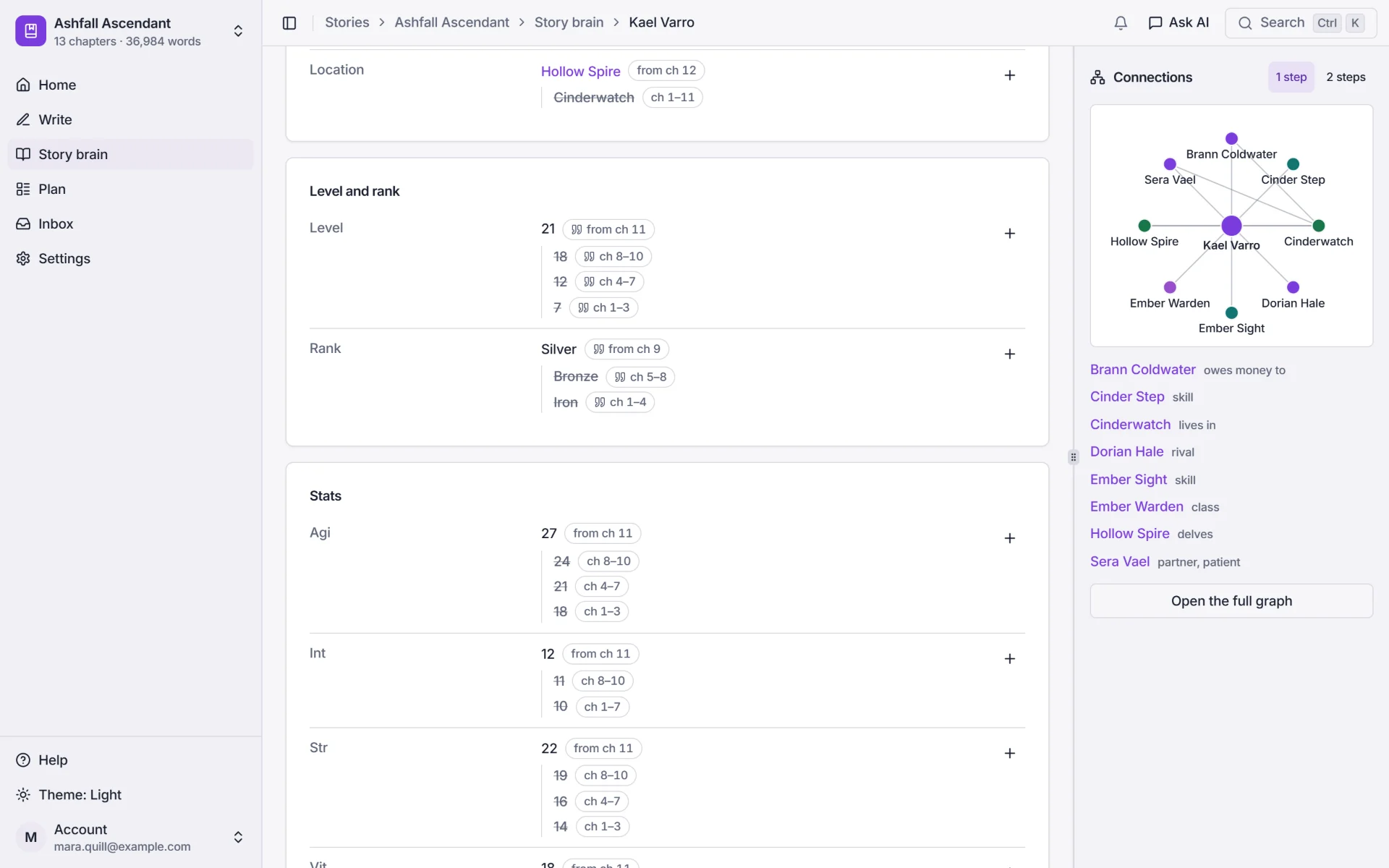
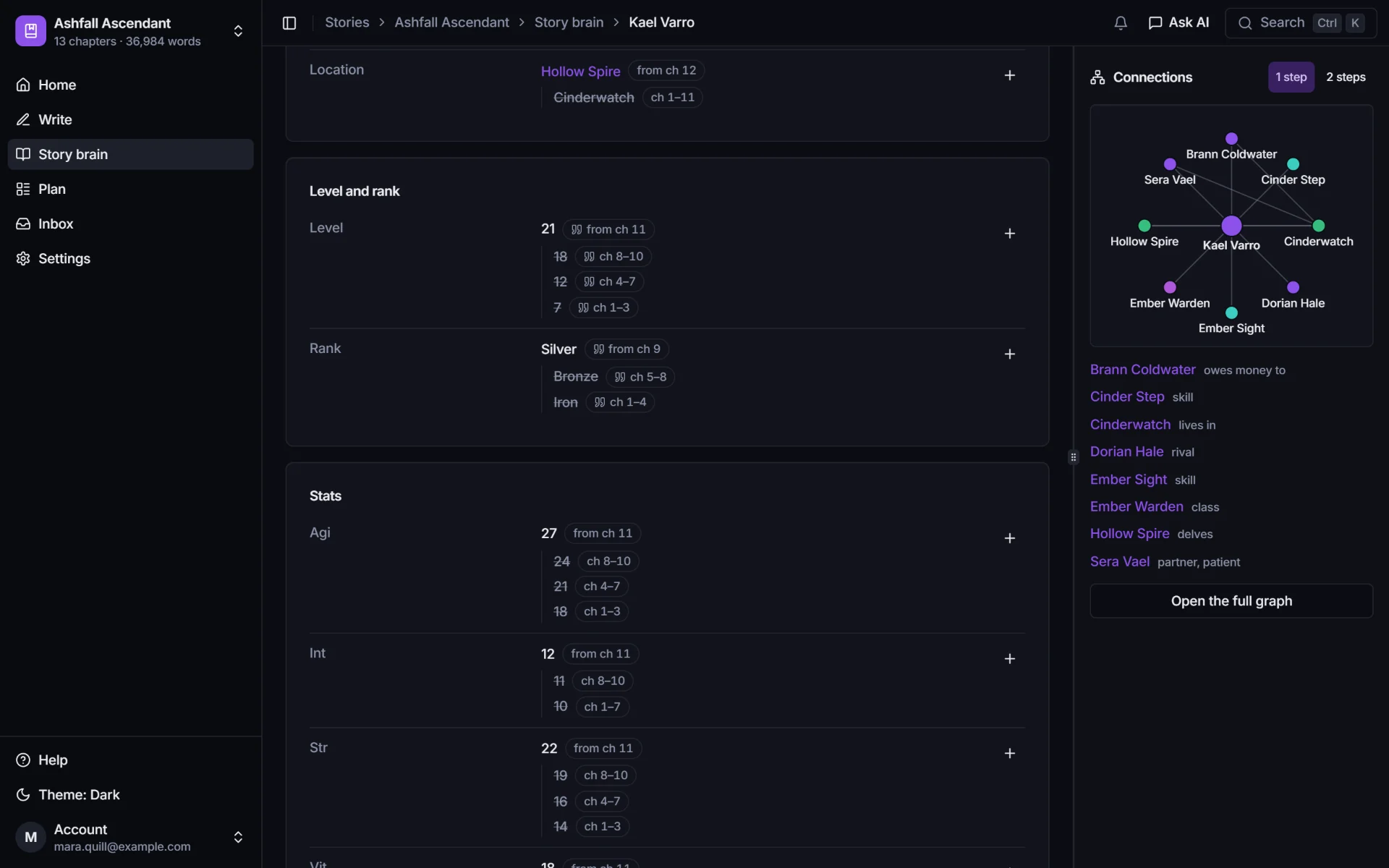
    Kael Varro's level and rank history in the story brain: level 21 from chapter 11 (18 in chapters 8 to 10, 12 in 4 to 7, 7 in 1 to 3), and rank Silver from chapter 9 (Bronze in 5 to 8, Iron in 1 to 4). Below, his stats with their own history.
    A graph of Kael's connections: Sera Vael, Brann Coldwater, Dorian Hale, Hollow Spire, Cinderwatch and his skills.

    Canon check

    Catches the slipped stage and the forgotten cost.

    Check a chapter and PlotWrite compares it with what was true at that point: a stage that went backwards, an elder in the wrong court, a technique used without its price.

    • Both quotes side by side: this chapter, and the earlier line it contradicts.
    • Fixes previewed as a change, never applied without you.
    • A cultivation deviation that set him back on purpose? Mark it intentional.
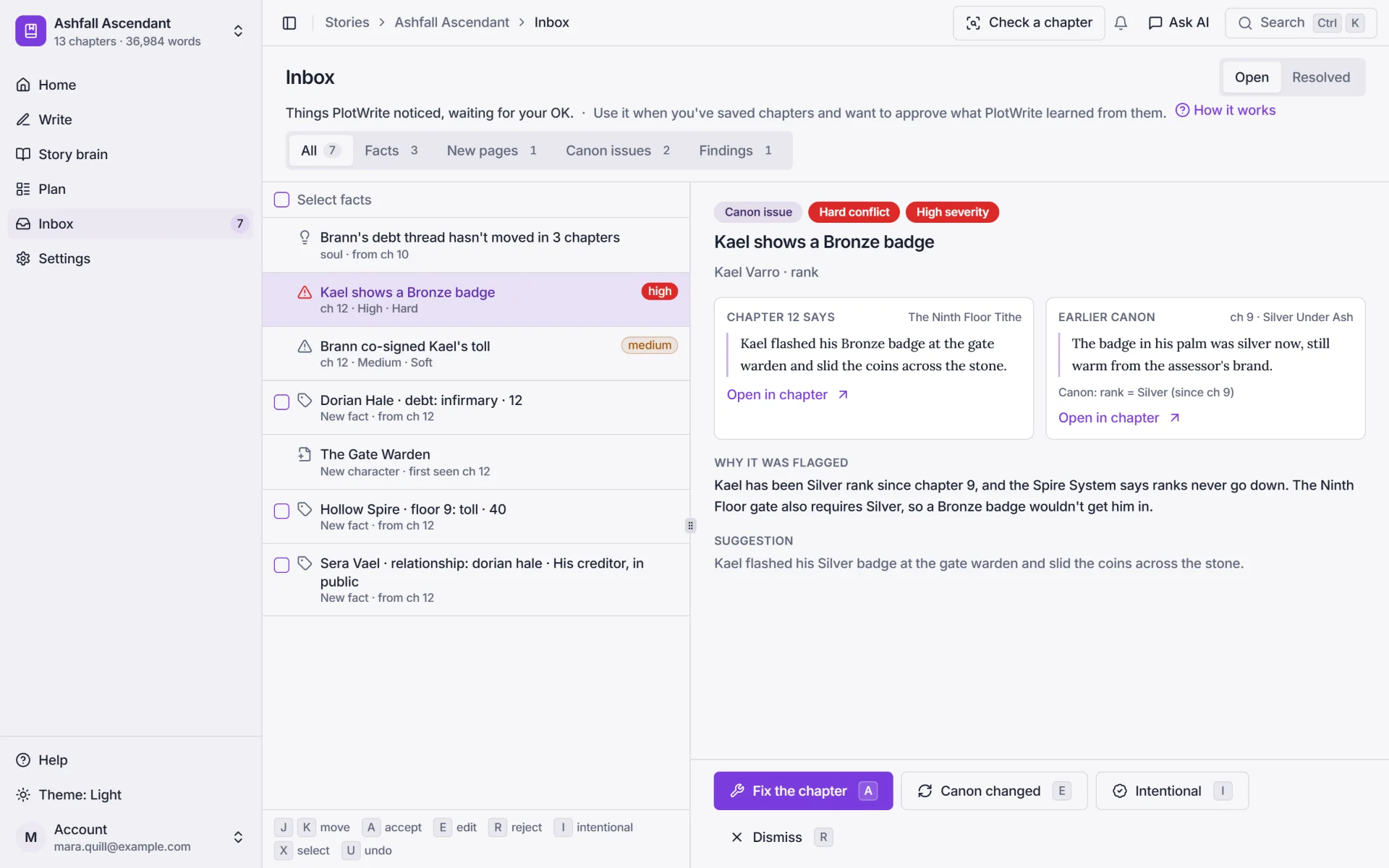
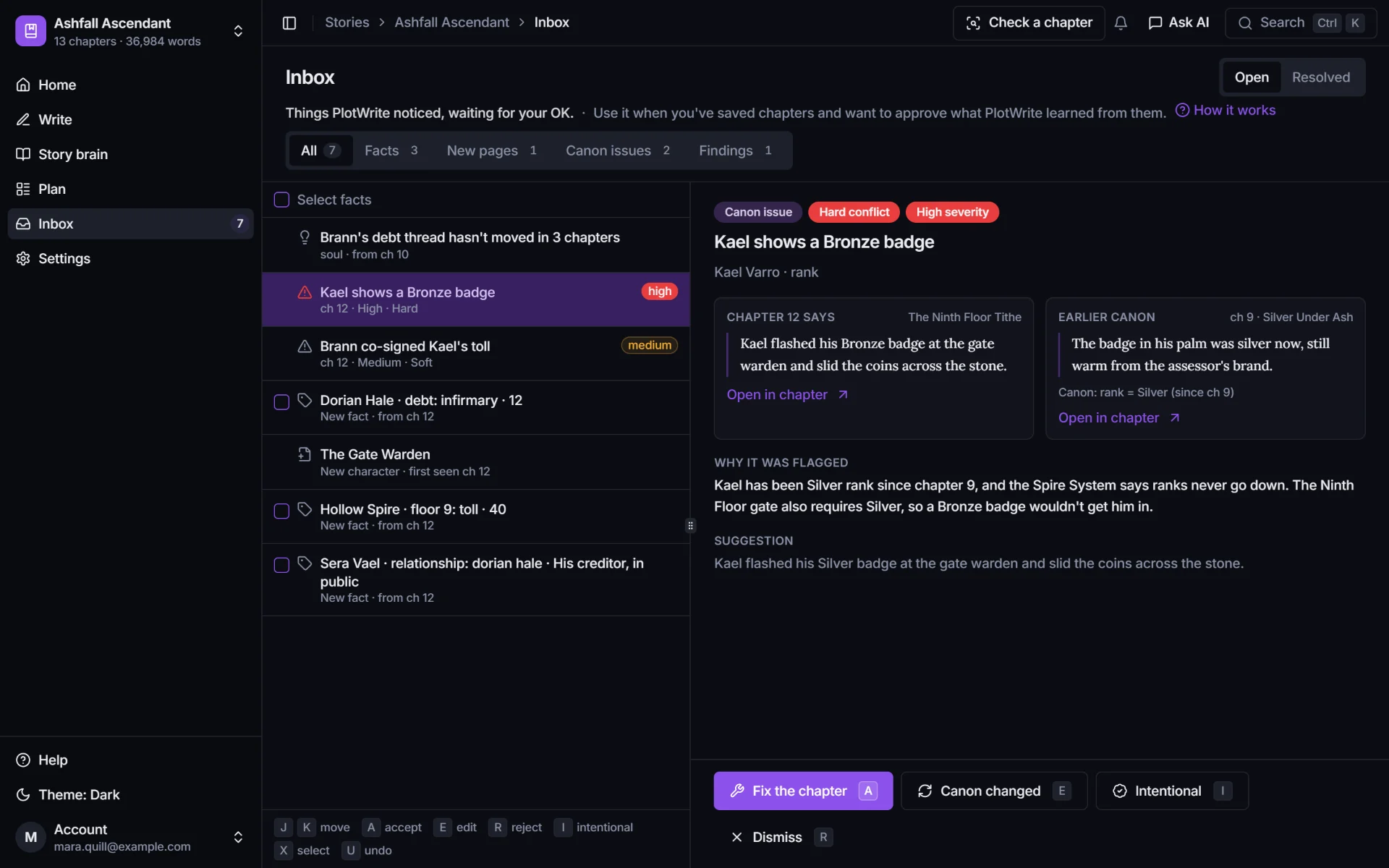
    The Inbox with a high-severity canon issue: chapter 12 says Kael flashed his Bronze badge, while earlier canon from chapter 9 says the badge in his palm was silver now.
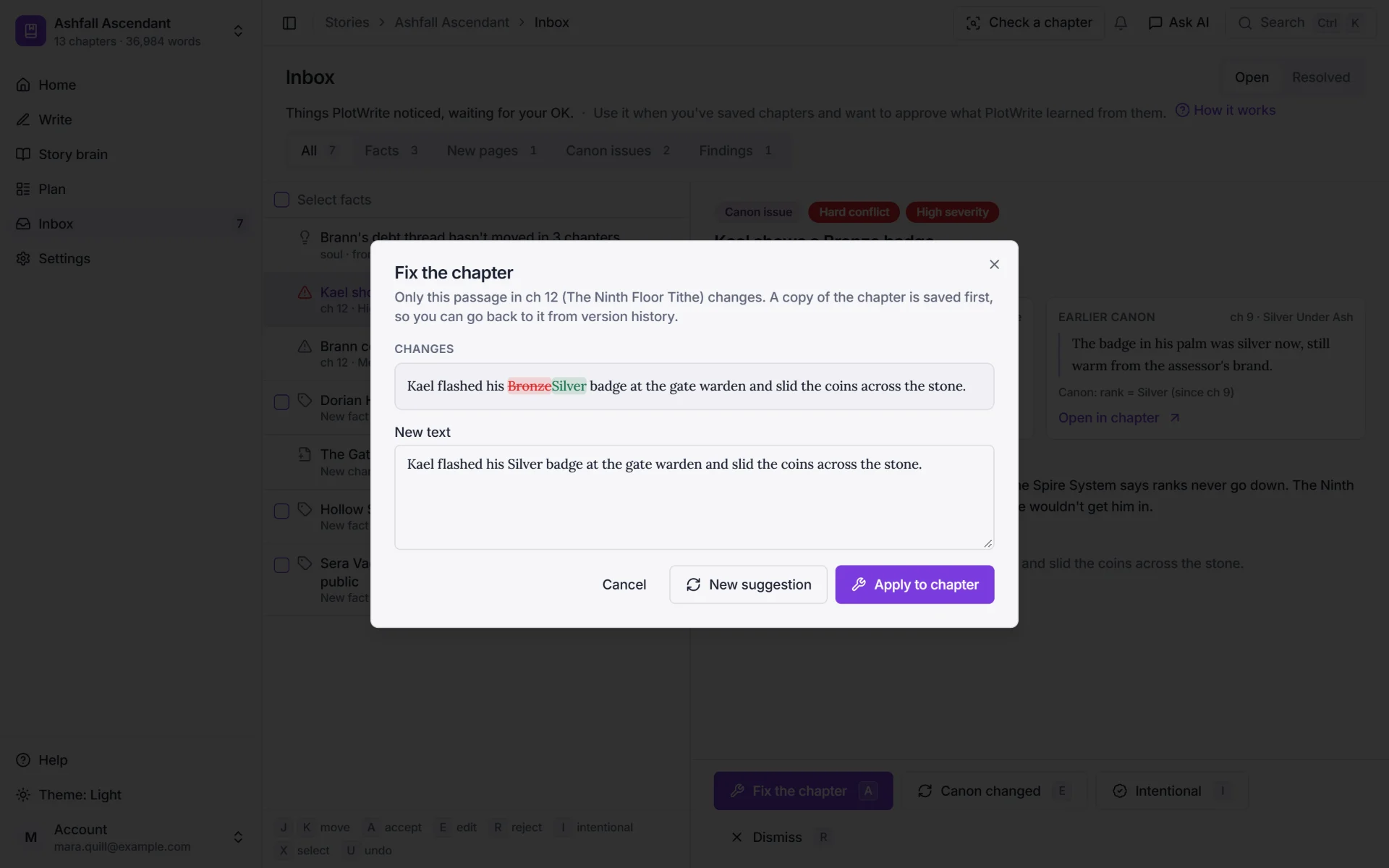
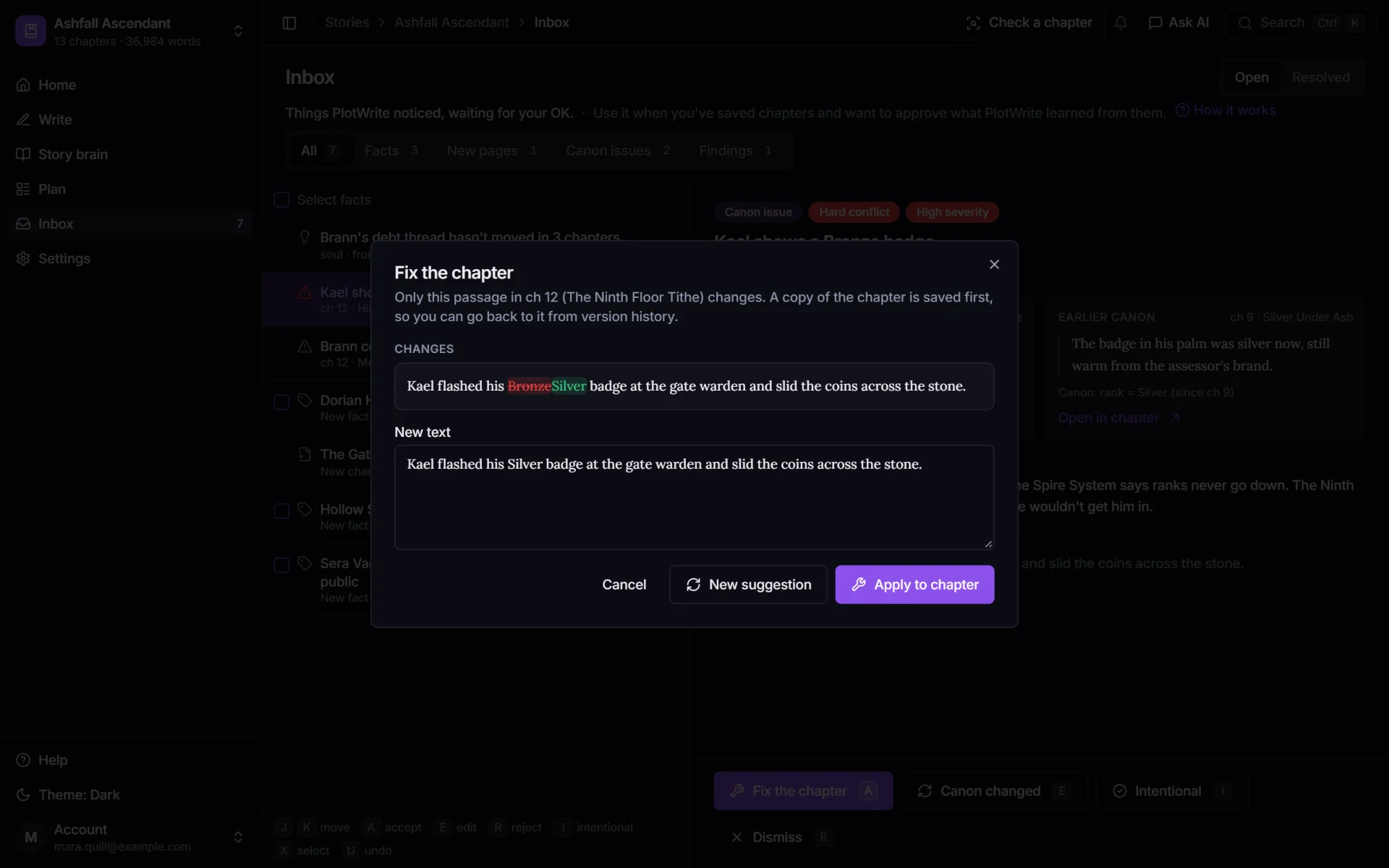
    The previewed fix: Bronze is struck out and Silver put in its place, before anything changes in the chapter.

    Plan the road to the breakthrough

    Seclusion, tribulation, the sect tournament: planned.

    Put the next arc's beats on a board, tie each one to a chapter, and brainstorm with a chat that has read your story brain: which elder owes whom, which realm, which thread is quiet.

    • Ideas, beats and arc goals, moved from Idea to Approved to Used.
    • The In-Between shows each thread from A to B, so the breakthrough has a road to it.
    • Ideas save to Plan, never straight into your canon or your chapters.
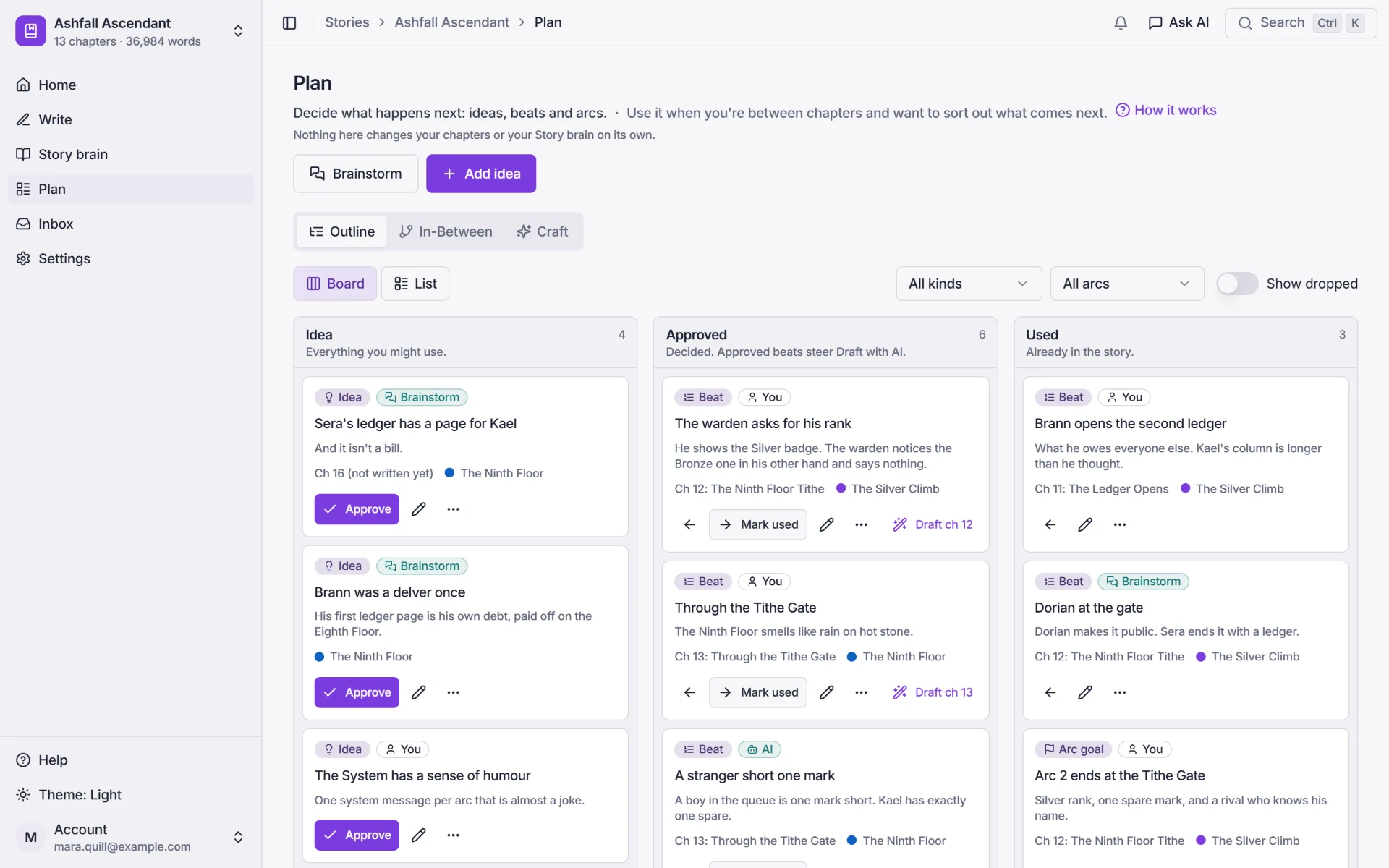
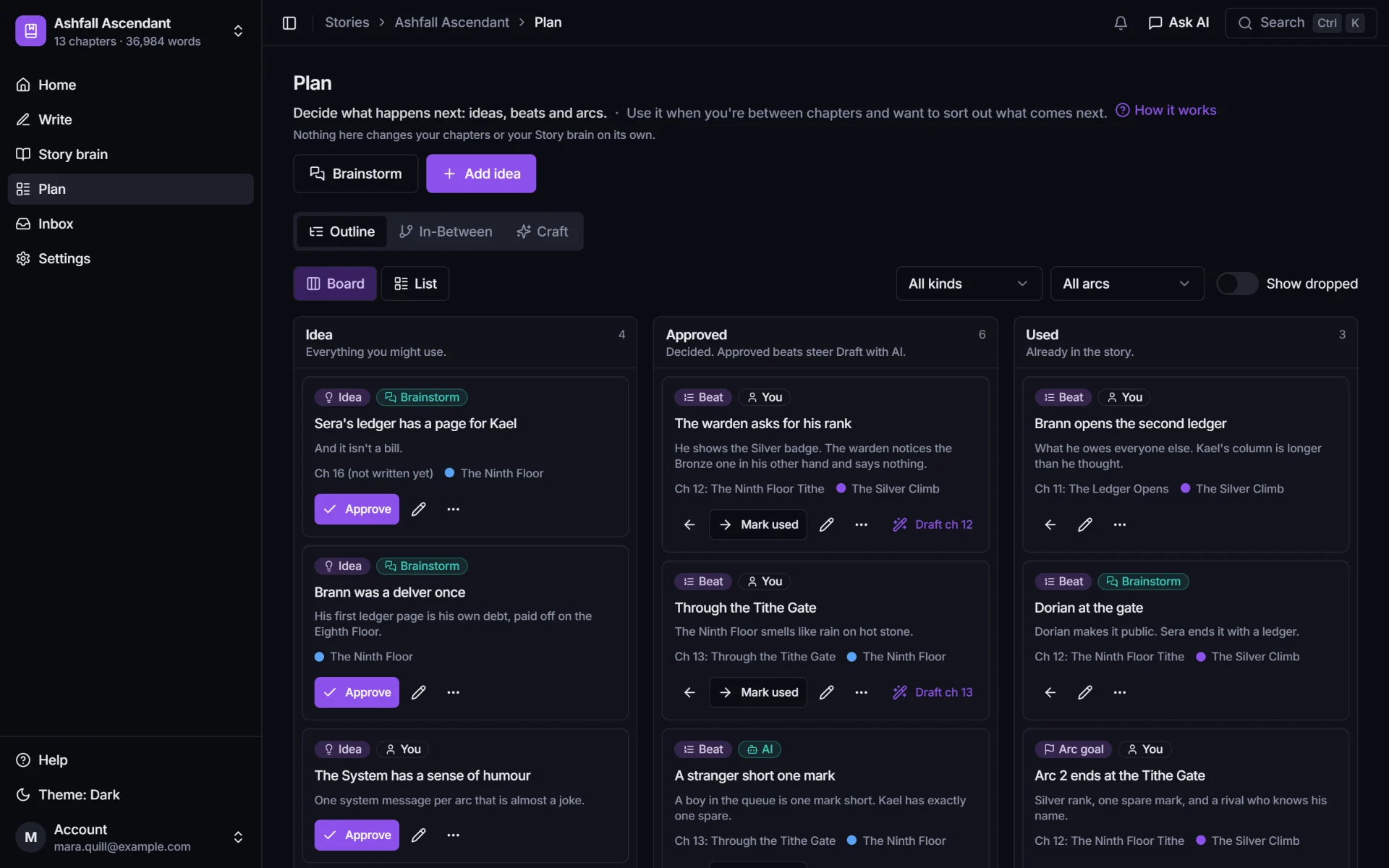
    The Plan board in three columns, Idea, Approved and Used: beats each tied to a chapter and an arc.
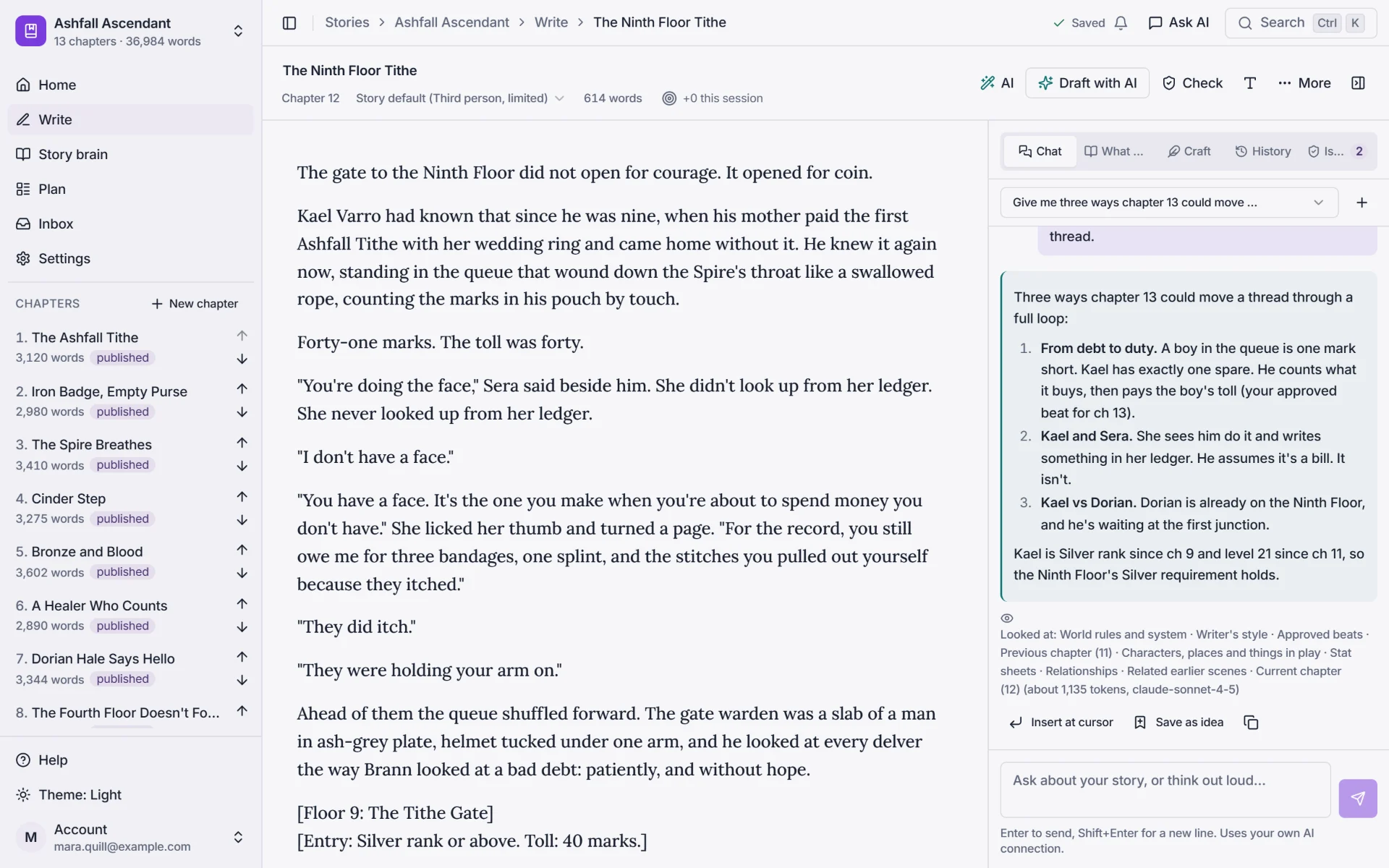
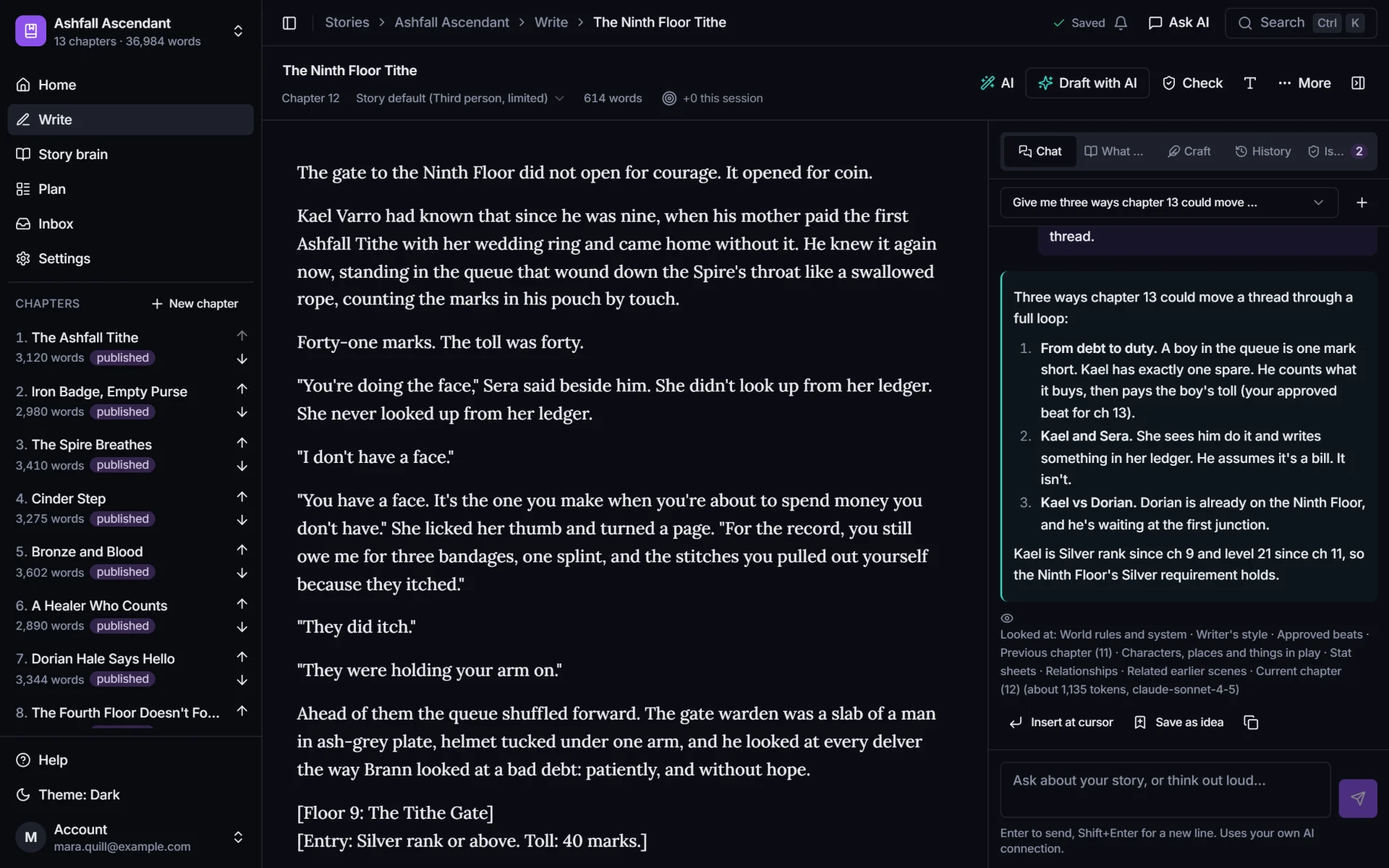
    The chat beside the editor suggests three ways the next chapter could move a thread, and lists what it looked at in the story brain.

    Realms, sects and the Dao

    Everything a cultivation reader keeps a chart of.

    Cultivation readers know the realm ladder by heart. PlotWrite keeps the chart for you, timed by chapter.
    • Realms and stages

      Your ladder, your names.

      • Each character's realm and stage, with the chapter of every breakthrough.
      • A later breakthrough never leaks into an earlier chapter.
    • Sects and seniority

      Who outranks whom, and since when.

      • Sects, courts, elders and disciples, each with their own page and [[links]].
      • A senior brother stays a senior brother until a chapter says otherwise.
    • Techniques and Dao insights

      What it does, what it costs, who knows it.

      • Techniques with their limits, quoted from the chapter that set them.
      • Dao insights and comprehension as facts with a chapter attached.

    Royal Road's AI policy

    The AI that reads your story, not the AI that writes it.

    Royal Road says you don't need to mention back-office help from an AI, like brainstorming or research, and that you do need to tag text an AI wrote. Memory, checks and planning never put a word in your chapters. Drafting is there if you want it, and we'll tell you plainly when it means a tag.

    Every feature mapped to the policy The tag rules, explained

    Back-office: no tag

    • The story brain and stat sheets
    • The canon check and the Inbox
    • The In-Between, Plan and the brainstorm chat

    Pasted AI prose: tag it

    • Draft with AI and Auto-write
    • AI rewrites of your paragraphs, used a lot

    Optional: nothing is drafted unless you ask. Royal Road decides the rules and can change them.

    No API key needed

    Bring the subscription you already have.

    Most writing tools sell AI credits or ask for an API key. Connect your Claude Pro or Max, or ChatGPT Plus plan in 3 steps: your plan does the writing, and PlotWrite keeps the story.

    • ClaudePro or Max
    • ChatGPTPlus or Pro

    Anthropic and OpenAI decide which plans can add connectors. Details in the FAQ.

    1. 1

      Add PlotWrite as a connector

      In Claude or ChatGPT, add a custom connector and paste the PlotWrite URL from your settings.

    2. 2

      Sign in to PlotWrite

      Approve it once. That's the whole setup.

    3. 3

      Write in Claude or ChatGPT

      Ask for chapter 13. It reads your story brain, Style DNA and threads, and saves the draft to PlotWrite for you to accept.

    Prefer your own key? Connect OpenRouter in one click, paste any API key, or run a local model with LM Studio.

    Questions

    Cultivation writers ask

    Can PlotWrite handle my own realm system?
    Yes. Realms, stages and their names are yours. PlotWrite keeps each character's realm and stage as facts timed by chapter, so it doesn't matter whether your ladder has three realms or twelve.
    Does it work for xianxia, wuxia and murim stories?
    Yes. Anything with ranks, sects, techniques and a long cast fits the same model: a page for every character, sect and technique, facts with the chapter they became true, and a canon check against them.
    I'm already 200 chapters in. Do I have to type everything in?
    No. Paste or upload the chapters you've posted (.txt or .md) and PlotWrite splits them at the chapter headings. Then it reads them on your AI and proposes facts, each with the line it came from. You approve them in the Inbox. Nothing becomes canon until you say so.
    Do I have to tag my story as AI on Royal Road if I use PlotWrite?
    Not for the story brain, the canon check or planning. Royal Road's AI policy says you don't need to mention back-office assistance such as brainstorming or research, and you do need to say so when you copy AI-written text into your story. PlotWrite's memory, checks and plans never put words in your chapters. If you paste prose from Draft with AI or Auto-write into a chapter, tag it the way Royal Road asks. Rules can change, so check Royal Road's current policy before you publish.
    Do I need an API key or AI credits?
    No. Add PlotWrite as a connector in Claude or ChatGPT and sign in once: your existing plan runs the model, and PlotWrite gives it your chapters and story brain. You can also connect OpenRouter in one click, paste an API key, or run a model on your own computer with LM Studio. PlotWrite never charges for AI.

    Bring your AI. PlotWrite brings the memory.

    • Your ChatGPT or Claude plan, your key, or your own computer
    • A story brain that knows every chapter
    • Nothing becomes canon without your approval
    • No card needed
    • Cancel anytime
    • PlotWrite never charges for AI

    Questions about plans, keys or the connector? Read the FAQ