Skip to content

    For GameLit authors

    Every game mechanic, every stat, and a clean line between the game and the real world.

    PlotWrite is writing software for GameLit. It reads the chapters you've written and keeps the game's mechanics, each player's stats and skills, and what happens on each side of the logout screen as facts timed by chapter. Before you post, it checks the new chapter against them.

    The AI that reads your story, not the AI that writes it.

    • No card needed
    • Cancel anytime
    • PlotWrite never charges for AI
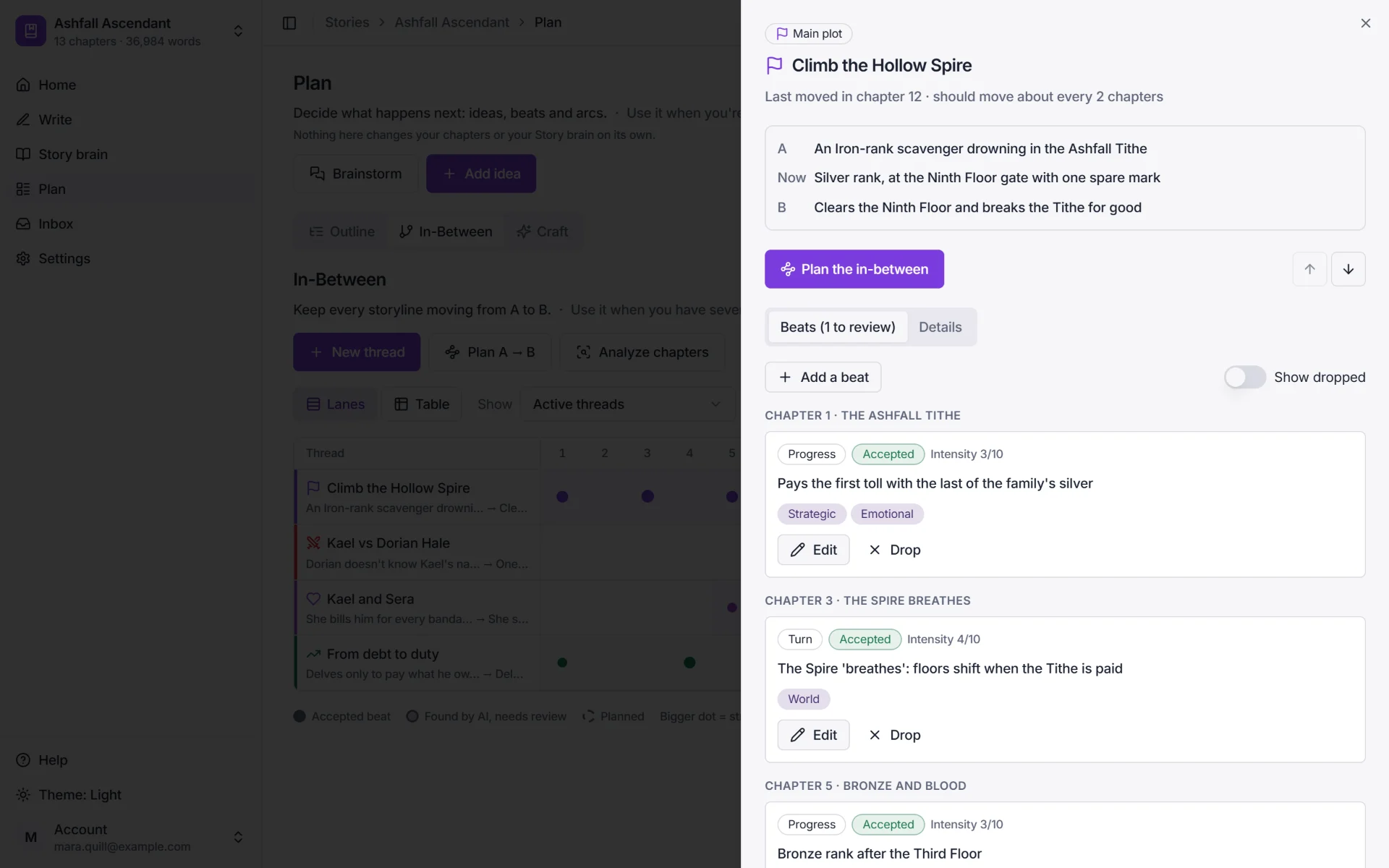
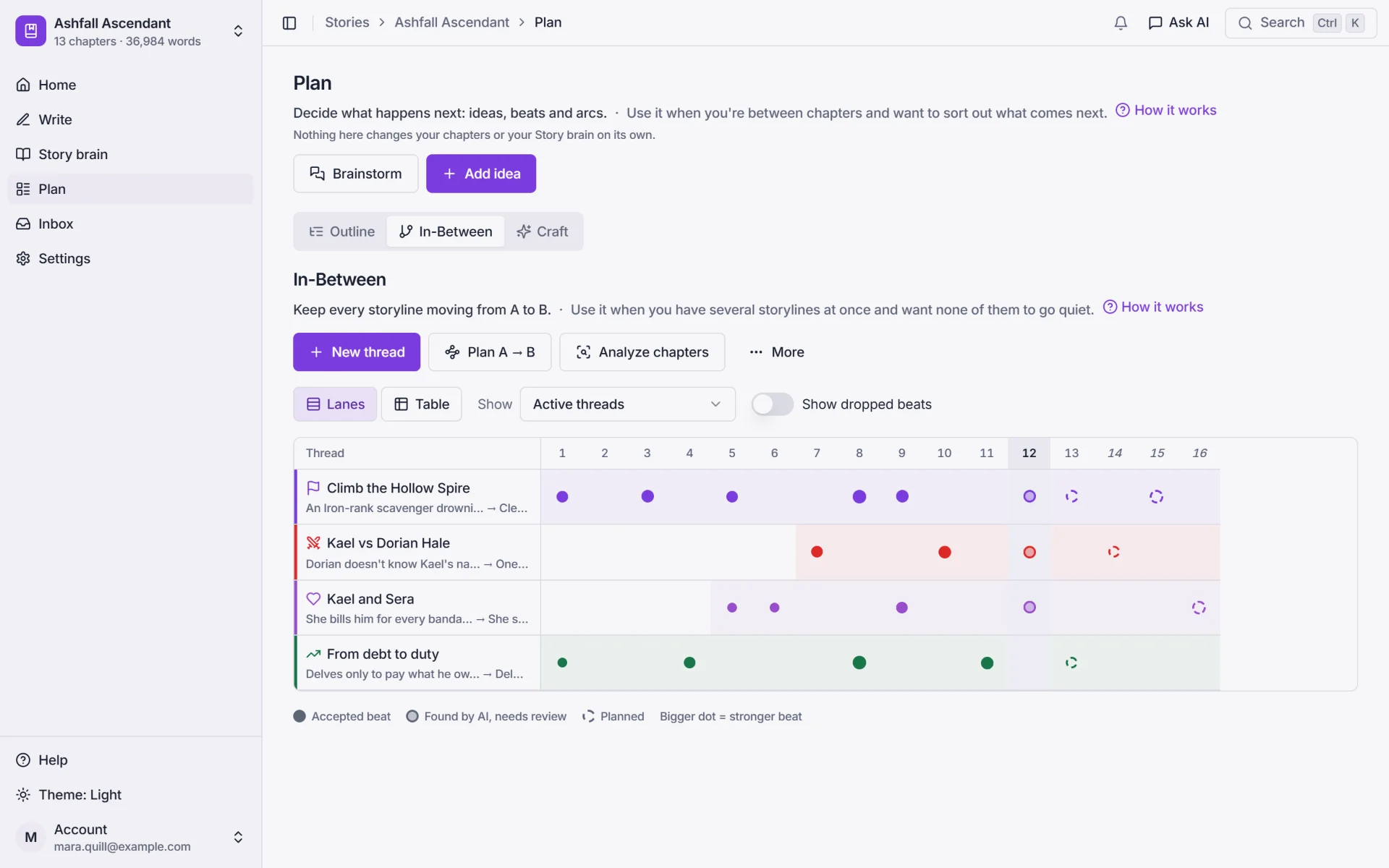
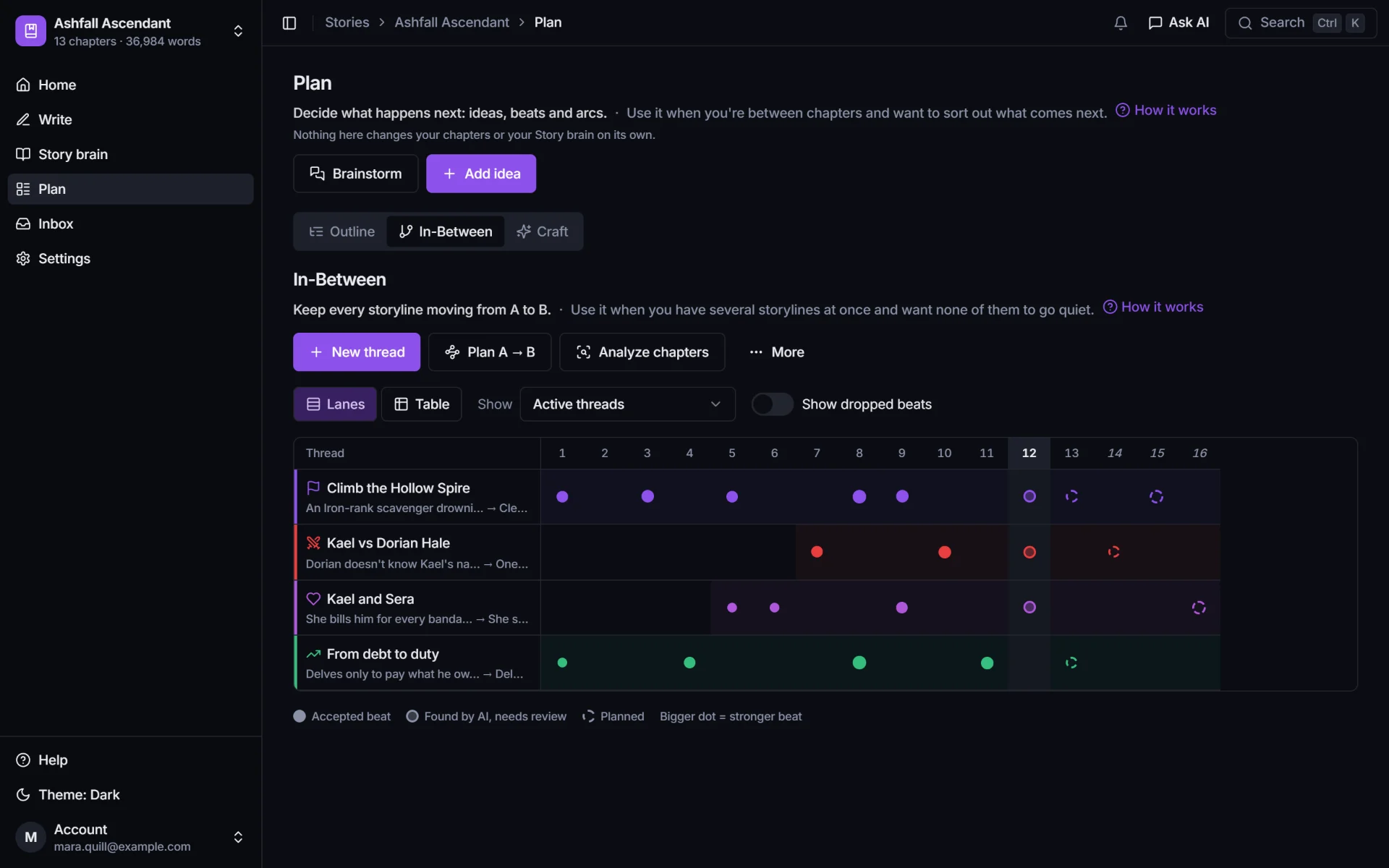
    The In-Between swimlanes: four threads (Climb the Hollow Spire, Kael vs Dorian Hale, Kael and Sera, From debt to duty) across chapters 1 to 16, with a dot for each chapter that moved them and dashed rings for planned beats.
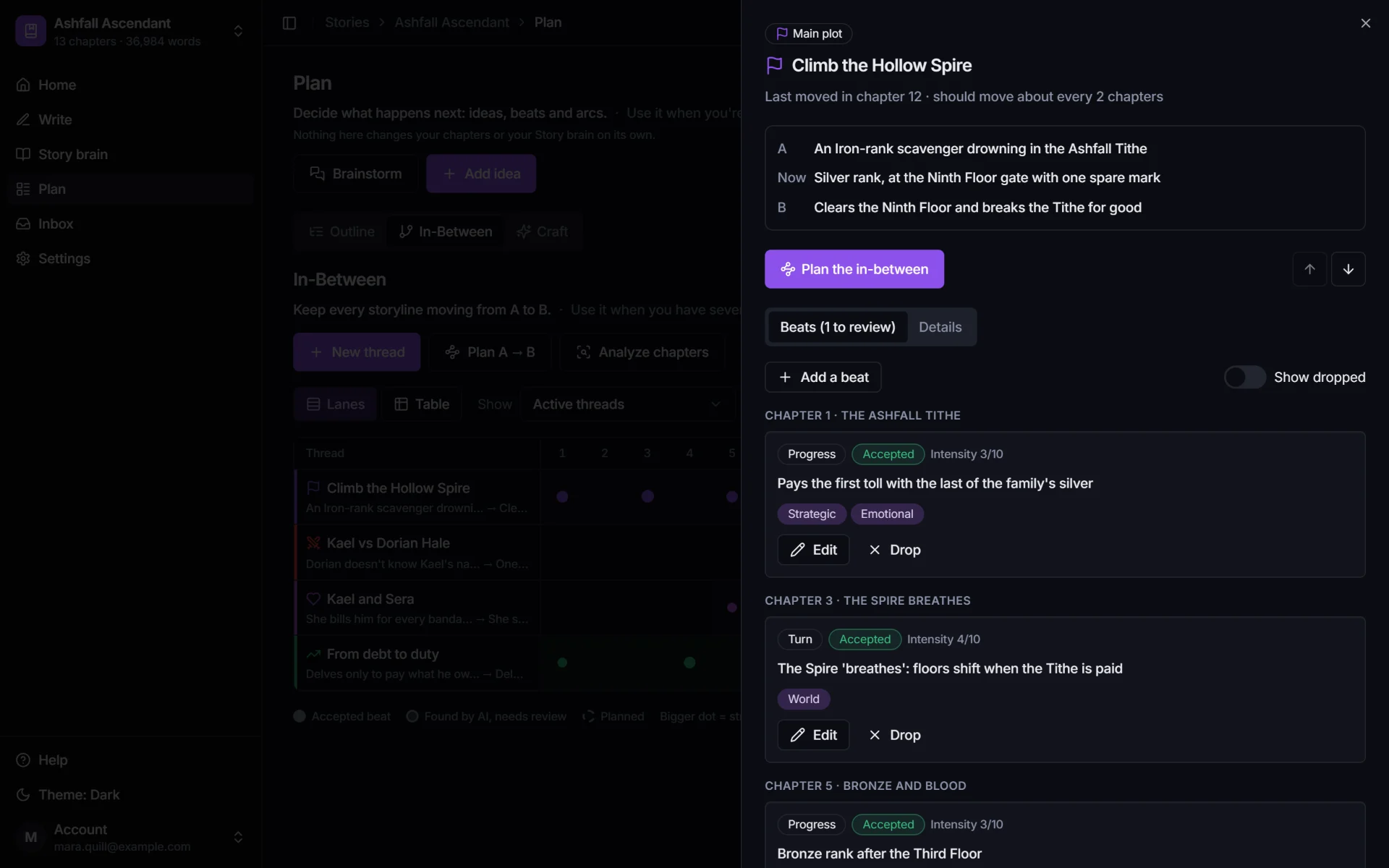
    One thread, Climb the Hollow Spire: A, an Iron-rank scavenger drowning in the Ashfall Tithe; now, Silver rank at the Ninth Floor gate; B, clears the Ninth Floor and breaks the Tithe. It last moved in chapter 12 and should move about every 2 chapters.

    The In-Between on a made-up sample serial, Ashfall Ascendant: four threads across sixteen chapters. In a GameLit serial, the in-game quest and the real-world plot each get a lane.

    The problem

    Where does a GameLit story slip?

    Many GameLit readers play the kind of game you're writing about. They know how cooldowns and patches work, and they notice when the game, or the world outside it, stops following its own rules.
    • A mechanic forgets how it works

      A skill had a cooldown when it was introduced. Fifteen chapters later the boss fight needs it twice in a row.

      Ch 12[Shadow Lunge: 5-minute cooldown]

      Ch 27He used Shadow Lunge, then used it again as the boss turned.

    • The line between worlds blurs

      A player's real name is a secret inside the game. Then someone in the guild uses it before anyone told them.

      Ch 14Nobody in the guild knew Dana's real name. She meant to keep it that way.

      Ch 36"Nice try, Dana," the guild master said in party chat.

    • A patch doesn't stick

      The game patched a mechanic mid-story. A few chapters later the old version is back, because your notes never caught up.

      Ch 40[Patch 1.2: Crafting no longer costs tool durability.]

      Ch 46After a night of crafting, her hammer was close to breaking.

    Made-up examples of the slips this genre makes.

    How PlotWrite helps

    How do you keep game mechanics consistent in GameLit?

    Give every mechanic, stat and patch the chapter it became true, keep track of who knows what on each side of the screen, and check every new chapter before you post. PlotWrite does all three from the chapters you've written.

    Stats and skills as of any chapter

    Every player's sheet, at the chapter you're writing.

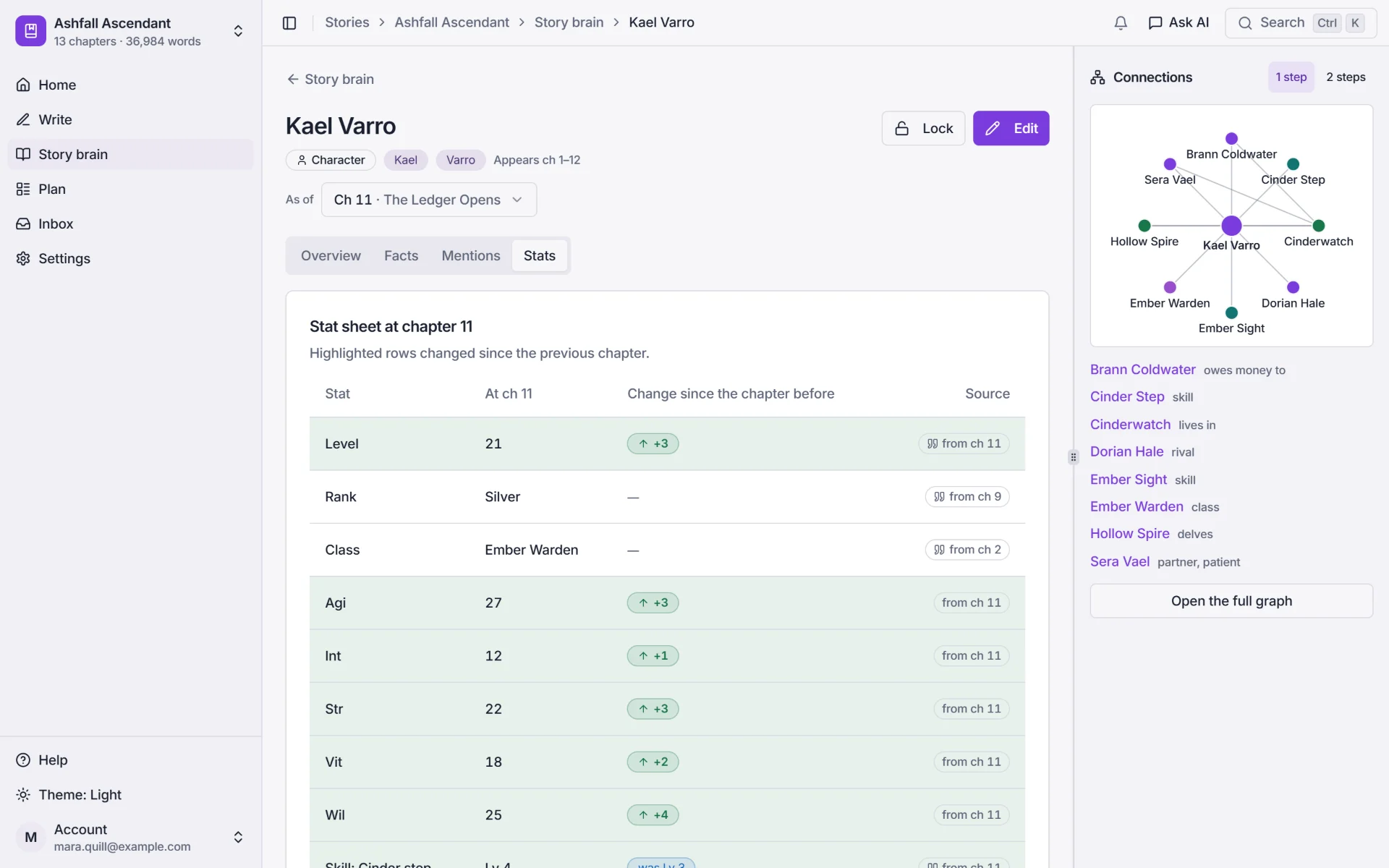
    Levels, stats, skills, classes and items are facts with the chapter they became true. Pick a chapter and see the sheet as your readers saw it then.

    • Your game's own stat names, whether it shows every number or only a few.
    • Skills keep the costs and cooldowns quoted from the chapter that set them.
    • Ask your story "what level was she at in chapter 9?" and get the answer from your own chapters.
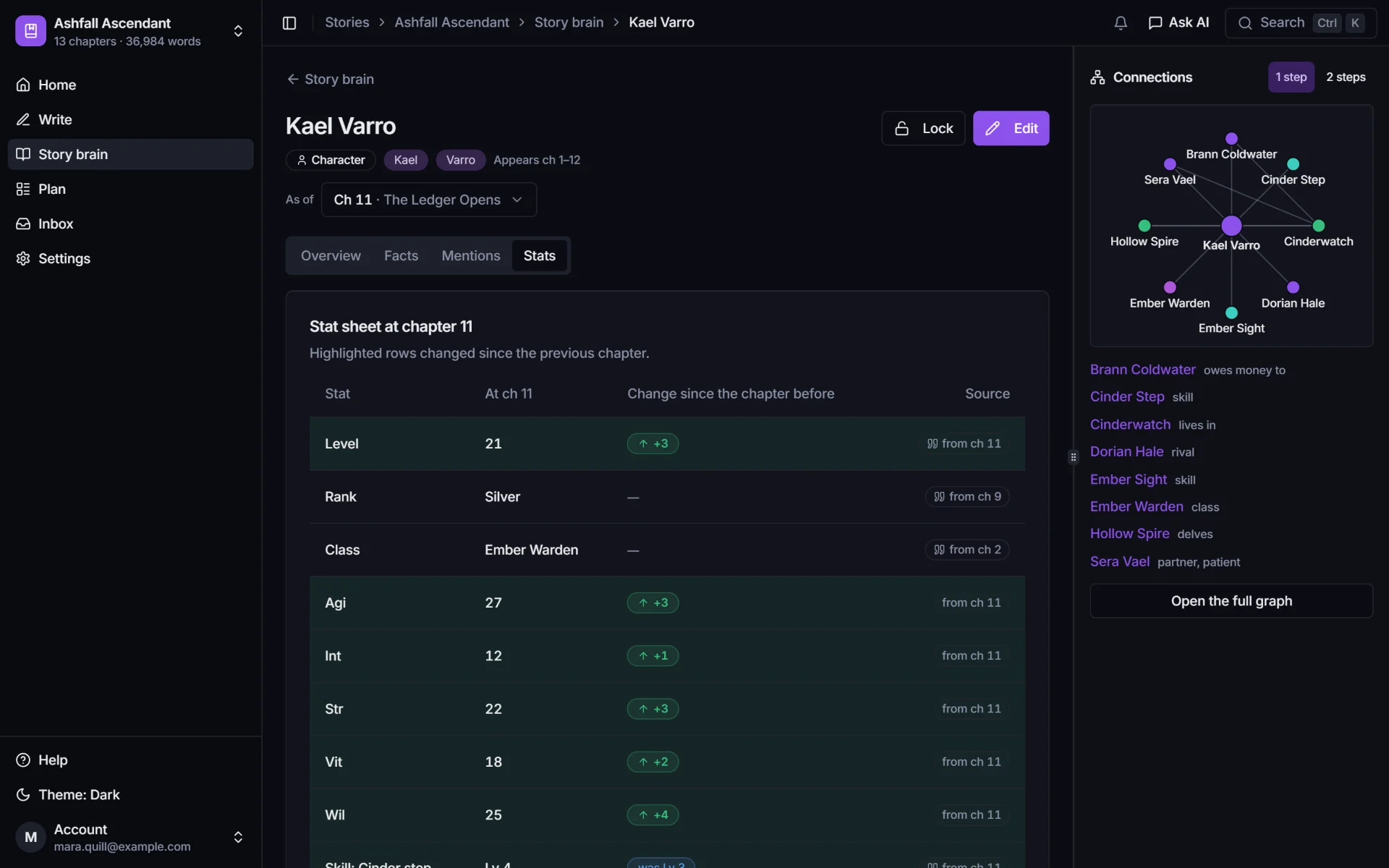
    Kael Varro's stat sheet at chapter 11: level 21 (up 3), rank Silver, class Ember Warden, AGI 27 (up 3), INT 12 (up 1), STR 22 (up 3), VIT 18 (up 2), WIL 25 (up 4), each with the chapter it came from.

    Check chapter

    Catches the mechanic that changed when nothing patched it.

    Before you post, Check chapter compares the new chapter with everything before it and flags what contradicts it: a cooldown that disappeared, an item nobody looted, a player who knows something they never learned.

    • Both quotes side by side, this chapter's line and the earlier line it contradicts.
    • Fixes are previewed as a change before a word in your chapter moves.
    • A deliberate twist, like a hidden mechanic? Mark it intentional and it stops flagging.
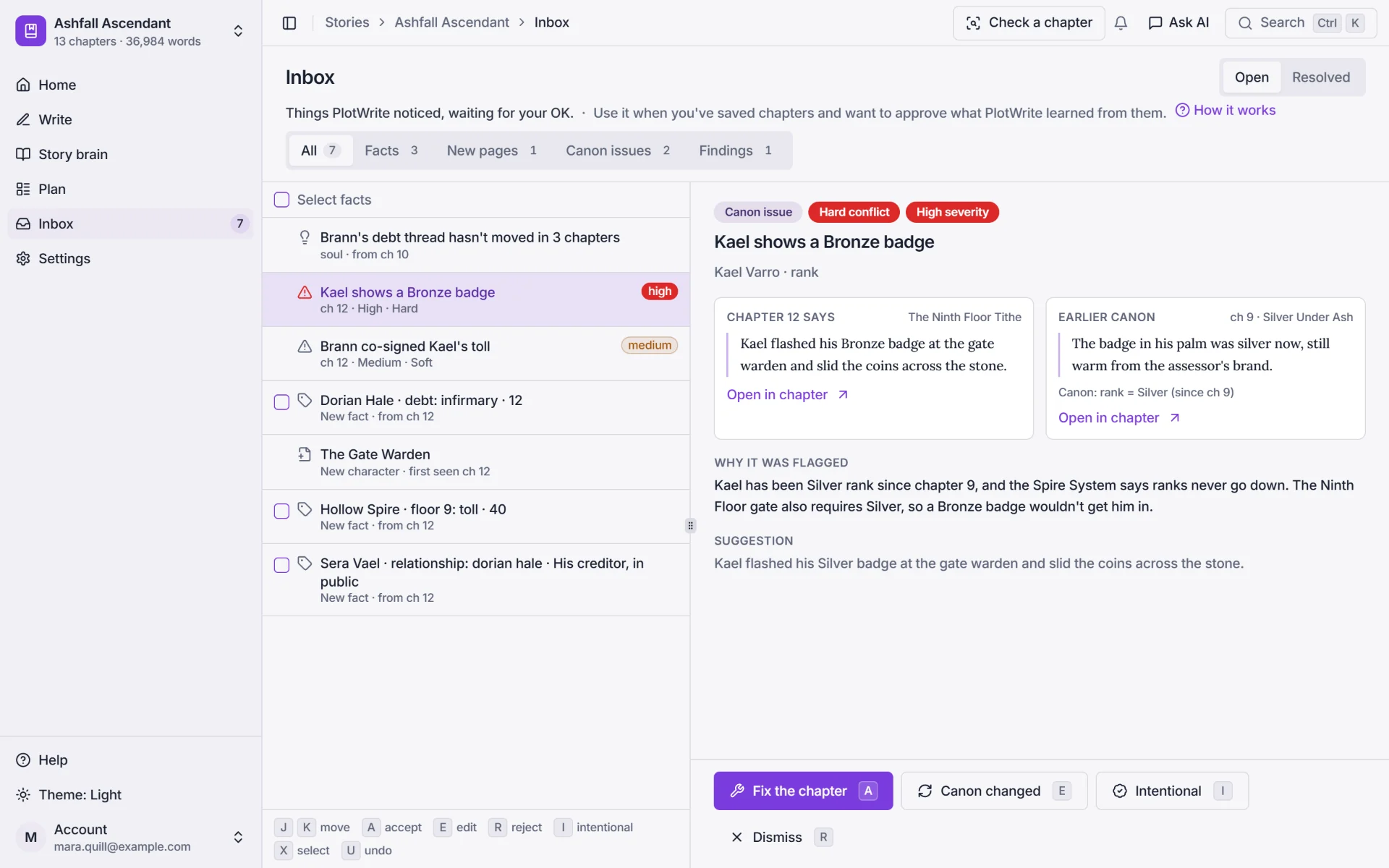
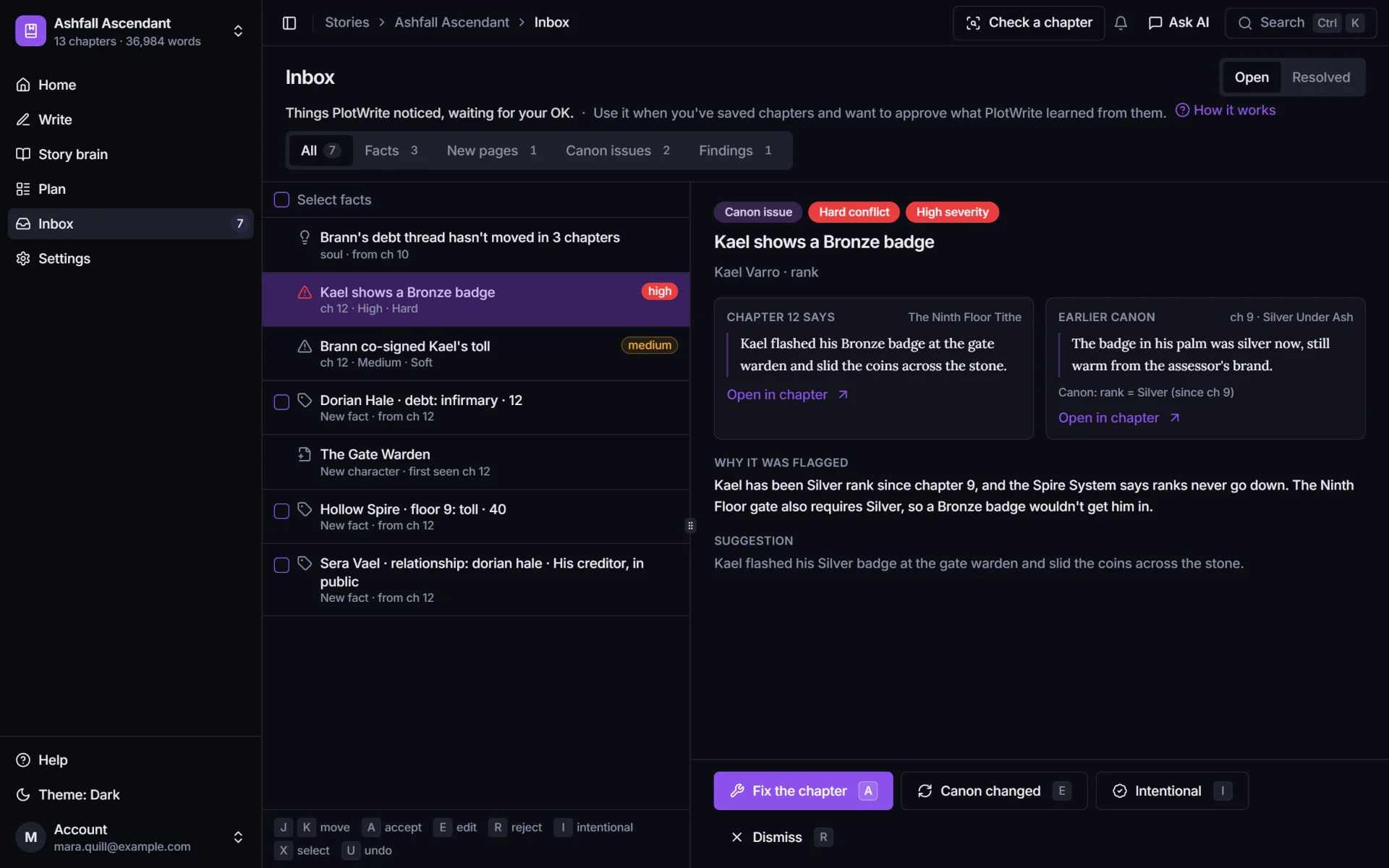
    The Inbox with a high-severity canon issue: chapter 12 says Kael flashed his Bronze badge, while earlier canon from chapter 9 says the badge in his palm was silver now.
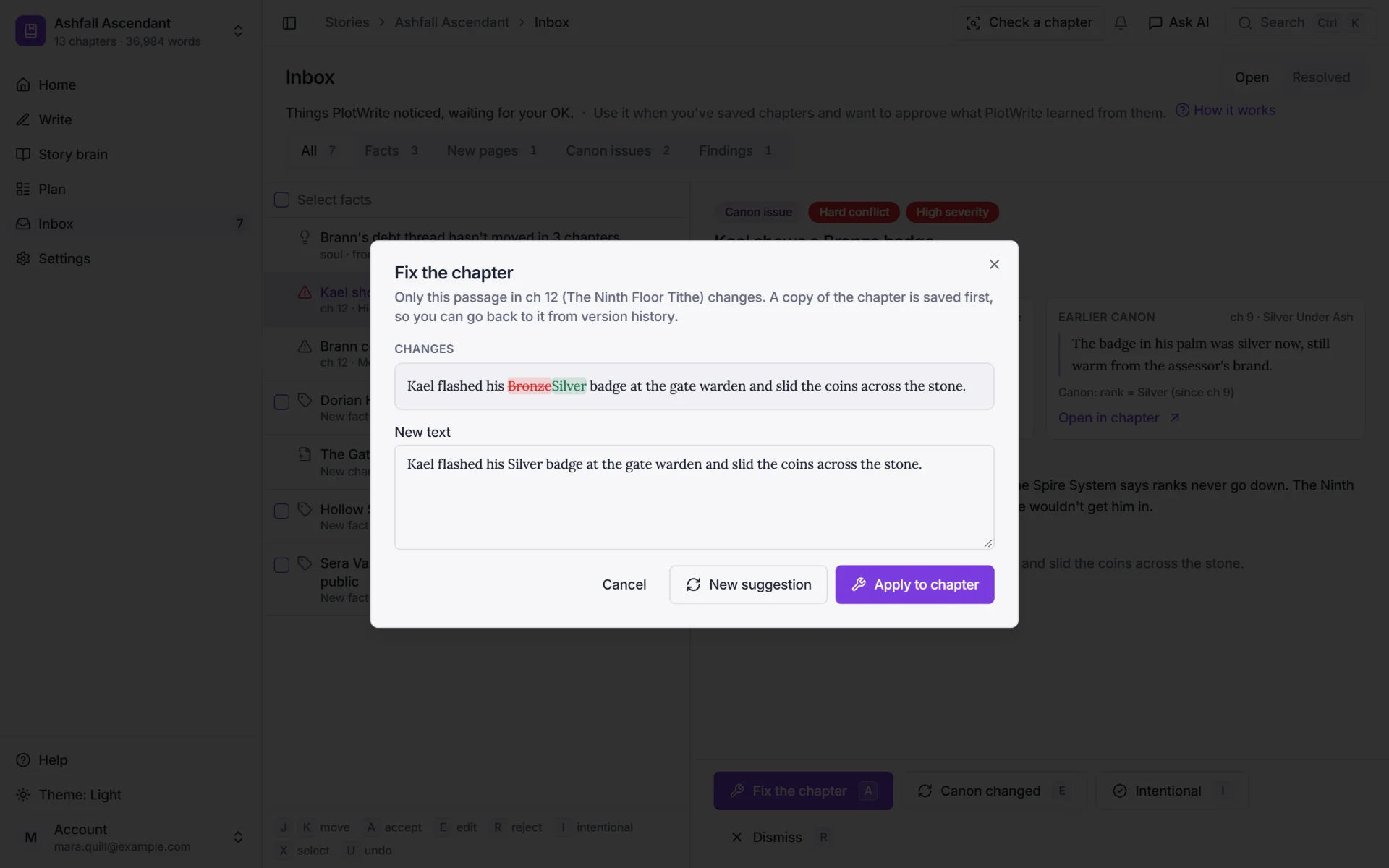
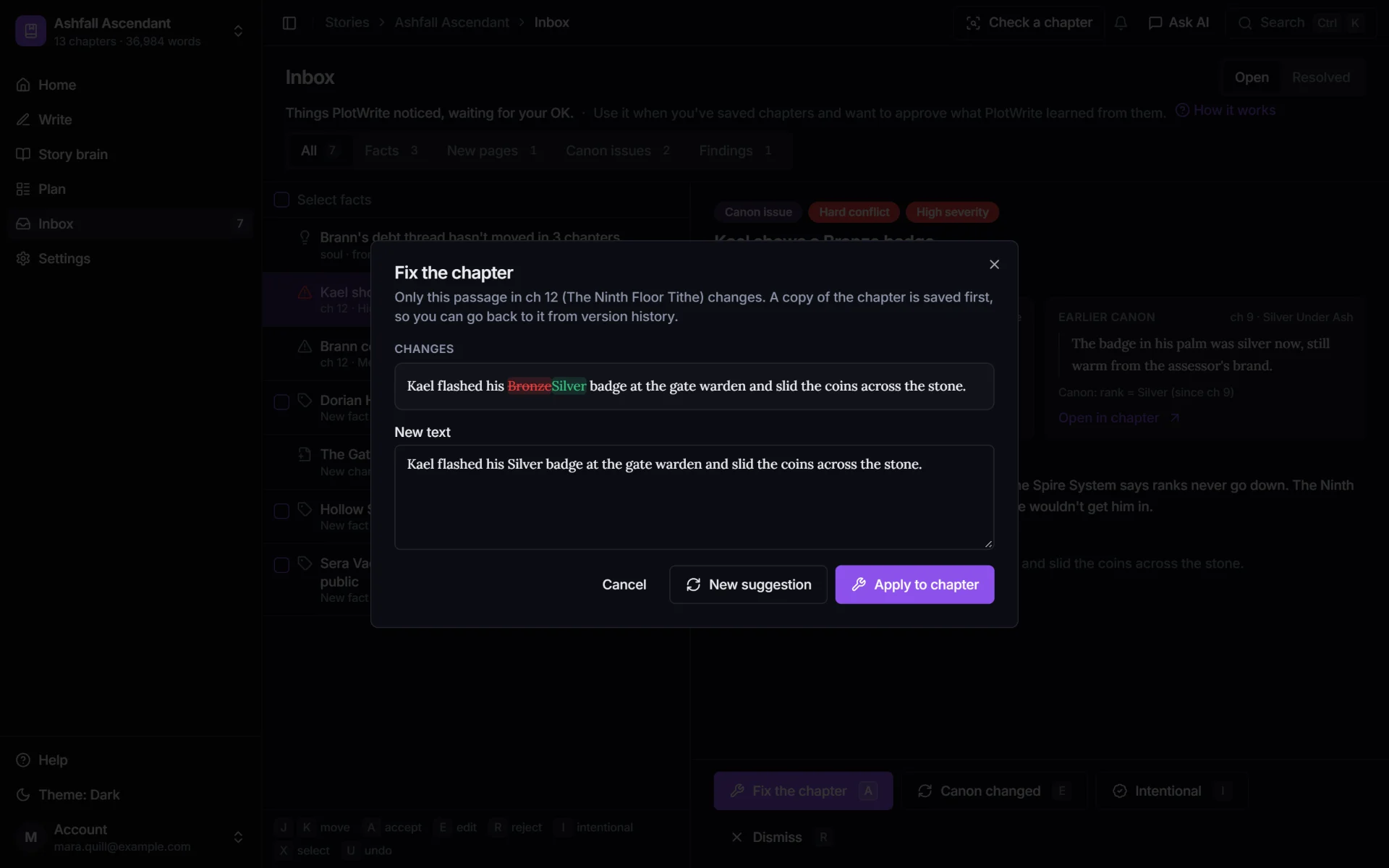
    The previewed fix: Bronze is struck out and Silver put in its place, before anything changes in the chapter.

    Both sides of the screen

    A page for every player, in the game and out of it.

    Characters, places and items each get a page, whether they live in the game or the real world. The Story brain keeps who knows what as of each chapter, so a secret identity stays secret until the chapter that gives it away.

    • Players, guilds and NPCs, each with what was true at every chapter.
    • In-game zones and real-world places as pages of their own.
    • Where everyone is as of each chapter, in the game or out of it.
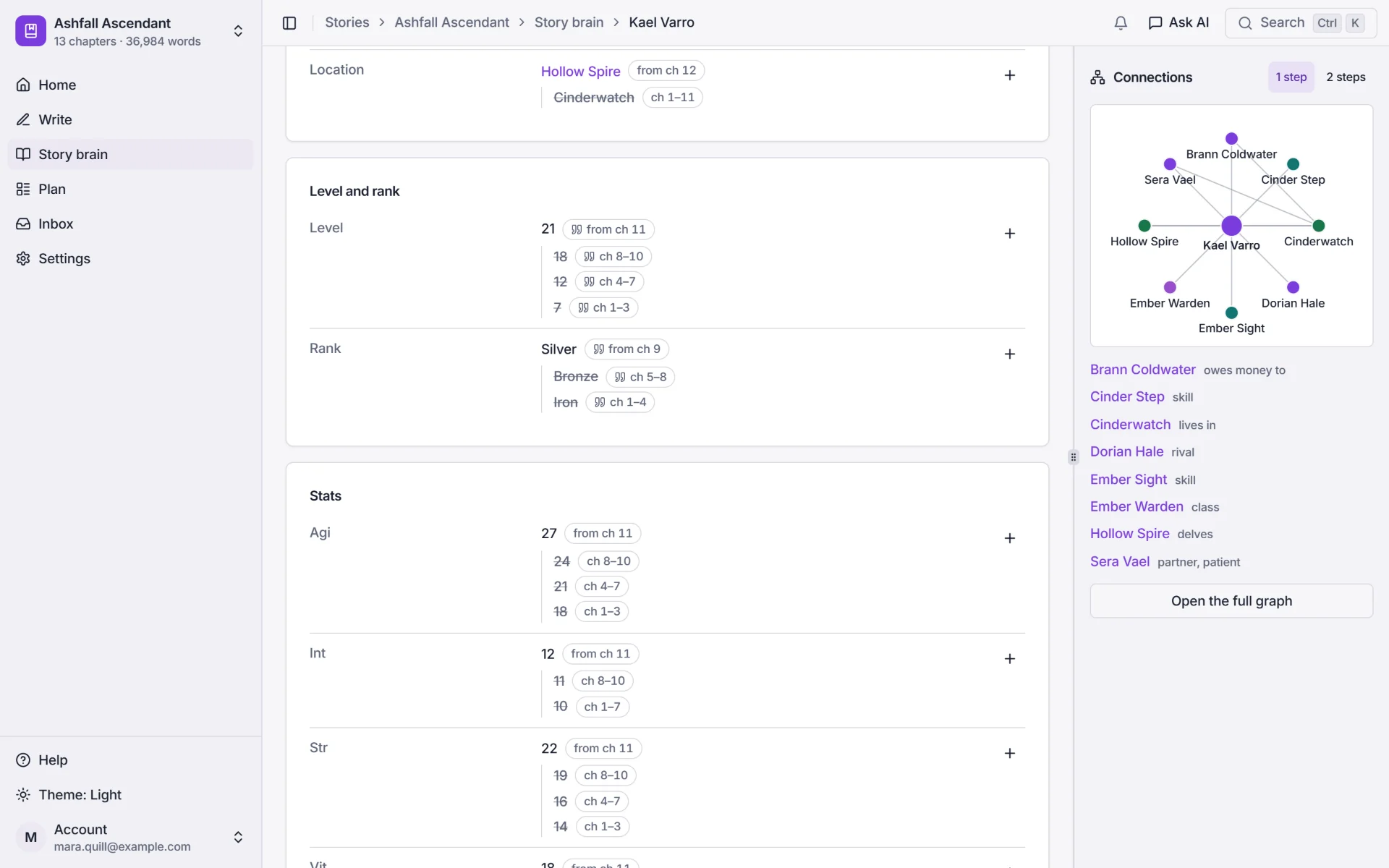
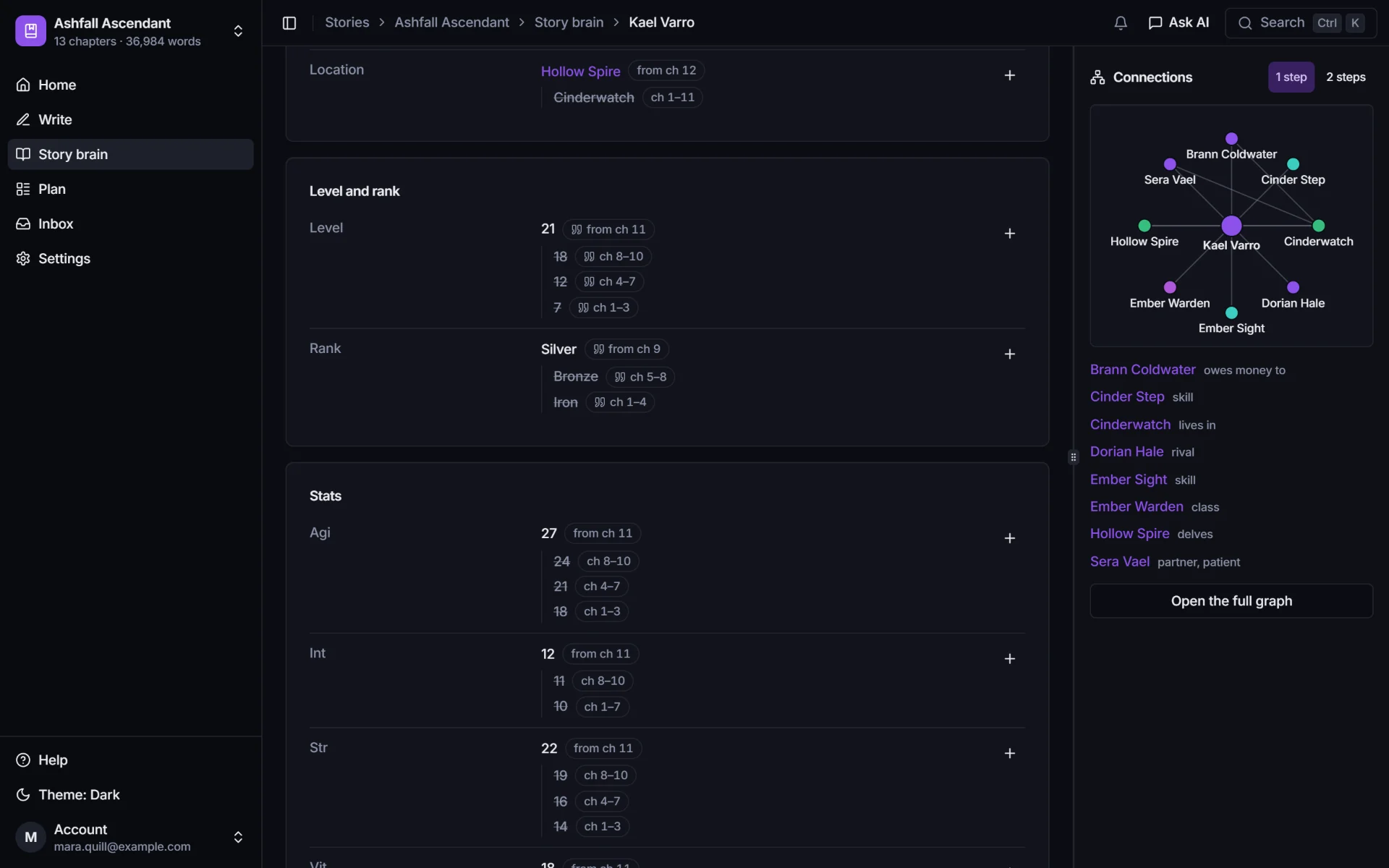
    Kael Varro's level and rank history in the story brain: level 21 from chapter 11 (18 in chapters 8 to 10, 12 in 4 to 7, 7 in 1 to 3), and rank Silver from chapter 9 (Bronze in 5 to 8, Iron in 1 to 4). Below, his stats with their own history.
    A graph of Kael's connections: Sera Vael, Brann Coldwater, Dorian Hale, Hollow Spire, Cinderwatch and his skills.

    Mechanics, stats and two worlds

    What does a GameLit serial need to keep straight?

    The game's mechanics, the players' stats, and the line between the game and the real world. PlotWrite keeps all three as facts timed by chapter.
    • Game mechanics

      How the game works, and when that changed.

      • Cooldowns, costs, drop rules and patches, quoted from the chapter that set them.
      • Check chapter flags a new chapter that forgets one.
    • Stats and gear

      The numbers players argue about.

      • Levels, stats, skills and items on a stat sheet for every player, under your game's names.
      • What changed since the chapter before, and the full history.
    • The game and the real world

      What happens inside the game, and what happens outside it.

      • Places and characters on both sides, each with a page of their own.
      • Who knows a player's real identity, as of the chapter they found out.

    Royal Road's AI policy

    The AI that reads your story, not the AI that writes it.

    Royal Road says you don't need to mention back-office help from an AI, like brainstorming or research, and that you do need to tag text an AI wrote. Memory, checks and planning never put a word in your chapters. Drafting is there if you want it, and we'll tell you plainly when it means a tag.

    Every feature mapped to the policy The tag rules, explained

    Back-office: no tag

    • The story brain and stat sheets
    • The canon check and the Inbox
    • The In-Between, Plan and the brainstorm chat

    Pasted AI prose: tag it

    • Draft with AI and Auto-write
    • AI rewrites of your paragraphs, used a lot

    Optional: nothing is drafted unless you ask. Royal Road decides the rules and can change them.

    No API key needed

    Bring the subscription you already have.

    Most writing tools sell AI credits or ask for an API key. Connect your Claude Pro or Max, or ChatGPT Plus plan in 3 steps: your plan does the writing, and PlotWrite keeps the story.

    • ClaudePro or Max
    • ChatGPTPlus or Pro

    Anthropic and OpenAI decide which plans can add connectors. Details in the FAQ.

    1. 1

      Add PlotWrite as a connector

      In Claude or ChatGPT, add a custom connector and paste the PlotWrite URL from your settings.

    2. 2

      Sign in to PlotWrite

      Approve it once. That's the whole setup.

    3. 3

      Write in Claude or ChatGPT

      Ask for chapter 13. It reads your story brain, Style DNA and threads, and saves the draft to PlotWrite for you to accept.

    Prefer your own key? Connect OpenRouter in one click, paste any API key, or run a local model with LM Studio.

    Questions

    GameLit writers ask

    What is the difference between GameLit and LitRPG?
    Both put game mechanics into the story. LitRPG usually shows them on the page as stats, levels and System screens, and centres on a character's progression. GameLit is the wider term for stories set in or around games, where the mechanics matter but the numbers can stay light. Readers and authors use the two loosely, and many serials are both.
    My story moves between the game and the real world. Can PlotWrite keep both straight?
    Yes. Characters, places and items get pages whether they live in the game or outside it, each with what was true at every chapter. Who knows a player's real name is tracked like any other fact, from the chapter they learned it. The in-game quest and the real-world plot can be separate threads in the In-Between, so neither goes quiet.
    How do I get game screens and stat blocks into Royal Road?
    Copy for Royal Road copies a chapter with its formatting kept, ready to paste into Royal Road's chapter editor. Word and EPUB export are there too, and chapter export is free on every plan. For a single game message, the free System notification generator makes a paste-ready box.
    I'm already 200 chapters in. Do I have to type everything in?
    No. Paste or upload the chapters you've posted (.txt, .md or Word) and PlotWrite splits them at the chapter headings. Then it reads them on your AI and proposes facts, each with the line it came from. You approve them in the Inbox. Nothing becomes canon until you say so.
    Do I have to tag my story as AI on Royal Road if I use PlotWrite?
    Not for the story brain, the canon check or planning. Royal Road's AI policy says you don't need to mention back-office assistance such as brainstorming or research, and you do need to say so when you copy AI-written text into your story. PlotWrite's memory, checks and plans never put words in your chapters. If you paste prose from Draft with AI or Auto-write into a chapter, tag it the way Royal Road asks. Rules can change, so check Royal Road's current policy before you publish.
    Do I need an API key or AI credits?
    No. Add PlotWrite as a connector in Claude or ChatGPT and sign in once: your existing plan runs the model, and PlotWrite gives it your chapters and story brain. You can also connect OpenRouter in one click, paste an API key, or run a model on your own computer with LM Studio. PlotWrite never charges for AI.
    Bring your AI. PlotWrite brings the memory.

    • Your ChatGPT or Claude plan, your key, or your own computer
    • A story brain that knows every chapter
    • Nothing becomes canon without your approval
    • No card needed
    • Cancel anytime
    • PlotWrite never charges for AI

    Questions about plans, keys or the connector? Read the FAQ