Skip to content

    For dungeon core authors

    Your dungeon's floors, monsters and mana, the same in chapter 300 as in chapter 30.

    PlotWrite is writing software for dungeon core serials. It reads the chapters you've written and keeps the core's growth, every floor and every monster type as facts timed by chapter. Before you post, it checks the new chapter against them. It also keeps the adventurers' side of the story moving.

    The AI that reads your story, not the AI that writes it.

    • No card needed
    • Cancel anytime
    • PlotWrite never charges for AI
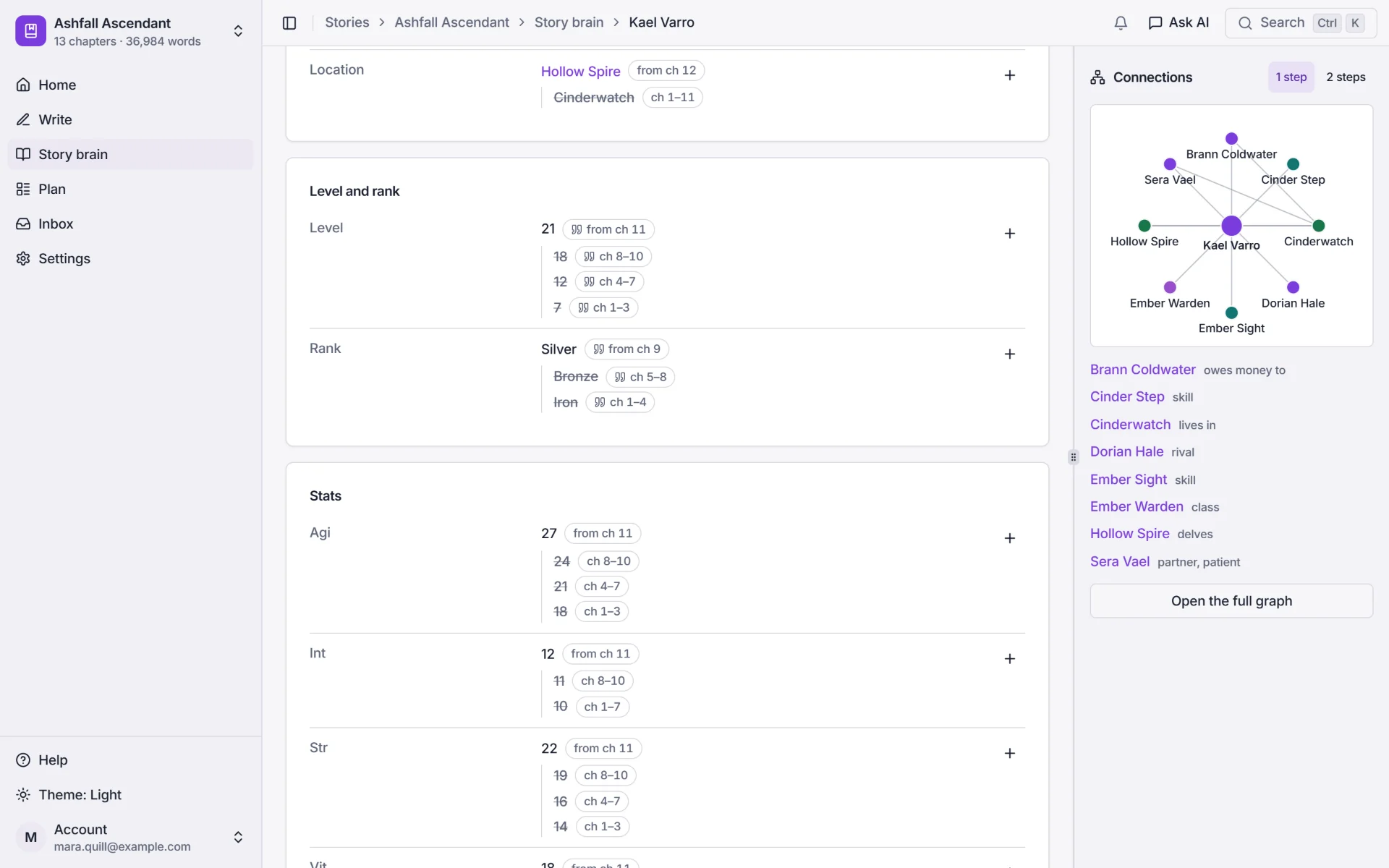
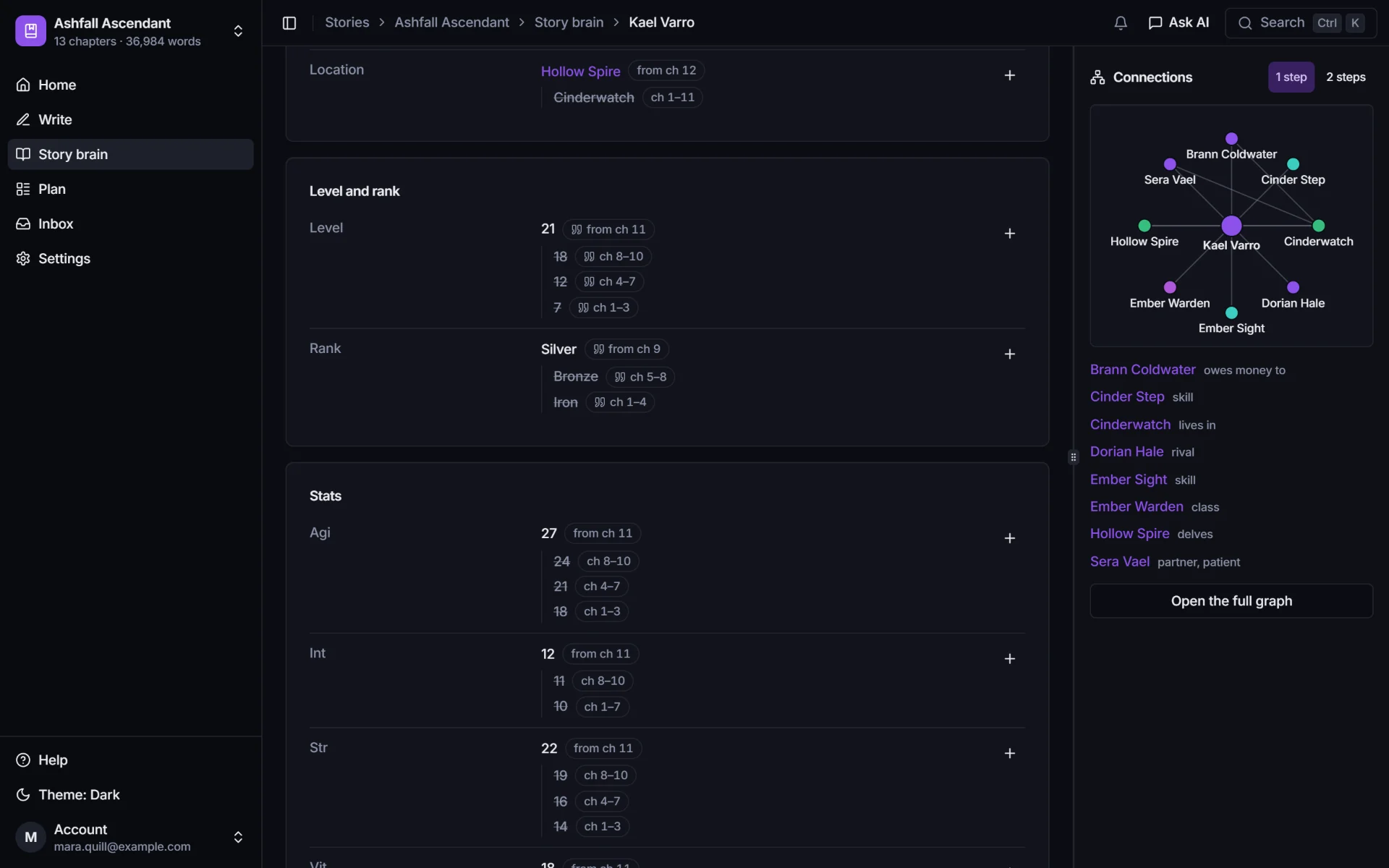
    Kael Varro's level and rank history in the story brain: level 21 from chapter 11 (18 in chapters 8 to 10, 12 in 4 to 7, 7 in 1 to 3), and rank Silver from chapter 9 (Bronze in 5 to 8, Iron in 1 to 4). Below, his stats with their own history.
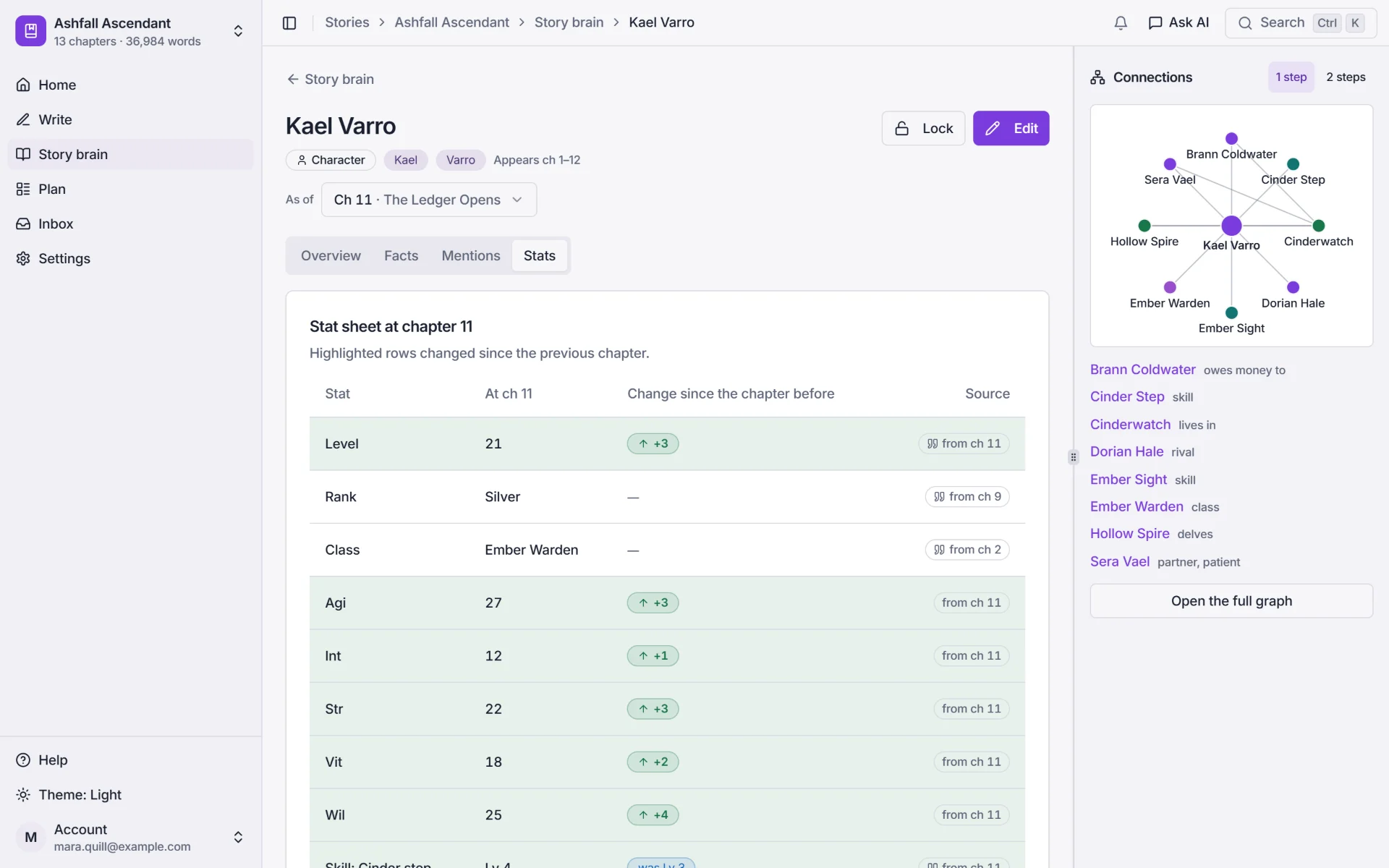
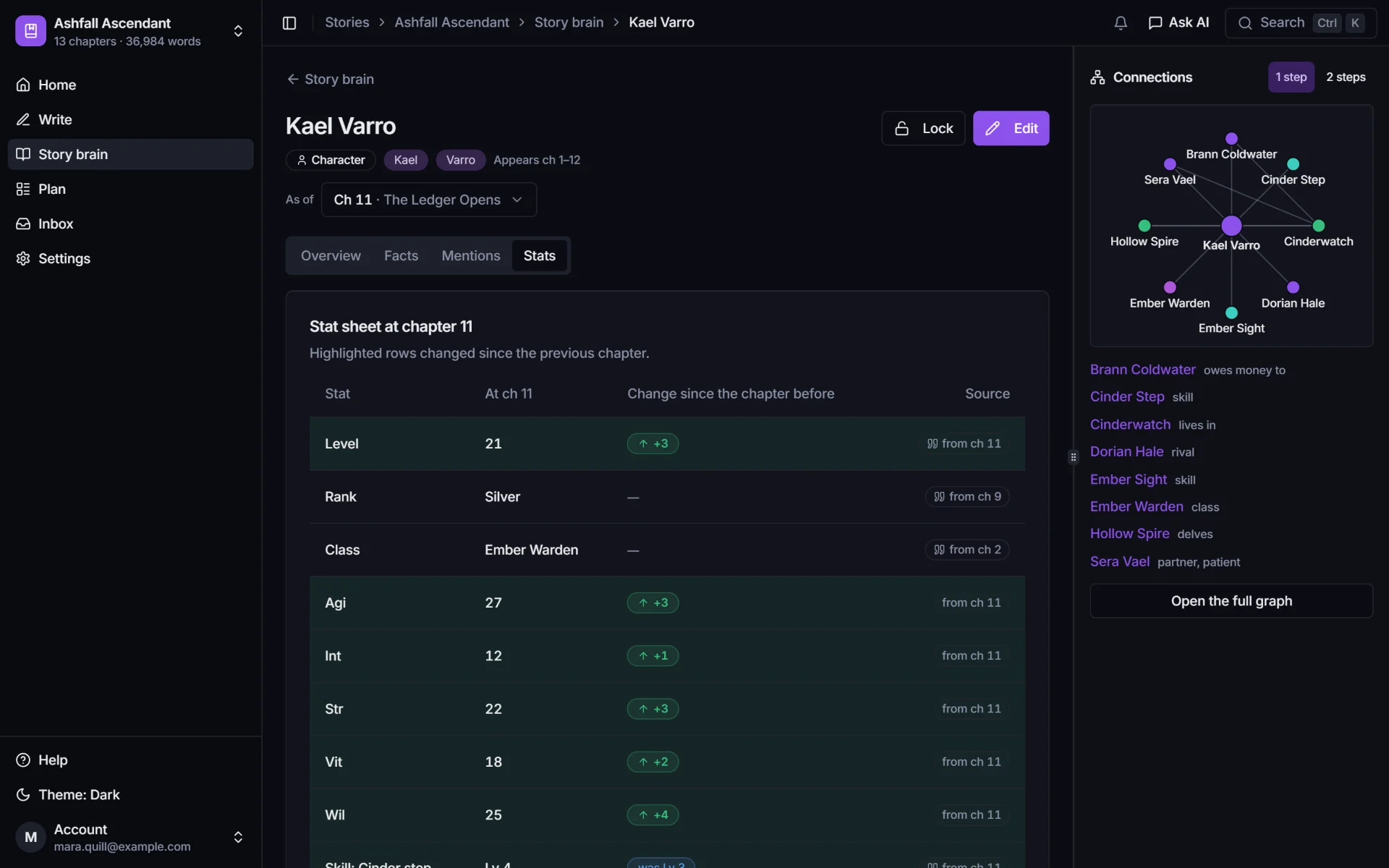
    A graph of Kael's connections: Sera Vael, Brann Coldwater, Dorian Hale, Hollow Spire, Cinderwatch and his skills.

    The Story brain on a made-up sample serial, Ashfall Ascendant: one character's rank history and the pages linked to it. Your core, floors and monsters get pages the same way, under your own names.

    The problem

    Where does a dungeon core serial lose track of itself?

    Dungeon core readers keep their own maps. They know which floor holds the slimes and what the last expansion cost, and they notice when the dungeon forgets.
    • A floor rearranges itself

      The boss room was on the third floor when the first party died there. Forty chapters later it's on the second, and nothing moved it.

      Ch 22The third floor ended in the boss room, where the Ashen Matron waited.

      Ch 63The party reached the Ashen Matron at the bottom of the second floor.

    • The mana stops adding up

      Every expansion had a price in the first arc. Then a busy chapter needs a new floor and a dozen spawns in one night, and the price quietly drops.

      Ch 15[Create floor: 400 mana. Reserve: 410 / 600]

      Ch 16I raised the fourth floor and still had mana for a dozen new spawns.

    • A monster forgets its evolution

      The goblins evolved in one chapter. A later fight still calls them plain goblins, and readers ask whether the evolution was undone.

      Ch 31[Evolution complete: Goblin → Hobgoblin (x12)]

      Ch 48Twelve goblins poured out of the side tunnels.

    Made-up examples of the slips this genre makes.

    How PlotWrite helps

    How do you keep a dungeon core consistent across hundreds of chapters?

    Give every floor, monster and mana change the chapter it happened, check each new chapter against them before you post, and keep the adventurers' side of the story moving. PlotWrite does all three from the chapters you've written.

    The core as of any chapter

    The core's growth, chapter by chapter.

    The core is a character in your Story brain, so its rank, level and skills each carry the chapter they changed. Floors are places and monster types are characters, each with a page that says what was true at every chapter.

    • Pick a chapter and see the core's rank, level and skills as they stood then.
    • Mana, spawn points or whatever your core spends sit on its stat sheet under your own names.
    • Ask your story "how many floors did the dungeon have in chapter 30?" and get the answer from your own chapters.
    Kael Varro's stat sheet at chapter 11: level 21 (up 3), rank Silver, class Ember Warden, AGI 27 (up 3), INT 12 (up 1), STR 22 (up 3), VIT 18 (up 2), WIL 25 (up 4), each with the chapter it came from.

    Check chapter

    Finds the moved boss room before your readers do.

    Before you post, Check chapter compares the new chapter with everything before it and flags what contradicts it: a floor in the wrong order, a monster that lost its evolution, mana the core never had.

    • Both quotes side by side, this chapter's line and the earlier line it contradicts.
    • Fixes are previewed as a change before a word in your chapter moves.
    • Rebuilt a floor on purpose? Mark it intentional and it stops flagging.
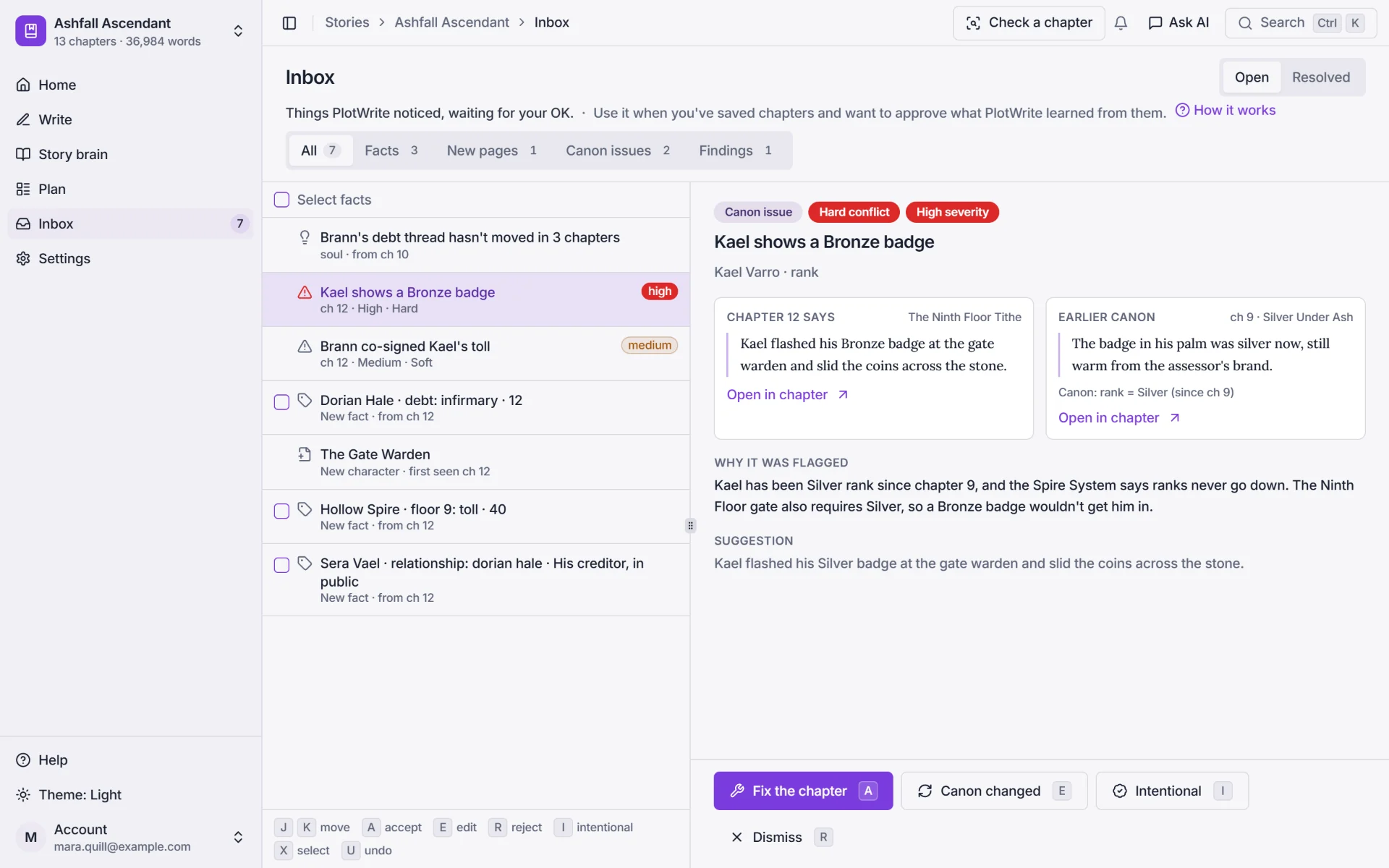
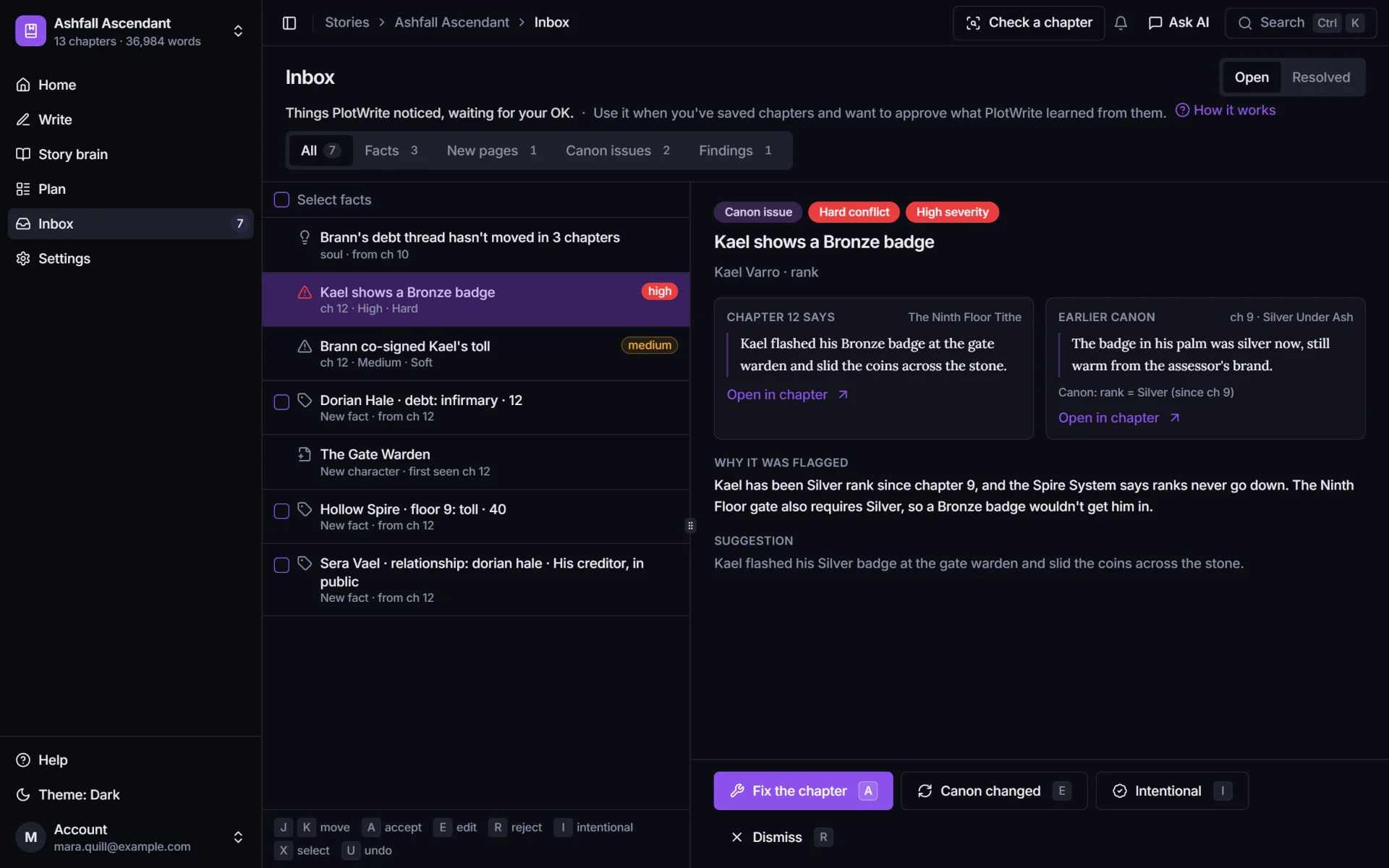
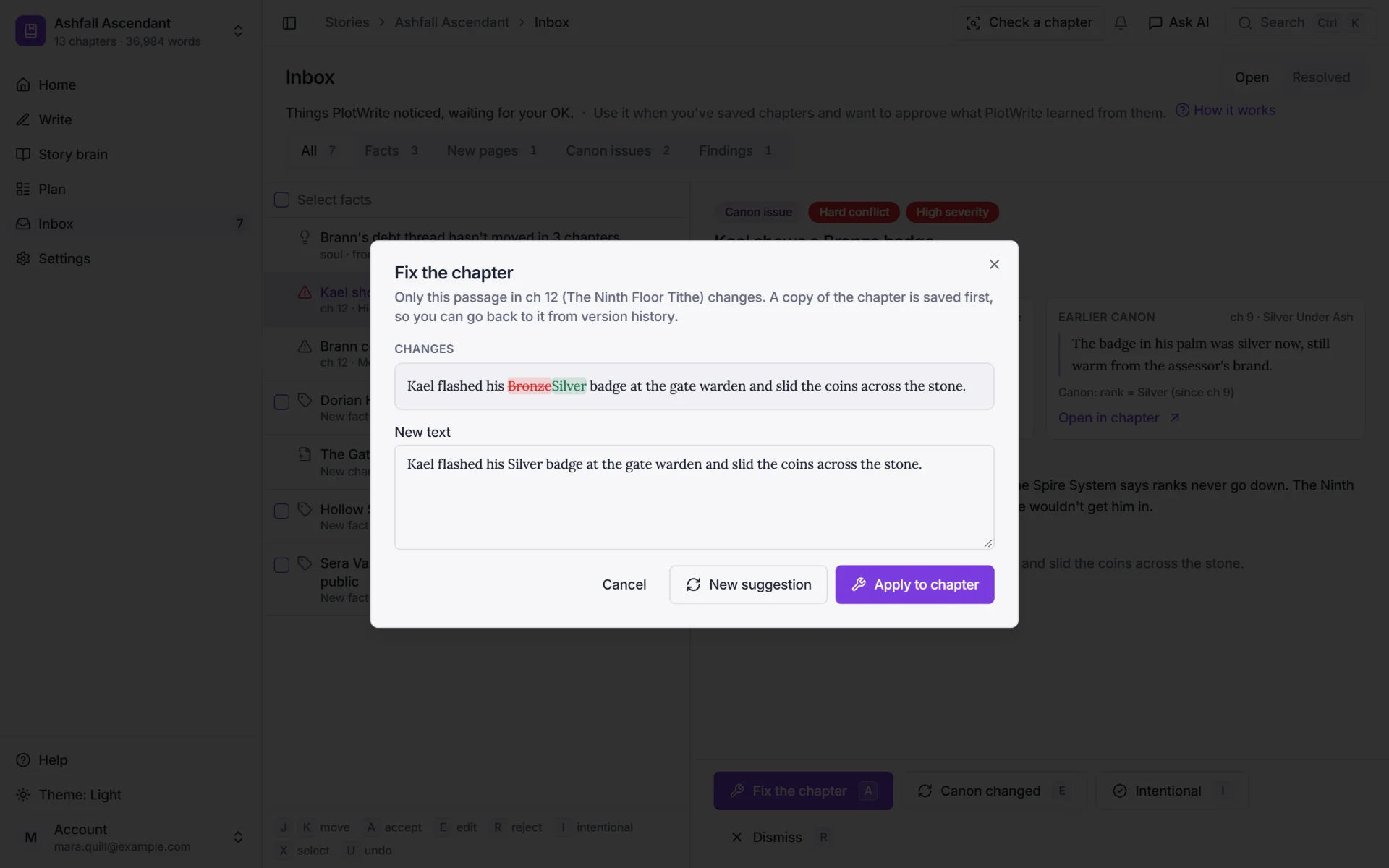
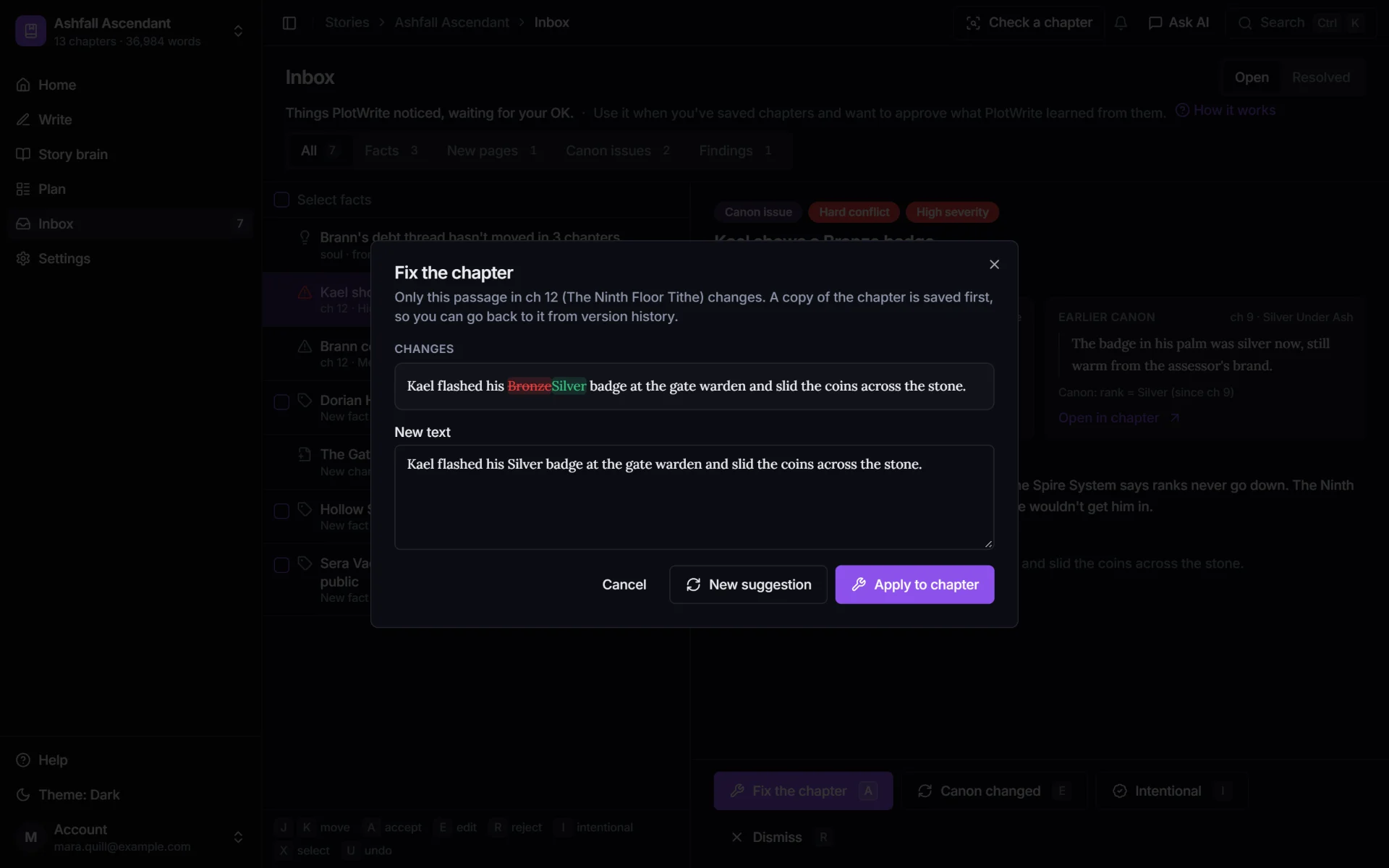
    The Inbox with a high-severity canon issue: chapter 12 says Kael flashed his Bronze badge, while earlier canon from chapter 9 says the badge in his palm was silver now.
    The previewed fix: Bronze is struck out and Silver put in its place, before anything changes in the chapter.

    The In-Between

    Keep the adventurers' side of the story moving.

    Most dungeon core serials cut between the core and the people walking into it. The returning party, the guild that wants the core gone and the rival dungeon are each a thread, and PlotWrite shows every thread across your chapters.

    • Every thread lane by lane, with a dot for each chapter that moved it.
    • Plan the beats between a party's first visit and the floor that finally stops them.
    • A thread that hasn't moved in a while stands out, so the party doesn't vanish for thirty chapters.
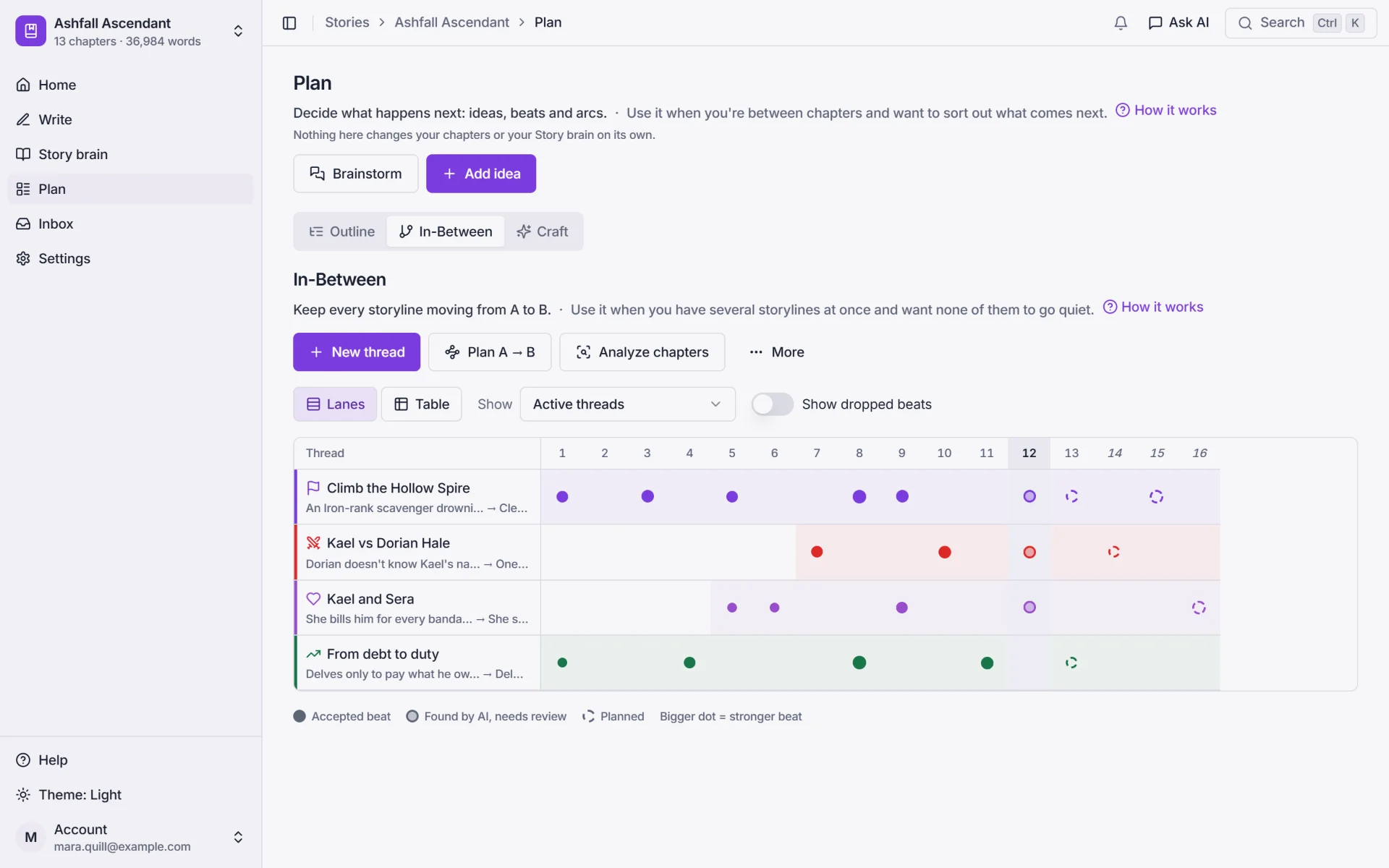
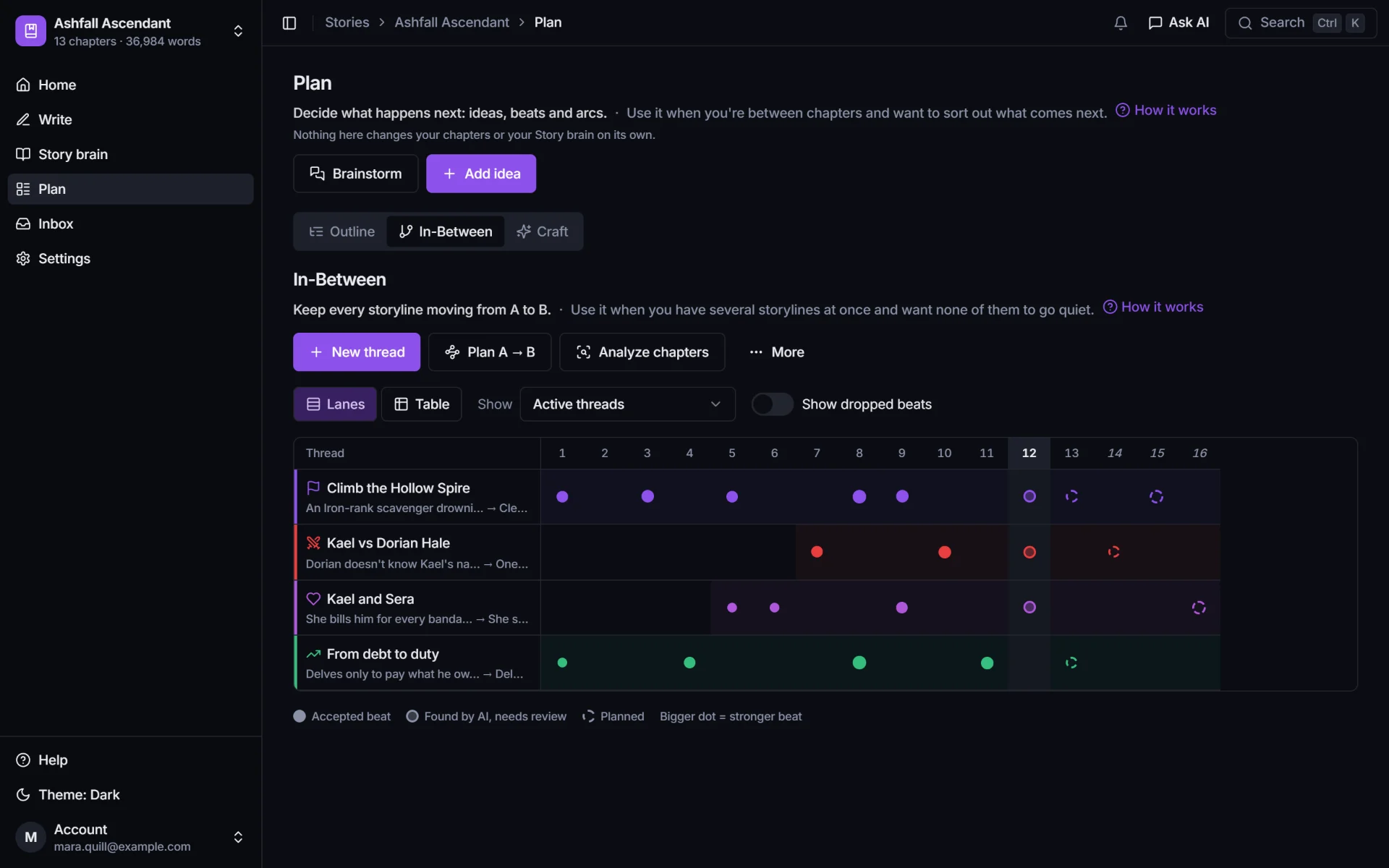
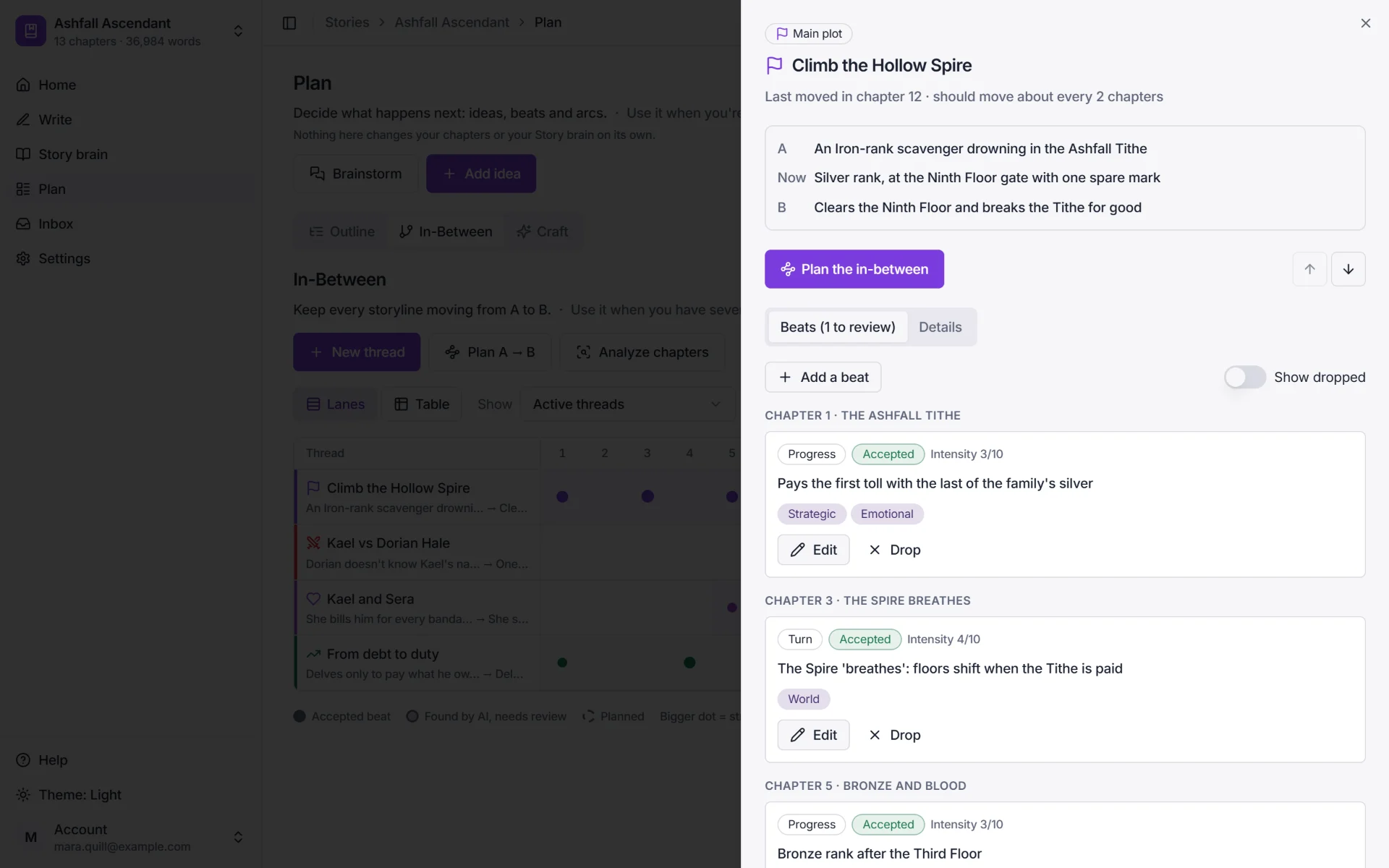
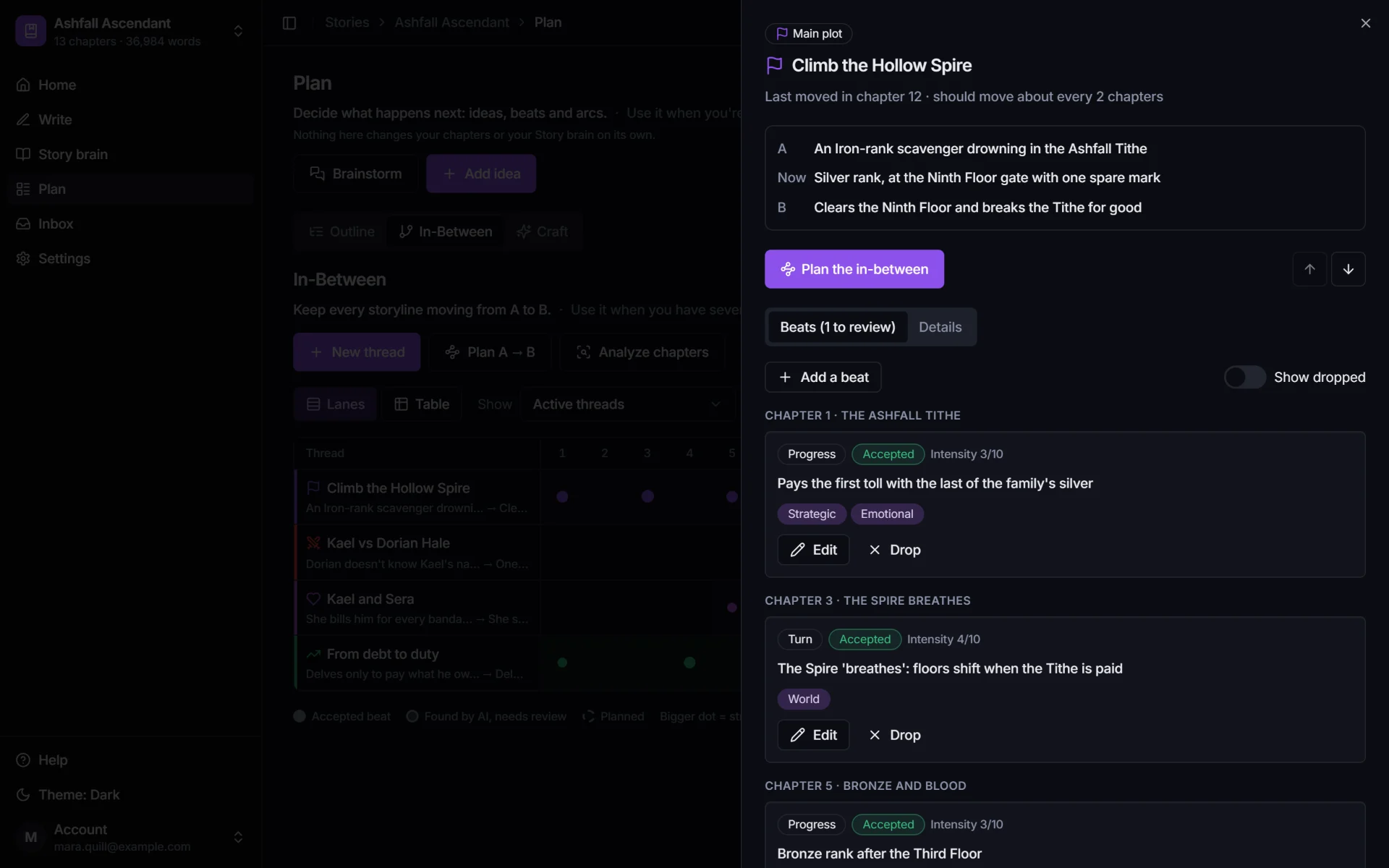
    The In-Between swimlanes: four threads (Climb the Hollow Spire, Kael vs Dorian Hale, Kael and Sera, From debt to duty) across chapters 1 to 16, with a dot for each chapter that moved them and dashed rings for planned beats.
    One thread, Climb the Hollow Spire: A, an Iron-rank scavenger drowning in the Ashfall Tithe; now, Silver rank at the Ninth Floor gate; B, clears the Ninth Floor and breaks the Tithe. It last moved in chapter 12 and should move about every 2 chapters.

    Floors, monsters and mana

    What does a dungeon core reader keep track of?

    Readers keep three ledgers in their heads: the map, the monster roster and the mana. They follow the build as closely as the fights, so PlotWrite keeps each ledger timed by chapter.
    • Floors

      The map, floor by floor.

      • Each floor is a place with its own page: layout, traps and the boss at the bottom.
      • A new floor is true from the chapter it opens, never earlier.
    • Monsters

      The roster and its evolutions.

      • Each monster type with its rank and the chapter of every evolution.
      • Check chapter flags a monster that appears before it was spawned, or in a form it already evolved past.
    • Mana and the core's growth

      What the core has, and what things cost.

      • Mana, core rank and level on the core's sheet, with the full history of each.
      • Costs quoted from the chapter that set them, so the next expansion pays the same price.

    Royal Road's AI policy

    The AI that reads your story, not the AI that writes it.

    Royal Road says you don't need to mention back-office help from an AI, like brainstorming or research, and that you do need to tag text an AI wrote. Memory, checks and planning never put a word in your chapters. Drafting is there if you want it, and we'll tell you plainly when it means a tag.

    Every feature mapped to the policy The tag rules, explained

    Back-office: no tag

    • The story brain and stat sheets
    • The canon check and the Inbox
    • The In-Between, Plan and the brainstorm chat

    Pasted AI prose: tag it

    • Draft with AI and Auto-write
    • AI rewrites of your paragraphs, used a lot

    Optional: nothing is drafted unless you ask. Royal Road decides the rules and can change them.

    No API key needed

    Bring the subscription you already have.

    Most writing tools sell AI credits or ask for an API key. Connect your Claude Pro or Max, or ChatGPT Plus plan in 3 steps: your plan does the writing, and PlotWrite keeps the story.

    • ClaudePro or Max
    • ChatGPTPlus or Pro

    Anthropic and OpenAI decide which plans can add connectors. Details in the FAQ.

    1. 1

      Add PlotWrite as a connector

      In Claude or ChatGPT, add a custom connector and paste the PlotWrite URL from your settings.

    2. 2

      Sign in to PlotWrite

      Approve it once. That's the whole setup.

    3. 3

      Write in Claude or ChatGPT

      Ask for chapter 13. It reads your story brain, Style DNA and threads, and saves the draft to PlotWrite for you to accept.

    Prefer your own key? Connect OpenRouter in one click, paste any API key, or run a local model with LM Studio.

    Questions

    Dungeon core writers ask

    What is a dungeon core story?
    Dungeon core is a LitRPG and progression fantasy subgenre in which the main character is the dungeon, usually a sentient core at its heart. The core grows by spending mana on floors, traps and monsters while adventurers try to clear it. Readers follow the build as closely as the fights, so floor layouts and monster ranks have to stay where you put them.
    How do I keep floors, monsters and mana straight in a dungeon core serial?
    Give each floor and each monster type its own page, and record every change with the chapter it happened: a new floor, an evolution, a jump in mana. In PlotWrite floors are places and monsters are characters in the Story brain, each with what was true at every chapter, and Check chapter flags a new chapter that contradicts them before you post.
    Does PlotWrite work when the POV switches between the core and the adventurers?
    Yes. The Story brain keeps who knows what as of each chapter, so a party can't know about the trap on the third floor before a chapter shows them learning it. Each side of the story is a thread in Plan and the In-Between, so the adventurers don't go quiet while the core builds.
    I'm already 200 chapters in. Do I have to type everything in?
    No. Paste or upload the chapters you've posted (.txt, .md or Word) and PlotWrite splits them at the chapter headings. Then it reads them on your AI and proposes facts, each with the line it came from. You approve them in the Inbox. Nothing becomes canon until you say so.
    Do I have to tag my story as AI on Royal Road if I use PlotWrite?
    Not for the story brain, the canon check or planning. Royal Road's AI policy says you don't need to mention back-office assistance such as brainstorming or research, and you do need to say so when you copy AI-written text into your story. PlotWrite's memory, checks and plans never put words in your chapters. If you paste prose from Draft with AI or Auto-write into a chapter, tag it the way Royal Road asks. Rules can change, so check Royal Road's current policy before you publish.
    Do I need an API key or AI credits?
    No. Add PlotWrite as a connector in Claude or ChatGPT and sign in once: your existing plan runs the model, and PlotWrite gives it your chapters and story brain. You can also connect OpenRouter in one click, paste an API key, or run a model on your own computer with LM Studio. PlotWrite never charges for AI.
    Bring your AI. PlotWrite brings the memory.

    • Your ChatGPT or Claude plan, your key, or your own computer
    • A story brain that knows every chapter
    • Nothing becomes canon without your approval
    • No card needed
    • Cancel anytime
    • PlotWrite never charges for AI

    Questions about plans, keys or the connector? Read the FAQ